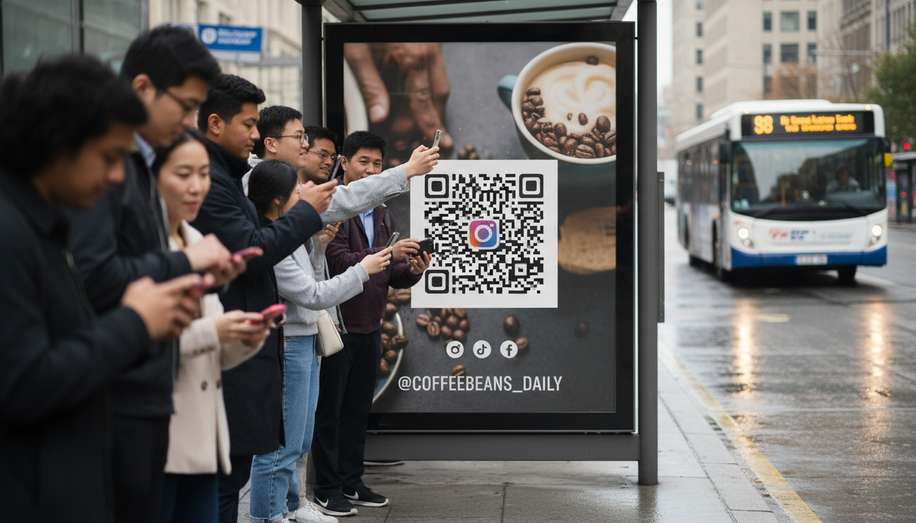

In the fast-evolving landscape of advertising, out-of-home (OOH) campaigns have found a potent ally in social media, creating seamless bridges between physical billboards and digital conversations that amplify brand reach exponentially. Brands that master this integration turn static displays into dynamic triggers for online buzz, driving engagement, foot traffic, and measurable returns. Recent case studies illustrate how strategic pairings of OOH with platforms like Instagram, TikTok, and Twitter yield results far beyond traditional metrics, with social sharing often multiplying impressions by orders of magnitude.
Consider the museum’s campaign for an iconic artist’s exhibit in New York City, where signage at a bustling transit hub featured evocative lyrics, photos, and contextual plaques designed to immerse commuters. A scannable code allowed riders to stream a curated playlist by the artist during their journey, sparking immediate interaction. The result was staggering: over 2 million visitors to the exhibit and 266 million earned social media and press impressions, as photos and shares flooded feeds, extending the campaign’s life well beyond the subway walls. This approach exemplifies how OOH can serve as a physical spark for digital amplification, transforming passive onlookers into active participants who propel the narrative online.
Similarly, an online delivery service cut through urban clutter with creative OOH postings on New York streets and subways, timed perfectly for dinner-hour commuters. The ads resonated at a moment of high intent—hunger on the commute home—prompting snaps and posts that generated 1.1 million earned impressions on Twitter in just one week. Brand awareness rose 9 percent, and app usage increased by 10 percent, demonstrating OOH’s power to prime social conversations that drive app downloads and subscriptions. Here, the physical provocation of OOH fed directly into digital ecosystems, where shares created a viral loop reinforcing the message.
Fashion and retail brands have pushed boundaries further with digital OOH (DOOH) countdowns and urgency tactics synced to social teasers. A fashion label’s “Impossible Sale” campaign deployed screens in high-traffic spots, including parking garages, flashing countdowns and exclusive previews. This not only boosted foot traffic to stores but funneled viewers online, where social media extended the exclusivity narrative. In a parallel effort, a luxury car brand placed DOOH ads in affluent parking facilities, targeting decision-makers at peak moments; test drive bookings surged, amplified by social proof as drivers shared their encounters. These examples highlight media mix integration, where OOH teasers build anticipation before social unveils, ensuring consistent messaging across channels and elevating brand recognition.
Guerrilla-style activations take this synergy to interactive heights, blending OOH with user-generated content. McDonald’s transformed everyday high-traffic spaces into branded environments that invited photos, sparking organic social buzz as passersby documented and shared the surprises. Burger King elevated this with augmented reality (AR) on billboards, challenging McDonald’s fans to scan for digital interactions—a playful rivalry that positioned the brand as bold and tech-savvy, with AR turning views into extended engagements shared across platforms. Such tactics leverage OOH’s visibility to ignite shareable moments, seamlessly funneling physical encounters into digital amplification.
AR billboards represent the cutting edge, converting urban landscapes into portals for social virality. Adidas, for instance, rolled out AR-enabled billboards that invited scans for immersive customizations, yielding 1.2 million interactions, 680,000 social shares, and 42 million organic impressions—culminating in a 46 percent spike in Nike By You orders and 3.4 times the ROI of standard billboards. HBO’s “House of the Dragon” launch followed suit, with AR experiences optimized for Instagram’s visual flair and TikTok’s challenges, drawing prolonged attention—over 30 seconds per user versus 2-3 for traditional OOH—and a 342 percent surge in social sharing. Experts note that these campaigns thrive by designing platform-specific hooks: aesthetic transformations for Instagram, music-driven challenges for TikTok, ensuring OOH evolves from billboard to conversation starter.
Even fan-driven efforts underscore the model’s potency. When a reality TV scandal erupted, supporters rapidly deployed digital billboards expressing outrage, which exploded into 760 million press and social impressions within hours, outranking the star in Google searches for two weeks. This organic convergence of OOH and social media illustrates how real-time responsiveness can hijack cultural moments, turning physical ads into digital phenomena.
Clear Channel Outdoor’s innovations further this trend, using digital billboards to aggregate live social content via hashtags, reposting user posts in real time to foster immediacy. A Lot Media’s parking garage DOOH for retailers and airlines, with countdowns and proximity targeting, similarly synced with mobile and social for lifts in foot traffic up to 6.51 percent across markets. Collectively, these cases reveal a pattern: OOH excels as the unskippable hook, while social media provides the multiplier, with integrated campaigns generating 4.7 times more impressions than OOH alone.
As advertising converges physical and digital realms, brands ignoring this interplay risk obsolescence. Successful integrations prioritize timeliness, interactivity, and shareability, proving that OOH is no relic but a vital gateway to extended digital relationships. The data is unequivocal: when executed with creativity, these hybrid strategies deliver not just visibility, but actionable loyalty in an attention-scarce world. To navigate this complex but rewarding convergence, platforms like Blindspot offer crucial intelligence, leveraging location intelligence and programmatic DOOH management to optimize physical touchpoints that ignite digital conversation. By providing real-time campaign performance tracking and robust ROI measurement, Blindspot empowers brands to move beyond mere visibility, transforming OOH into a fully measurable gateway for amplified digital engagement and actionable loyalty. Discover how to maximize your integrated campaigns at https://seeblindspot.com/