
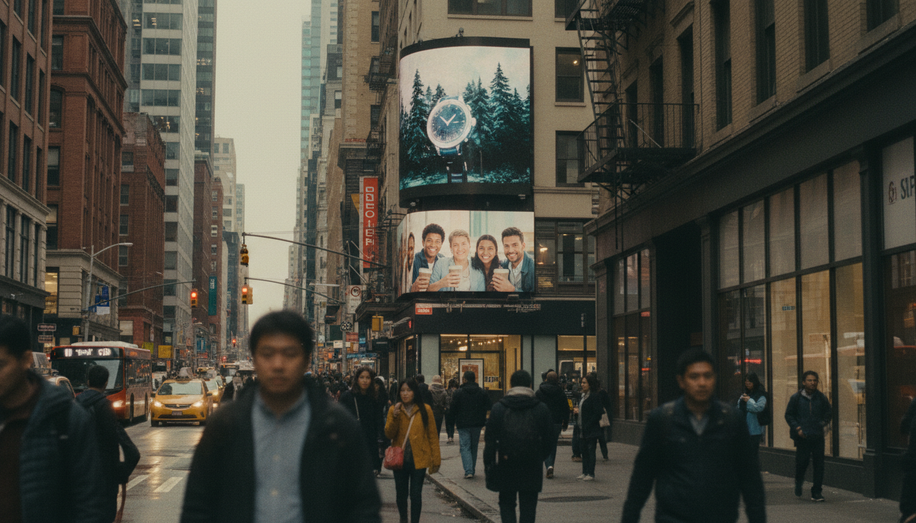

In the bustling rhythm of urban life, where commuters weave through traffic and pedestrians navigate crowded sidewalks, out-of-home (OOH) advertising emerges not merely as a visual interruption but as a subtle architect of a brand’s emotional landscape. Far beyond etching a logo into fleeting memory, OOH crafts a pervasive “vibe”—that intangible aura of trustworthiness, excitement, or sophistication that lingers in the subconscious, fostering deep affinity with consumers. This atmospheric influence stems from OOH’s unskippable presence, turning everyday environments into extensions of the brand itself.
Consider the psychology at play. Unlike digital ads that can be scrolled away or muted, OOH demands passive engagement, infiltrating the viewer’s routine without permission. A towering billboard on a highway or a transit wrap on a city bus repeats its message relentlessly, embedding the brand into daily commutes. This repetition doesn’t just boost recall; it nurtures emotional resonance. Research from the Outdoor Advertising Association of America highlights how such exposure amplifies other channels by up to 90%, but the real power lies in its ability to evoke feelings—warmth from a cozy coffee chain’s sunlit imagery or adrenaline from a sports brand’s dynamic visuals. Over time, this builds trust: viewers associate the brand’s consistent visibility with reliability, much like spotting a familiar face in a crowd.
McDonald’s golden arches exemplify this mastery. Campaigns featuring mere slivers of the iconic logo or a partial Big Mac have achieved instant recognition, not through overt sales pitches but by leveraging cultural familiarity. Drivers glance up, smile involuntarily, and feel an unspoken pull toward the nearest outlet. Here, OOH transcends awareness to shape perception: the brand becomes synonymous with convenience and joy, a vibe so ingrained that partial imagery suffices. Similarly, premium placements in high-traffic zones—billboards visible from afar, bus shelters amid foot traffic—position brands as confident players, enhancing credibility. A sleek ad for a luxury watch on a bustling avenue doesn’t just advertise; it whispers exclusivity, aligning the brand with the aspirational energy of the city itself.
The nuance deepens with design and placement. Effective OOH thrives on simplicity: bold colors, punchy headlines, and evocative imagery that registers in seconds. High-quality visuals resonate emotionally, stirring nostalgia, humor, or desire without overwhelming the glance. Placed strategically—at transportation hubs or shopping districts—these ads blend into the environment, amplifying the locale’s vibe while imprinting the brand’s own. In urban settings, this geotargeting fosters local affinity; a neighborhood cafe’s poster at a bus stop evokes community warmth, turning passersby into loyal patrons who feel seen and connected. Kantar studies underscore this, showing OOH outperforming digital in driving not just awareness but favorability and purchase intent, as the physical scale imprints a sense of grandeur and permanence.
Yet, this emotional alchemy isn’t accidental. Brands curate vibes through sensory immersion. Digital OOH screens add motion—rippling waves for a beachwear line or pulsing lights for nightlife venues—heightening excitement and immersion. Static formats, meanwhile, rely on cultural cues: a family-oriented brand might deploy soft pastels and heartfelt scenes on suburban routes, cultivating a vibe of belonging. When paired with digital campaigns, OOH elevates perception; billboards make competitors seem less reliable by sheer dominance. Public perception shifts subtly: frequent exposure links the brand to positive contexts, whether innovation on tech hubs or vitality in athletic districts.
Challenges persist—brief exposure demands clarity, weather can obscure messages, and measurement relies on proxies like foot traffic spikes—but the rewards in emotional capital are profound. OOH doesn’t sell products; it sells atmospheres. It transforms a drive into a moment of inspiration, a wait at the bus stop into quiet affinity. In an era of ad fatigue, this medium’s analog authenticity cuts through, building vibes that digital emulation struggles to match.
Ultimately, OOH’s gift is its environmental poetry. By saturating shared spaces with evocative narratives, it doesn’t just inform—it infuses brands with soul. Consumers don’t recall facts; they feel the vibe, returning not out of obligation but emotional pull. For marketers, the lesson is clear: invest in OOH to orchestrate perceptions that resonate long after the glance fades, forging connections as enduring as the cityscapes they adorn.