
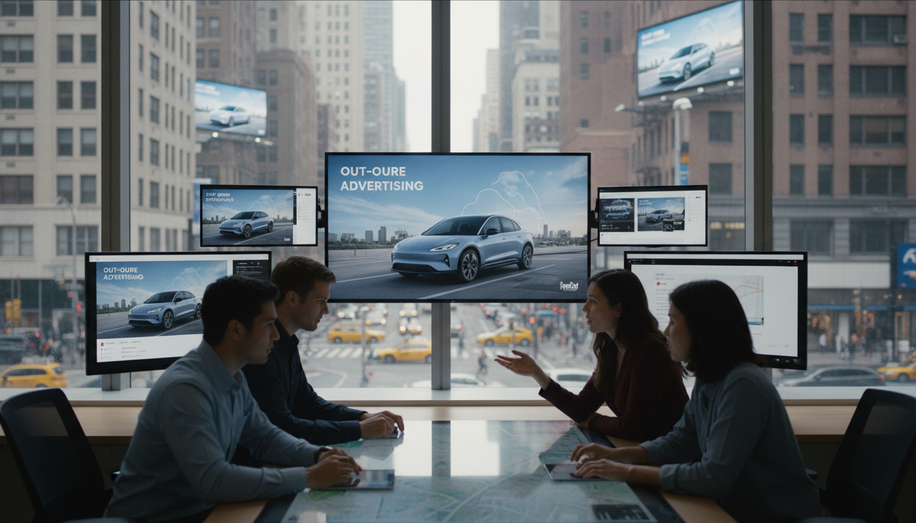

In the evolving landscape of cross-channel marketing, out-of-home (OOH) advertising has emerged as a vital amplifier, bridging the gap between physical presence and digital engagement to deliver superior return on investment. Far from being a relic of traditional media, OOH—particularly its digital variant, DOOH—is surging in relevance, with global market projections reaching USD 56.1 billion by 2034 at a compound annual growth rate of 12.09% from 2026 onward. This growth underscores OOH’s role not as a standalone channel but as a strategic enhancer that boosts the efficacy of digital, social, and TV campaigns through seamless integration and measurable impact.
Marketers are increasingly decoding the OOH media mix by leveraging programmatic buying, which dominated 65.51% of the DOOH segment in 2026, allowing real-time ad delivery based on dynamic triggers like location, weather, demographics, and events. This flexibility enables OOH to complement digital channels with precision timing. For instance, a billboard campaign near a sports stadium can prime audiences for mobile retargeting, extending reach and driving store visitations by up to 127% when paired with digital follow-ups. In the U.S., venues like SoFi Stadium and the Las Vegas Sphere have transformed into premium DOOH hubs, equipped with immersive LED walls and interactive kiosks that facilitate contextual campaigns during live events, turning passive exposure into active fan engagement.
Integration with retail media networks (RMNs) further exemplifies best practices, as retailers sync DOOH screens in stores, malls, and transit hubs with first-party data such as purchase history and foot traffic. This omnichannel approach enhances ad relevance—think time-of-day promotions for FMCG brands, which held a 33.5% market share in 2026—and improves attribution across physical and digital touchpoints. Data-driven platforms track user engagement from OOH exposure to conversion outcomes, correlating spikes in web traffic, branded search volume, and even offline retail visits with campaign performance. The result? A unified media plan where OOH acts as the “reach engine,” delivering geographic-based impressions immune to digital ad fatigue, blockers, or platform fragmentation.
Consider how OOH amplifies TV campaigns. Linear TV’s fragmentation has pushed brands toward connected TV (CTV), yet OOH provides the mass awareness layer that sequential messaging demands. Studies from the Out of Home Advertising Association of America (OAAA) reveal that 99% of sports fans exposed to OOH spent locally post-event, reinforcing its conversion power at community levels. When layered with TV spots, OOH extends narrative continuity: a national broadcast builds broad recall—already superior to other formats, with 83% of shoppers remembering OOH ads within 30 minutes—while targeted DOOH reinforces calls-to-action via mobile geotargeting. This synergy has fueled OOH revenue to a record $2.13 billion in Q3 2025 alone, with year-to-date figures hitting $6.98 billion amid 18 straight quarters of growth.
Social media integration takes this further, capitalizing on DOOH’s real-time interactivity. Programmatic DOOH, projected to grow 23% in ad spend by 2026 to $1.23 billion, pairs with social platforms for cohesive storytelling. A viral social campaign can be amplified by dynamic OOH screens that respond to trending conversations or user-generated content, fostering shareable moments. Retailers and brands in high-mobility sectors like FMCG exploit this by tailoring messages to inventory levels or promotions, blending social buzz with unavoidable outdoor visibility. North America, commanding a 33.64% global share in 2025, leads this charge, with its $7.4 billion valuation in 2026 driven by urban infrastructure upgrades and consumer shifts toward experiential advertising.
Proving ROI remains the linchpin of OOH’s cross-channel dominance. Unlike digital metrics plagued by declining trust and unreliable signals, OOH offers robust attribution: measuring digital lift through search surges, pipeline influence via sales funnel acceleration, and offline actions like event attendance or store traffic. As ad budgets realign—OOH spend surpassing $9 billion in 2024 and eyeing $10.72 billion by 2029—agencies justify allocations with the same rigor applied to programmatic or search channels. Best practices demand starting with audience mapping: identify high-traffic OOH zones that overlap with digital footprints, then deploy programmatic tools for dynamic creative optimization.
Europe mirrors this trajectory, with digital screens proliferating in hubs like London and Paris under privacy-focused regulations that bolster advertiser confidence; the UK and Germany markets are valued at $0.7 billion and $0.83 billion by 2026, respectively. Globally, the outdoor segment’s 60.44% share in 2026 reflects urban mobility patterns fueling demand. For agencies and brands, the playbook is clear: treat OOH as the connective tissue in media mixes, not an add-on. By sequencing it ahead of digital and social for awareness, alongside TV for reinforcement, marketers unlock amplified engagement and ROI that digital alone cannot match.
This decoding of the OOH media mix reveals a channel reborn through technology, poised to sustain its momentum into 2026 and beyond. With OOH spend forecasted at $9.89 billion that year, driven by billboards and transit formats, the message is unequivocal: integrate thoughtfully, measure meticulously, and watch cross-channel performance soar. To truly unlock this cross-channel potential and meticulously track ROI, platforms like Blindspot offer comprehensive solutions. By providing real-time campaign performance tracking, advanced ROI measurement and attribution, and robust programmatic DOOH campaign management, Blindspot empowers agencies and brands to strategically integrate OOH, demonstrating its amplified impact across the entire media mix. Explore how at https://seeblindspot.com/