
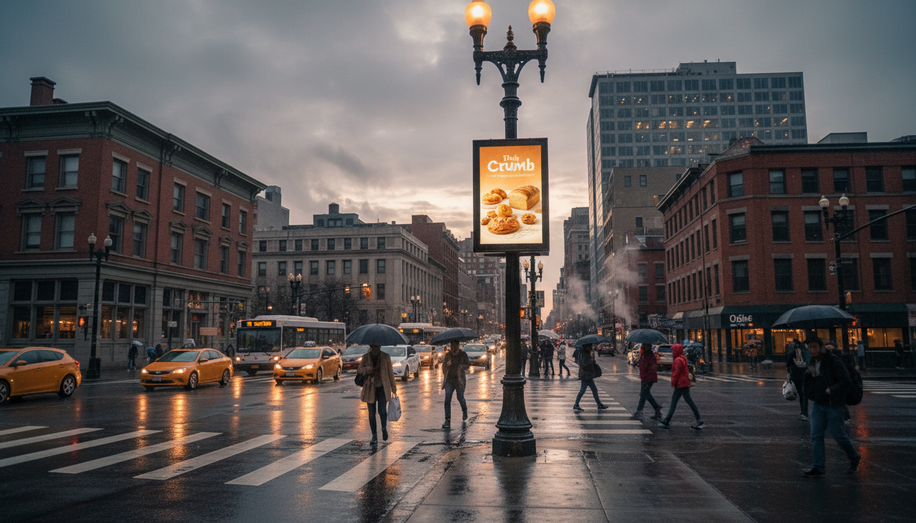

The outdoor advertising industry is experiencing a dramatic shift as brands increasingly recognize the untapped potential of residential neighborhoods and suburban corridors. With the out-of-home advertising market projected to reach $9.89 billion in 2026, a growing portion of this investment is flowing toward hyperlocal placements that connect with consumers in the communities where they live, work, and spend their leisure time.
This residential renaissance reflects a fundamental change in how marketers approach consumer engagement. Unlike digital platforms plagued by ad saturation and declining consumer trust, out-of-home advertising in residential areas offers constant, unavoidable visibility without the invasiveness associated with online tracking and data collection. The strategy proves particularly effective for local businesses, community services, and lifestyle brands seeking authentic connections with their target demographics.
The most compelling advantage of residential OOH placement lies in its ability to deliver mass reach while maintaining hyperlocal precision. Street furniture advertising, transit shelter placements, and smaller-format billboards have emerged as increasingly popular vehicles for reaching consumers in neighborhood contexts, where strategic placement can deliver high visibility to pedestrians and commuters navigating daily routines. A single well-positioned billboard in an urban residential area can reach over five million people monthly, while suburban placements capture consistent daily exposure as residents move between home, workplace, and local amenities.
Smart technology has transformed what residential OOH can accomplish. Modern installations equipped with sensors, GPS, and artificial intelligence tailor content dynamically based on real-time factors including traffic patterns, local events, and weather conditions. This contextual approach minimizes advertising waste while maximizing relevance—campaigns utilizing such adaptive strategies report action rates boosted by six percent and purchase intent 1.3 times higher than generic placements, with fifty-five percent of audiences reporting that campaigns feel personally relevant.
The timing of residential OOH campaigns aligns particularly well with consumer behavior patterns. Billboard advertising proves most effective between six and nine in the morning and four to seven in the evening, capturing commuters during peak travel times through residential corridors and toward employment centers. These temporal windows align naturally with consumer consciousness and decision-making, creating optimal conditions for brand recall and purchase consideration.
Effectiveness metrics underscore why local businesses are increasingly embracing residential OOH strategies. Approximately forty percent of consumers recognize a brand after seeing a billboard advertisement within seven days, while seventy-one percent report having purchased a product influenced by billboard advertising. For local businesses specifically, billboard campaigns drive an average eleven percent increase in store visits, demonstrating direct conversion from awareness to foot traffic.
The sustainability of this growth reflects fundamental shifts in media consumption and consumer behavior. Nearly half of all internet users employ ad blockers, and skippable digital advertisements have become the norm, making unavoidable outdoor placements strategically valuable. Residential areas represent the final frontier in advertising reach—spaces where traditional digital strategies prove ineffective, yet consumer attention remains accessible and engaged.
Regional and community-focused campaigns particularly benefit from residential OOH placement. Unlike national campaigns requiring broad geographic distribution, localized billboard strategies achieve higher recall rates and prove more cost-effective for businesses targeting specific neighborhoods or municipalities. This efficiency extends to community services and lifestyle brands whose value propositions resonate most powerfully when positioned within the geographic areas they serve.
As the outdoor advertising market continues its five-point-three percent compound annual growth rate through 2033, residential placement strategies represent a frontier where authentic consumer connection meets measurable business impact. For publications and practitioners in the OOH space, the residential revolution signals not decline but transformation—a reorientation toward the spaces where consumers genuinely live and where advertising can deliver genuine value without intrusive data collection or manipulative digital tactics.