
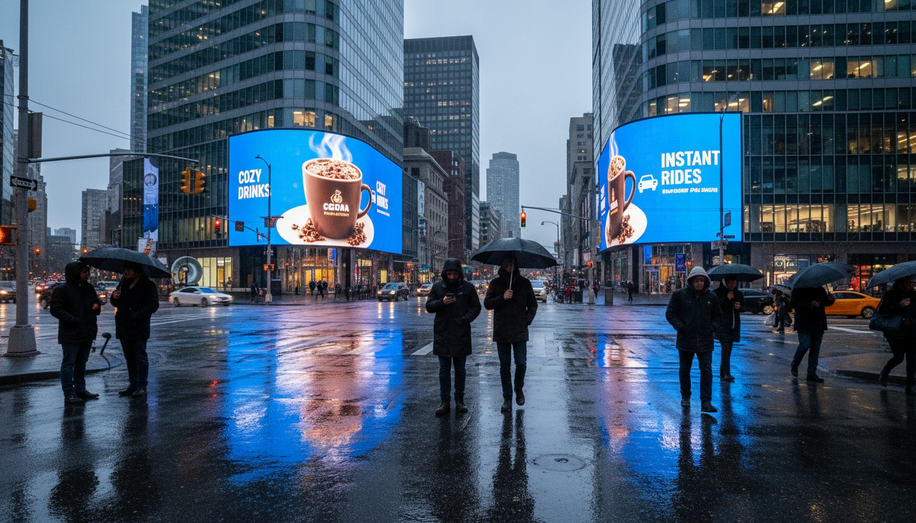

Programmatic digital out-of-home (pDOOH) advertising has long promised to elevate out-of-home media from static billboards to dynamic, data-driven canvases, yet its true power remains largely untapped beyond basic impression buys. As the global pDOOH market surges past $900 million in recent years toward projections exceeding $6 billion by 2030 and $1 billion in ad spend by 2026, industry innovators are pushing boundaries with hyper-contextual targeting, sophisticated audience segmentation, and real-time dynamic creative triggers that transform screens into responsive storytelling machines. These advancements are not mere increments; they represent a paradigm shift, integrating physical environments with digital precision to deliver measurable impact in high-traffic real-world spaces.
At the heart of this evolution lies hyper-contextual targeting, which leverages granular environmental data to serve ads attuned to the immediate surroundings and audience behaviors. Retailers, for instance, now harness customer address data, IP signals, SDK integrations, web analytics, and sales figures to pinpoint consumer preferences over-indexing in specific locations at varying times of day. A screen near a grocery store might cycle through campaigns: morning ads for commuters eyeing breakfast options, midday promotions for lunch crowds, and evening messages for after-work shoppers—all within the same inventory slot. This temporal and locational acuity extends to venue-specific granularity, thanks to the Out-of-Home Advertising Association of America’s (OAAA) updated OpenOOH taxonomy. Previously bundled categories like “retail media” or “entertainment” are now dissected into precise classifications—checkout counters, product aisles, store entrances, cinema lobbies, live music venues, or sports arenas—enabling advertisers to intercept consumers at exact journey touchpoints. “The latest evolution of the OpenOOH taxonomy provides buyers with clear, granular and actionable information about the physical environment of each individual display,” notes Ari Buchalter, Chief Strategy Officer at Broadsign, allowing confident contextual targeting across platforms.
Complementing this is advanced audience segmentation, fueled by programmatic platforms that mirror online ecosystems while bridging to the physical world. By 2026, half of all DOOH campaigns are expected to be purchased programmatically, with digital screens from bus stops to Times Square adapting creatives based on audience data, weather, or time-of-day triggers. Brands segment viewers not just demographically but through behavioral overlays, such as product affinities derived from nearby store traffic or mobile signals. JCDecaux, a leader in the space, exemplifies this by enabling multiple tailored campaigns on a single panel, dynamically shifting based on proximate consumer profiles. This segmentation integrates seamlessly into omnichannel strategies: a consumer spotting a pDOOH ad in an airport can be retargeted via mobile, creating a cohesive narrative from screen to device. The OAAA’s taxonomy aligns OOH inventory language with digital standards, reducing friction for buyers accustomed to granular programmatic channels and accelerating cross-platform planning. Premesh Purayil, Chief Technology Officer at OUTFRONT Media, emphasizes that such clarity “reduces friction, increases confidence, and accelerates investment.”
Dynamic creative triggers elevate these capabilities further, turning static displays into adaptive engines responsive to live inputs. AI now orchestrates this at every campaign stage—from audience forecasting and automated optimization to context-aware creative selection and attribution modeling. A coffee brand might trigger morning rush-hour visuals on a downtown billboard, seamlessly pivoting to afternoon refreshment messaging, all automated via programmatic pipes. Weather data can prompt rain-themed promotions on urban screens, while traffic sensors adjust messaging for commuter flows. JCDecaux’s Vendor Inventory Optimisation for Out-of-Home (VIOOH) platform underscores the efficiency, delivering over 10 times lower carbon emissions than programmatic display due to its broadcast model and streamlined supply chain. Early 2025 research from the company highlights AI’s three emerging use cases in pDOOH: predictive analytics for planning, real-time personalization, and enhanced measurement. This AI infusion, combined with mobile location data and retailer partnerships, closes the attribution loop, linking screen exposures to store visits and sales—proving lift beyond impressions.
These innovations are symbiotic, building on standardized frameworks like OAAA’s taxonomy for “what” and “where,” IAB guidelines for buying, and MRC standards for viewability and measurement. The result? pDOOH sheds its awareness-only mantle to drive conversions in omnichannel ecosystems. Retail media networks, proliferating in stores, exemplify untapped potential: screens at aisle ends can trigger personalized offers synced to loyalty data, extending digital retargeting into brick-and-mortar precision. Entertainment venues similarly unlock hyper-local engagement, with ads in sports arenas adapting to game momentum or crowd sentiment via integrated sensors.
Yet challenges persist, including data privacy and supply chain complexities, but momentum is undeniable. By 2026, budgets are shifting from saturated digital formats to pDOOH’s high-impact physicality, drawn by transparent reporting and real-time scalability. As Patrick Dolan, OAAA Chief Operating Officer, states, “Clear, consistent standards are a growth engine for the industry—reducing friction, increasing confidence for buyers.” Programmatic DOOH’s untapped potential lies in this fusion: hyper-contextual relevance, segmented precision, and triggered dynamism that make every screen a strategic asset. Far from basic impressions, it’s redefining advertising as an immersive, accountable force in the real world, poised to capture a commanding share of digital budgets.