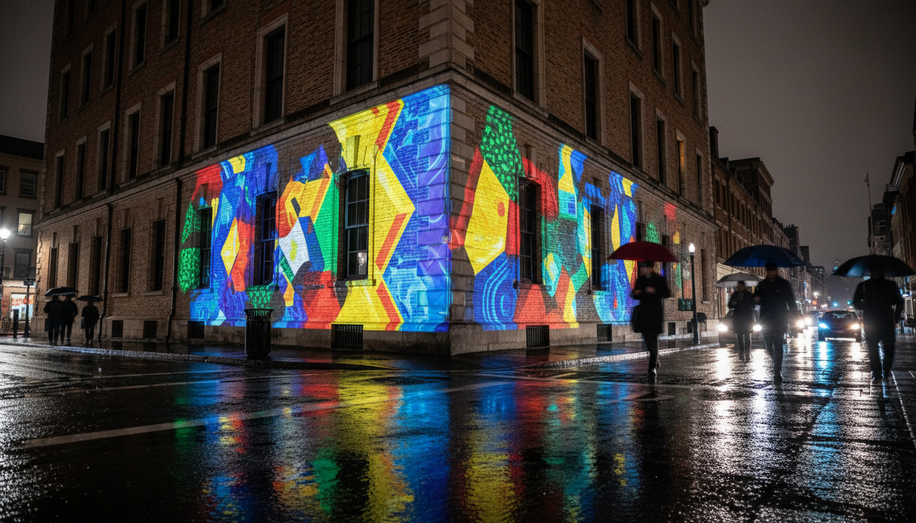

In an era where static billboards compete for attention in an increasingly crowded visual landscape, projection mapping has emerged as a transformative force in out-of-home advertising, turning ordinary buildings and urban landmarks into dynamic, immersive brand experiences that captivate audiences in ways traditional media cannot. This powerful technology represents a fundamental shift in how brands activate public spaces, moving beyond fleeting impressions to create memorable moments that generate organic social media amplification and lasting brand recall.
Projection mapping’s appeal lies in its ability to transform any architectural surface into a canvas for storytelling. Unlike conventional outdoor advertising confined to fixed dimensions and static imagery, projection mapping leverages advanced digital projection technology to create animations, choreographed sequences, and three-dimensional visual effects that breathe life into building facades, monuments, and landscapes. The scale alone commands attention—Target’s Halloween activation at the Nokia Plaza in Los Angeles used eleven projectors to animate “Skeletown Square” with synchronized lighting and original musical scoring, while the Van Gogh Immersive Experience deployed 53 projectors in Toronto to create images reaching 26 feet high and up to 170 feet wide. This scale transcends what traditional advertising methods can achieve, stopping pedestrians in their tracks and commanding the attention of diverse demographics.
The technology’s flexibility extends its appeal across industries and event types. Fashion brands have utilized projection mapping to highlight individual products, with Nike, Mercedes-Benz, and Lamborghini all leveraging the format to showcase their latest offerings at expos and venues. Sports organizations have embraced the medium for promotional campaigns—AC Sparta Praha partnered with AV Media Events to launch their outdoor jersey collection through a spectacular projection display on Prague’s iconic Old Town Astronomical Clock, while cricket promotion campaigns transformed London’s Tower Bridge into a colossal installation celebrating national sports heroes.
For cultural and institutional clients, projection mapping serves purposes beyond commercial promotion. The “Lighting of the Sails 2023” exhibition on the Sydney Opera House transformed the iconic venue into a 360-degree tribute to Australian artist John Olsen, allowing thousands to experience high-resolution digital art reflected across the harbor. Similarly, the White Night festival in Melbourne utilized projection mapping as part of a three-day public celebration of art and culture, demonstrating how the format can serve community engagement alongside commercial objectives.
The technical sophistication required to execute projection mapping campaigns distinguishes them from conventional advertising. Specialized production teams must account for unique architectural features, surface materials, and environmental conditions when programming multimedia content. Strategic placement of equipment—whether through mobile projector vehicles or fixed installations—requires careful site analysis and often necessitates coordination with municipal authorities and venue management. This complexity demands collaboration between creative agencies, projection specialists, and technical production teams, resulting in campaigns that feel more like public art installations than advertisements.
From a strategic marketing perspective, projection mapping offers measurable advantages. The format generates substantial press coverage and social media engagement, with displays creating shareable content that extends their reach far beyond physical viewers. Brands can execute multiple activations across different locations in a single night, reaching varied audiences and optimizing cost efficiency. The medium accommodates both quick promotional activations and extended campaigns designed to build sustained footfall and awareness. Additionally, the dramatic visual impact differentiates brands from competitors relying on conventional advertising, creating a sense of innovation and cultural relevance.
As urban spaces become increasingly saturated with advertising messages, projection mapping represents an evolution in how brands interact with public environments. By transforming architectural landmarks into dynamic, immersive experiences, this technology creates moments that audiences actively seek out and share rather than passively ignore. For forward-thinking brands willing to invest in this innovative format, projection mapping offers the opportunity to cement their presence in the collective memory of urban audiences—turning buildings into billboards that tell stories, not just sell products. To truly capitalize on the significant investment and creative power of these large-scale public installations, precise audience measurement and analytics, along with real-time campaign performance tracking, are essential. Platforms like Blindspot empower brands to quantify the impact of these transformative experiences, optimize strategic placement, and attribute tangible ROI, ensuring every iconic activation delivers measurable business value. Learn more at https://seeblindspot.com/