
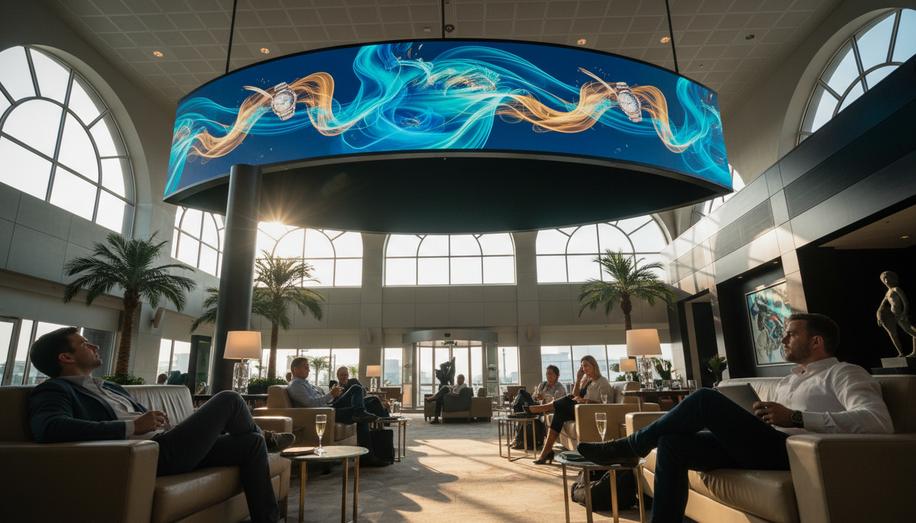

Airport advertising represents one of the most strategically valuable channels in the out-of-home media landscape, offering brands unprecedented access to affluent, educated, and actively engaged audiences during moments of high intent. As air travel continues to surge and travelers spend extended periods within airport terminals, this premium environment has emerged as a compelling alternative to traditional outdoor advertising channels, delivering measurable results across the entire marketing funnel.
The audience composition in airports fundamentally distinguishes this medium from other OOH placements. Frequent flyers—those taking four or more round-trip flights annually—account for nearly 60% of all airport advertising impressions despite representing only 18% of airline travelers. These travelers are far from ordinary consumers. Frequent flyers are over three times as likely to live in households earning $100,000 or more annually, with 61% concentrated in the 25-to-54 age demographic. More striking still, frequent flyers are over twice as likely to hold executive titles and exercise influence over $500,000 or more in business spending. This concentration of decision-makers and high-net-worth individuals creates unparalleled opportunities for brands targeting premium segments and B2B audiences.
The captive nature of airport environments amplifies advertising effectiveness in ways that traditional transit or street-level OOH cannot replicate. Passengers spend considerable time navigating security queues, waiting in lounges, and transiting between gates, creating extended dwell periods that foster genuine engagement with advertising messages. This captive audience phenomenon proves particularly powerful because travelers encounter ads in multiple contexts throughout their journey—at check-in, near security, and at departure gates—creating layered exposure that reinforces brand messaging through spatial repetition.
Beyond mere exposure, airport travelers demonstrate exceptional receptivity to advertising. Recent Nielsen research commissioned by Clear Channel Outdoor reveals that 82% of frequent flyers read airport advertisements, with 61% recalling seeing them and 57% taking action after viewing. This 57% action rate represents an 8% increase from 2022 data, signaling growing engagement as airports modernize and expand. The actions taken are notably specific and measurable: 45% scanned QR codes, while 36% visited advertised social media sites. These metrics indicate that airport advertising successfully bridges awareness and conversion, particularly for campaigns employing digital integrations.
The psychological state of travelers further enhances advertising effectiveness. Passengers typically exhibit positive, receptive mindsets while in airports, making them more inclined toward messaging for premium goods, travel services, and financial products. This emotional openness, combined with the absence of competing stimuli that characterize airport advertising environments, creates conditions for premium brand messaging to resonate distinctly.
Creative strategies optimized for airport environments leverage dynamic content capabilities unavailable in static outdoor formats. Digital screens enable real-time personalization based on flight information, time of day, or destination weather conditions, adding relevance layers that increase viewer engagement and appreciation. For brands targeting tech-savvy decision-makers—65% of frequent flyers report their companies lead or keep pace with technological trends—this sophistication in creative execution proves essential.
Measurement frameworks for airport advertising have matured significantly, with Nielsen studies now providing granular insights into audience behavior, demographics, and post-exposure actions. This data-driven approach enables brands to justify premium placements through concrete performance metrics rather than relying on estimated impressions alone. The consistency of engagement metrics across multiple years establishes airport advertising as a reliable channel with predictable returns.
As traditional media fragmentation continues and consumer attention becomes increasingly scarce, airport advertising offers brands a defensible position within premium audiences’ daily routines. The channel delivers concentrated demographic targeting, extended exposure periods, measurable engagement, and proven conversion metrics—positioning it as an indispensable component of integrated media strategies targeting affluent, influential, and mobile professionals in 2026 and beyond.