
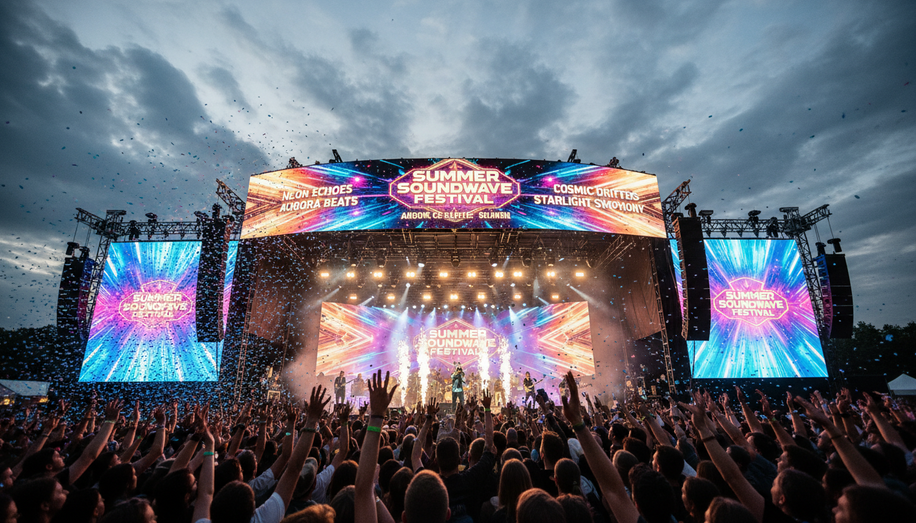

In the electric roar of a packed stadium or the pulsating rhythm of a music festival, out-of-home (OOH) advertising seizes the moment, transforming fleeting glances into unforgettable impressions. Nowhere does this medium shine brighter than in the entertainment industry, where dynamic stadium screens, immersive concert displays, and venue wraps dominate the visual landscape, captivating audiences at their most euphoric peaks. As global OOH revenue surges toward USD 41.62 billion in 2026, growing at a 3.67% CAGR to USD 49.86 billion by 2031, entertainment hubs stand as prime battlegrounds for brands vying to embed themselves in the cultural zeitgeist.
Stadiums, the coliseums of modern spectacle, exemplify OOH’s commanding presence. Massive LED video boards, often spanning hundreds of square feet, pulse with high-definition ads timed to game halftimes or seventh-inning stretches, reaching hundreds of thousands of fans per event. In North America, which claims 34.70% of global OOH revenue, these installations leverage dense interstate networks and programmatic digital auctions to boost yields without expanding physical footprints. Consider a NFL showdown at SoFi Stadium or a MLB classic at Yankee Stadium: brands like Coca-Cola or Verizon flash synchronized campaigns that blend with the action, their messages amplified by the crowd’s shared adrenaline. Digital OOH (DOOH), now 34% of total UOH spend and growing 7.5% year-over-year, powers this precision, enabling real-time content swaps based on weather, scores, or social buzz. Airports feeding these venues post the strongest growth at 7.19% CAGR, as affluent travelers linger over 60 minutes, priming them for narrative-driven ads that foreshadow the excitement ahead.
Concerts and music festivals elevate OOH to immersive artistry. At venues like Madison Square Garden or festivals such as Coachella and Glastonbury, perimeter LED walls, stage-side screens, and elevated jumbotrons create a 360-degree ad ecosystem. These displays don’t just advertise; they synchronize with performances, morphing into light shows that extend the artist’s brand while slipping in sponsor messages seamlessly. Transit OOH, surging at 10.6% in key segments, blankets shuttle buses, entry gates, and urban rail lines ferrying fans to the gates, ensuring pre-arrival exposure. Street furniture—banners on light poles, wrapped fences, and interactive kiosks—further saturates the periphery, turning approach paths into branded corridors. In 2024, U.S. OOH revenue topped $9.1 billion for the first time, with “Live Theater, Opera, Music, and Dance” ranking among the top ten spending categories, underscoring entertainment’s outsized role. Disney, a perennial top spender alongside Apple and McDonald’s, deploys these assets to cross-promote films, streaming hits, and park experiences, capitalizing on the venue’s halo effect.
What makes OOH irresistible in these settings is its unskippable intimacy amid massive scale. Fans, phones aloft and senses heightened, encounter ads in a distraction-free zone where attention spans stretch longest—dwell times in venues often exceed those of any digital platform. Roadside OOH, holding 42.55% of revenue, captures drivers en route, while on-site digital retrofits command premium pricing through flexible dayparts and AI-driven targeting. Programmatic adoption, led by North America and Europe, integrates real-time data for hyper-local relevance: a beer brand might trigger festival-specific creatives based on lineup announcements, lifting engagement via deterministic footfall attribution from telecom data. This tech infusion accelerates DOOH’s 5.71% annual expansion, outpacing static formats that still hold 55.30% market share but cede ground to LED upgrades.
Entertainment advertisers reap measurable triumphs. In election-year 2024, categories like amusements grew double-digits, with 60% of top OOH spenders increasing budgets and 13 more than doubling investments—Nike, Honda, and Meta among them. Venues provide captive demographics: young, affluent, socially active consumers whose post-event shares amplify reach exponentially. U.S. market projections paint a bullish picture, from $10.34 billion in 2024 to $16.72 billion by 2030 at 8.3% CAGR, fueled by urbanization clustering audiences in hubs like New York City, population 8.3 million. Globally, Asia-Pacific emerges fastest-growing, as stadiums in Mumbai or Seoul retrofit for K-pop spectacles and cricket epics.
Yet OOH’s dominance faces evolution, not obsolescence. Rising maintenance costs and input prices temper gains, with U.S. billboard revenue dipping 5.1% in 2025 projections to $8.7 billion, even as the broader market climbs. Brands counter by blending OOH with omnichannel strategies—retail media networks link venue screens to app retargeting—ensuring attribution loops close seamlessly. Interactive elements, like QR codes on jumbotrons or AR filters synced to concerts, bridge physical and digital, turning passive views into active conversions.
In entertainment’s high-stakes arena, OOH isn’t mere backdrop; it’s the spotlight thief, stealing shares of mind when emotions run hottest. As digital transformation accelerates—billboards at 36.60% revenue baseline, transit at 5.88% CAGR—expect stadiums, concerts, and venues to pioneer the next wave, where AI-personalized spectacles redefine audience captivity. For advertisers, the message is clear: in the heart of the show, OOH doesn’t just advertise—it performs.
To truly maximize the strategic impact, personalization, and measurable ROI of advanced OOH advertising within these high-engagement entertainment venues, advertisers need robust technological support. Blindspot can empower this, offering programmatic DOOH campaign management that leverages real-time data for hyper-local content and precise targeting. By integrating audience measurement and ROI attribution, brands can accurately track the impact of their “performing” ads, ensuring every impression at peak emotional moments translates into demonstrable value. Visit https://seeblindspot.com/ to learn more.