
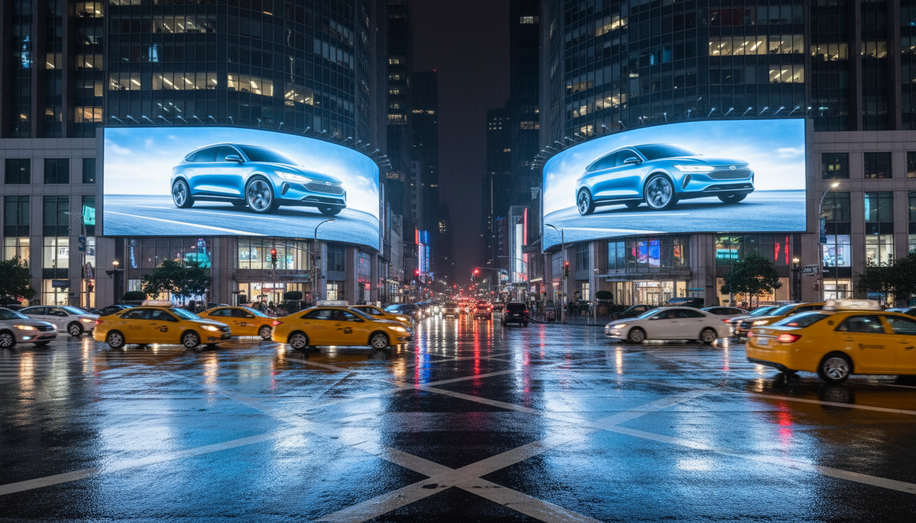

Out-of-home advertising has become essential for automotive brands seeking to capture consumer attention in an increasingly fragmented media landscape. As car manufacturers and dealerships navigate competitive markets and shifting consumer behavior, OOH strategies are proving to be a powerful tool for launching vehicles, promoting limited-time offers, and strengthening brand presence where it matters most—on the road and in the communities where buyers live.
The automotive sector faces a unique challenge: reaching informed, mobile consumers at precisely the moment they’re considering a purchase. Traditional digital channels struggle with ad avoidance and brand safety concerns, but outdoor advertising provides what digital cannot—an unavoidable, tangible presence that captures attention during consumers’ daily commutes and routines. For auto retailers and manufacturers, this advantage translates into measurable results. Research demonstrates that an OOH campaign targeting vehicle buyers achieved an 83% lift in dealership visits among exposed consumers, showcasing the medium’s direct impact on foot traffic and showroom engagement.
Digital Out-of-Home technology has amplified these results by enabling real-time flexibility. DOOH allows dealerships and manufacturers to update promotional messages instantly, adjusting offers based on market conditions, inventory levels, or seasonal demand. A luxury sedan launch can feature dynamic creative showcasing safety features on one billboard while highlighting sustainability credentials on another, tailored to specific geographic audiences. This real-time capability proves invaluable for time-sensitive promotions—flash sales, limited edition releases, or month-end clearance events reach consumers when motivation peaks.
Strategic placement amplifies OOH effectiveness for automotive brands. Billboards positioned along high-traffic expressways in congested urban areas reach captive audiences of commuters likely to be in the market for vehicles. In cities where personal vehicle ownership is rising and public transit ridership declining, such placements become particularly valuable. Similarly, bus shelter advertising and digital panels in urban centers provide access to residents and commuters making daily transportation decisions. These locations ensure automotive messages reach potential buyers during their natural decision-making windows.
Creative execution distinguishes successful automotive OOH campaigns from forgettable ones. Bold visuals, compelling copy, and innovative extensions—such as lighting effects or three-dimensional embellishments—transform billboards into memorable brand experiences. Creative specialists understand that automotive OOH must move beyond simple product shots; it must tell a story that resonates emotionally while delivering clear product benefits. A campaign highlighting a vehicle’s spacious interior for families might visually demonstrate folded seats or show children comfortably arranged for road trips, proving functionality rather than merely asserting it.
The mobile-first consumer adds another layer of complexity that OOH addresses effectively. Over 70% of vehicle purchasers use smartphones for research and comparison shopping, yet 76% of adults take action on mobile devices after seeing an OOH advertisement. This means effective automotive OOH drives consumers from billboards directly to digital channels—websites, configurators, and dealership locators—at moments when buying intent is highest. The integration of location extensions and proximity targeting allows seamless transitions from outdoor awareness to online action.
Brand loyalty and community presence represent longer-term benefits that OOH delivers for dealerships. Consistent billboard presence reflects a dealership’s commitment to its neighborhood, building trust and familiarity over time. When creative executions reflect local personality and community involvement, outdoor advertising becomes more than promotion—it becomes a neighborhood fixture that customers recognize and remember.
Looking forward, automotive marketers recognize that OOH works most effectively within integrated campaigns combining search, social, video, and local strategies. Standalone billboard campaigns achieve results, but synchronized systems that funnel awareness from outdoor impressions through digital channels to showroom visits optimize return on investment. As privacy regulations tighten and third-party cookies disappear, OOH’s first-party reach and untrackable impact become increasingly valuable for building brand awareness that complementary digital channels can then convert.
For automotive brands launching new models, promoting seasonal sales events, or building dealership loyalty, out-of-home advertising offers proven, measurable pathways to consumer engagement. In an industry where location, timing, and creative impact determine success, OOH remains unmatched in its ability to reach buyers where they live, work, and drive.
For automotive marketers seeking to maximize these benefits, platforms like Blindspot provide the essential intelligence. By leveraging its location intelligence, programmatic DOOH campaign management, and robust ROI measurement, brands can ensure optimal strategic placement and real-time message flexibility, driving measurable action among today’s discerning car buyers. Discover how to quantify and optimize your out-of-home investment at https://seeblindspot.com/