
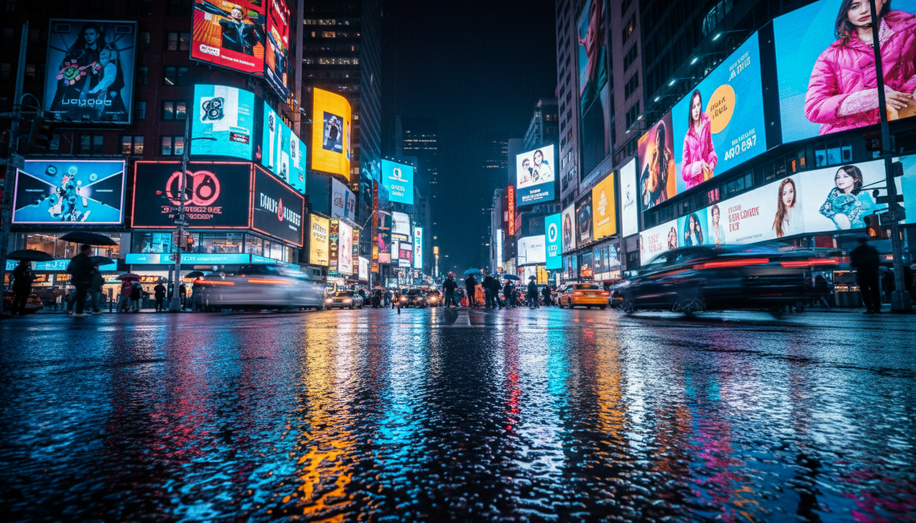

In the early days of out-of-home (OOH) advertising, measurement was rudimentary, relying on simple traffic counts to gauge potential exposure. As far back as 1937, devices captured pedestrian and vehicular movement, providing advertisers with basic audience estimates that evolved into the Traffic Audit Bureau (TAB), established in 1934 to deliver third-party data on OOH audiences. These metrics, known as daily effective circulation (DEC) until 2011, offered a rough proxy for impressions but lacked depth, unable to link sightings to consumer behavior or sales lift.
This foundational approach stemmed from OOH’s origins in the 1830s, when large-format posters—over 50 square feet—promoted circuses in New York, evolving into standardized billboards by 1901 that fueled national campaigns for brands like Coca-Cola and Kellogg. By the 1920s, enamel and steel structures lined highways, adapting to the automobile boom sparked by the Model T in 1908, yet proof of performance remained elusive. Advertisers in the 1800s never demanded detailed reports, but by the mid-20th century, the industry sought validation. A landmark 1975 campaign by Outdoor Advertising Inc. (OAI) featuring Miss America Shirley Cochran demonstrated OOH’s power, boosting her name recognition by 940% nationwide.
The push for better metrics intensified with OOH’s expansion. The 1962 introduction of bus shelter ads by JCDecaux and the 1965 Highway Beautification Act, which regulated billboard placement, diversified formats while highlighting measurement gaps. Early efforts like 2002 tests by Arbitron and Nielsen for outdoor ratings aimed to mirror TV metrics, but static OOH’s limitations persisted—impressions were counted, yet actions were untraceable.
The digital revolution in the early 2000s marked a turning point. Digital out-of-home (DOOH) billboards, first installed around 2005, enabled real-time content updates, dayparting, and dynamic messaging tied to weather or time. This shift demanded sophisticated tools. Sensors, cameras, and geolocation emerged to track dwell time, engagement, and impressions more precisely than traffic counts ever could. By the 2010s, Digital Out-of-Home Analytics integrated these with programmatic buying, allowing automated, data-driven targeting—raincoat ads during storms, sunglasses on sunny days—elevating OOH from mass-reach medium to precision instrument.
Yet true evolution arrived with attribution models that stitched OOH into the broader marketing ecosystem. Foot traffic counts, once the gold standard, gave way to mobile location data and clean-room environments matching ad exposures to store visits. Platforms now correlate billboard views with smartphone geofencing, revealing not just impressions but incremental lift: a 20-30% uptick in visits post-exposure, per industry benchmarks. Multi-touch attribution, borrowed from digital channels, assigns credit across the funnel—awareness from highway spectaculars, consideration via transit screens, conversion through retail networks.
Geofencing and beacon technology exemplify this leap. When a consumer’s phone pings near a DOOH screen, subsequent behaviors—like app downloads or purchases—are tracked anonymously, proving OOH’s role in the path to purchase. In 2021 analyses, this closed the loop advertisers craved since the vinyl era of the 1970s, when hand-painted boards yielded to computerized prints. Today, AI enhances it further, predicting audience demographics from camera data without invading privacy, while cross-channel platforms integrate OOH with CTV, social, and search for holistic ROI.
These advancements have transformed skepticism into strategic imperative. Pre-digital OOH was a top-of-funnel brute force; now, multi-touch models quantify its integrated impact, showing how a Times Square digital display drives online searches or e-commerce spikes. The Out of Home Advertising Association of America (OAAA), evolved from 1891’s bill poster groups, champions this era, with OBIE Awards since 1942 underscoring creative effectiveness backed by data.
Challenges remain—privacy regulations like GDPR demand ethical data use, and rural coverage lags urban hubs—but the trajectory is clear. From 1930s traffic counters to AI-fueled attribution, OOH measurement has matured, proving its worth across awareness, engagement, and conversion. Marketers no longer guess; they measure, optimize, and dominate the funnel with OOH as the connective tissue in omnichannel campaigns.
As programmatic DOOH scales—projected to grow 50% by 2026—expect even finer granularity: real-time sentiment analysis from facial recognition proxies and blockchain for transparent verification. The legacy lives on, not as relic but reinvention, where every impression fuels actionable insight.