
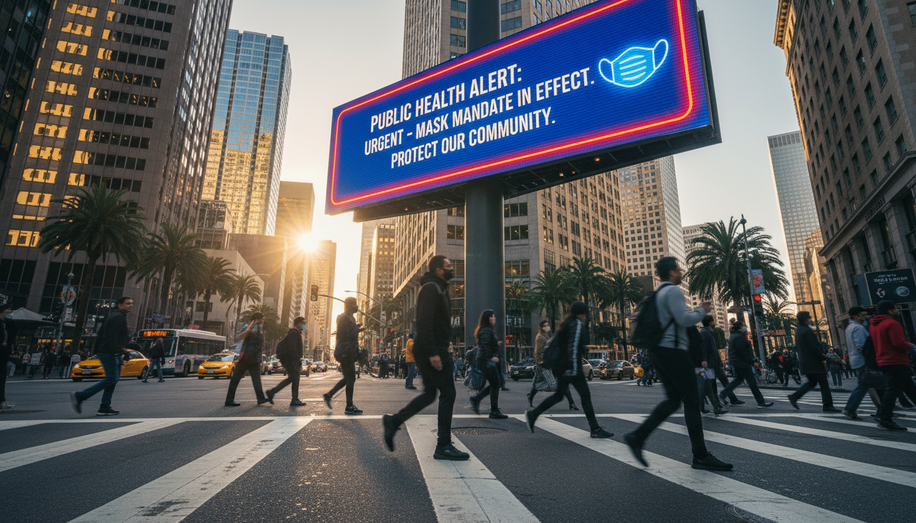

In the heart of a bustling metropolis, where skyscrapers pierce the sky and crowds surge through intersections, out-of-home (OOH) advertising transforms from mere commercial spectacle into a lifeline. When emergencies strike—be it a public health outbreak, natural disaster, or urgent security alert—OOH’s unmissable presence on billboards, digital screens, and mobile displays delivers critical information to millions in real time, cutting through digital noise and reaching those who need it most. This urban stage, alive with constant foot and vehicle traffic, amplifies urgent public announcements like no other medium, ensuring broad, immediate impact where seconds count.
Consider the chaos of a wildfire encroaching on city outskirts or a sudden flood submerging low-lying neighborhoods. Traditional channels like television or social media falter: power outages cripple broadcasts, internet congestion overwhelms apps, and not everyone scrolls feeds during evacuation. Enter mobile LED trucks, agile digital billboards on wheels that prowl high-risk zones, flashing evacuation routes, shelter locations, and safety protocols in bold, evolving visuals. These trucks park strategically in community centers, parks, or near shelters, lingering in high-foot-traffic areas to hammer home messages repeatedly. Their mobility shines where fixed infrastructure fails, navigating compromised roads to broadcast real-time updates on fire perimeters or safe exits, visually mapping danger zones for split-second decisions that save lives.
This potency stems from OOH’s inherent advantages: ubiquity and inescapability. Urban dwellers encounter dozens of OOH displays daily—highway gantries, transit hubs, building facades—commanding attention without requiring active engagement. During Hurricane Matthew in 2016, hospitality businesses ravaged by the storm underscored communication’s role in quelling panic; those leveraging visible, multi-channel updates kept guests oriented amid confusion. Fast-forward to modern crises, and OOH elevates this principle citywide. Miami International Airport’s swift social rebuttal to a misattributed flood video demonstrated how rapid, visible clarification steers narratives, but pairing it with OOH could have blanketed terminals and approach roads with factual overlays, preempting viral misinformation.
Public health crises further spotlight OOH’s edge. The 2018 Tide Pod Challenge spiraled into hospitalizations, prompting the U.S. Consumer Product Safety Commission to deploy football star Rob Gronkowski in a stark video warning. Imagine scaling that via urban digital networks: screens in subways and malls pulsing with “Do Not Eat” mandates, QR codes linking to resources, reaching teens en route to school or hangouts. In economic downturns, these same assets pivot to hope, with mobile trucks cruising unemployment hotspots to advertise job fairs, aid applications, and recovery programs—bridging gaps for those offline and accelerating community stabilization.
Dutch railroad operator NS offers a blueprint for proactive transparency during a brutal snowfall. Their live blog chronicled advice, delays, and staff heroics, urging off-peak travel. Deployed across station billboards and train-wrapped displays, such content would have permeated urban rail networks, reducing overcrowding and building trust through unrelenting visibility. Similarly, Audubon Zoo’s jaguar escape response—swift newsroom posts and a press conference—contained panic; OOH extensions on nearby streets could have informed passersby of closures and investigations instantaneously.
Beyond alerts, OOH fosters dialogue in crises demanding public buy-in. Guerrilla-style adaptations, like bold street murals or pop-up installations, humanize responses, inviting interaction where corporate statements fall flat. Domino’s 2009 “Pizza Turnaround” used raw street interviews to reclaim trust post-scandal; transposed to OOH, transparent kitchen cams on city screens would have confronted commuters with accountability. Tesco’s in-aisle apologies for tainted meat rebuilt shopper faith at point-of-purchase—scale that to urban billboards near grocers, and brands signal reform amid reputational storms. Marriott’s post-breach QR-coded lobby displays personalized redress; airport OOH fleets could extend this accountability across concourses, turning digital woes into tangible gestures.
Yet OOH’s power demands precision. Messages must be concise, multilingual, and adaptive—digital screens refreshing data feeds from command centers. Placement matters: target commuter arteries for evacuations, residential clusters for health alerts. Integration with apps via scannable codes enhances depth without diluting immediacy. As cities densify and disasters intensify—wildfires in urban wildlands, pandemics in transit throngs—agencies must pre-map OOH assets into crisis plans, training operators for seamless activation.
Critics might argue OOH risks overload in ad-saturated environments, but emergencies demand disruption. Its broad reach—undiscriminating across demographics, devices, or connectivity—ensures no one is left behind, from non-English speakers to the digitally disconnected. In an era of fragmented media, OOH stands as the urban nervous system, pulsing vital intelligence to keep societies resilient.
Real-world deployments affirm this. During economic slumps, job-info trucks in high-unemployment zones empower the vulnerable, parking where crowds gather to multiply exposures. Environmental perils see them threading wildfire-threatened streets, their glow piercing smoke for pathfinding clarity. When misinformation erupts, as at Miami Airport, OOH’s fixed gaze counters falsehoods with authoritative repetition.
Ultimately, on the urban stage, OOH is more than advertising—it’s infrastructure for survival. Governments, utilities, and NGOs increasingly embed it in protocols, recognizing its role in not just informing but unifying. As climate volatility and health threats escalate, mastering OOH for crisis communications isn’t optional; it’s the thread binding panic to preparedness, chaos to coordinated response. In cities that never sleep, these silent sentinels ensure the wake-up call is heard.