
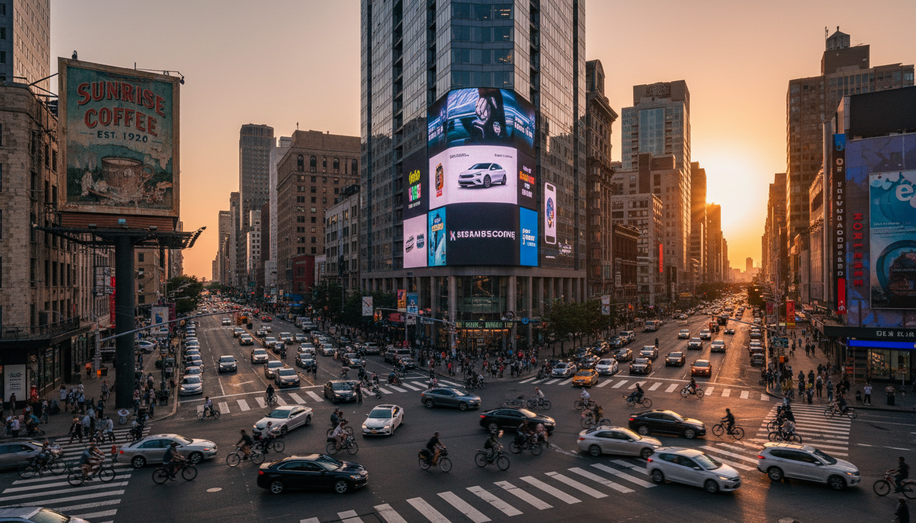

In the bustling streets of 19th-century New York, the roots of out-of-home (OOH) media buying took hold with a simple act of promotion: Jared Bell printing the first large-format posters—over 50 square feet—to advertise circus acts in 1835. These early efforts marked the dawn of OOH as a commercial force, relying entirely on manual labor and face-to-face negotiations between advertisers, local merchants, and rudimentary posting companies. By the 1860s, businesses could lease outdoor spaces for hand-painted or lithographed billboards, a shift enabled by new regulations allowing the purchase of public-facing real estate. Media buying was artisanal and localized; agents haggled over prime wall space or fences, gluing posters or commissioning painters for vibrant displays that listed goods and services to lure passersby.
This fragmented approach coalesced into an industry by the late 1800s. The earliest recorded billboard leases date to 1867, followed by the formation of the International Bill Posters’ Association in 1872, which professionalized posting practices across North America. Standardization arrived at international expositions: the 24-sheet billboard format, stitched from lithographed sheets in a 2:1 ratio, debuted at the 1889 Paris Expo and the 1893 World’s Columbian Exposition, becoming the blueprint for modern static displays. Media purchasing remained a relationship-driven endeavor, with buyers negotiating directly with landowners or small firms—often numbering around 300 by 1870—for postings on walls, street railways (from 1850), and emerging highways. Agencies like the Fulton Group and Cusack Co. merged in 1925 to form General Outdoor Advertising Company, the first major consolidation, signaling scale but still tethered to manual deals and on-site inspections.
The early 20th century formalized these practices amid rapid urbanization. The Outdoor Advertising Association of America (OAAA), evolving from mergers like the 1925 Poster Advertising and Painted Outdoor Advertising Associations, advocated for the medium while the National Outdoor Advertising Bureau (formed 1915) inspected billboards for agencies. Measurement emerged as a cornerstone: In 1934, the Traffic Audit Bureau (TAB) provided third-party audience data, giving buyers empirical leverage in negotiations previously guided by intuition and foot traffic estimates. Iconic campaigns underscored OOH’s power— Coca-Cola’s 1931 Santa Claus billboard redefined holiday imagery, while a 1975 OAAA effort featuring Miss America Shirley Cochran boosted her name recognition by 940 percent, proving measurable impact. Yet buying stayed traditional: Agencies pored over printed rate cards, bartered for rotations on static inventory like bulletins and posters, and coordinated painted spectacles along new highways built for the Model T era.
Regulatory headwinds shaped the landscape too. Tobacco firms pivoted to OOH after the 1972 broadcast ban, only for a 1999 settlement with states to prohibit it on billboards. By the 1990s, formats expanded to bus shelters and transit ads, but purchasing logistics lagged, demanding exhaustive calls, faxes, and site visits for static and early painted boards. The OAAA’s 1991 centennial and mergers, like the Institute of Outdoor Advertising into OAAA in 1994, highlighted maturation, yet the process was labor-intensive, prone to human error, and opaque without real-time data.
The digital revolution, igniting around the 2000s, shattered this stasis. Static billboards gave way to LED screens enabling dynamic content, while audience metrics evolved from TAB’s manual counts to GPS-tracked impressions and geofencing. Traditional buying—endless RFPs, haggling over impressions, and static contracts—yielded to supply-side platforms (SSPs) and demand-side platforms (DSPs). Automation arrived with programmatic OOH, borrowing from digital ad tech: Buyers now bid in real-time for digital inventory across networks, using data on demographics, weather, and footfall to optimize placements. Platforms like Vistar Media streamlined what once required armies of planners, shifting from weeks-long negotiations to milliseconds. This pivot, accelerated post-2010, fused OOH with online precision, allowing cross-channel campaigns where a digital billboard might trigger mobile retargeting.
Key shifts define this evolution: from opaque, manual trades to transparent, data-fueled auctions; from static ubiquity to addressable precision; from agency monopolies to self-serve tech stacks. By 2026, over half of OOH spend flows programmatically, with AI forecasting inventory and predicting engagement. Future trends point further: Integration with connected TV and retail media networks promises omnichannel fluidity, while 5G enables hyper-local, interactive formats like AR overlays on DOOH screens. Sustainability pressures—e.g., energy-efficient LEDs—and privacy regulations will refine automated buying, demanding ethical data use amid cookieless worlds. Yet the core endures: OOH commands unskippable attention in physical space, now supercharged by tech that echoes its 1835 origins in captivating the public at scale.