
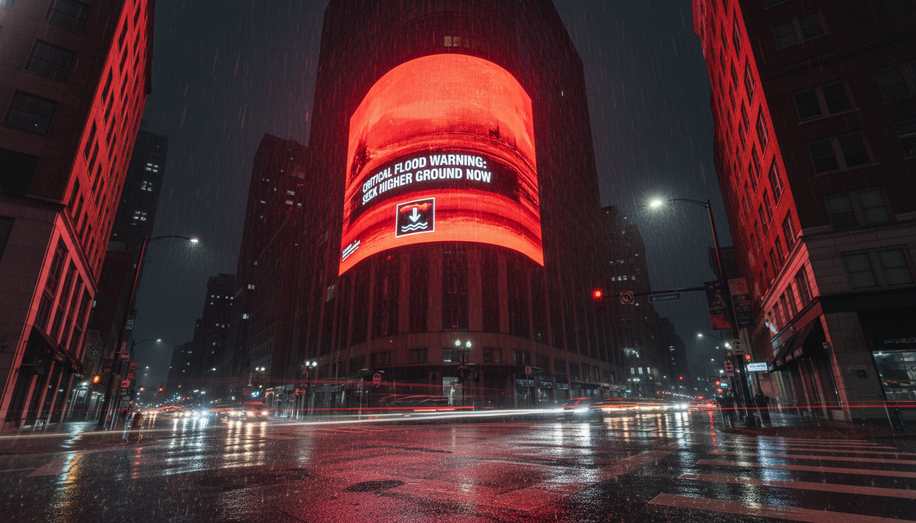

In the chaotic moments following a natural disaster, when power grids fail and cell towers overload, a single billboard flickering to life can become a lifeline. Out-of-home (OOH) advertising, particularly its digital evolution known as digital out-of-home (DOOH), has proven itself as a rapid-response powerhouse for public safety and crisis communication, delivering urgent messages to millions when every second counts. Unlike fleeting social media posts or jammed phone lines, DOOH screens in high-traffic areas—airports, highways, transit hubs—can update in real time, cutting through the noise to guide behavior and save lives.
The COVID-19 pandemic showcased this capability on an unprecedented scale. In March 2020, as the virus swept across the U.S., the Ad Council partnered with the White House, HHS, and CDC to rally OOH industry leaders like Clear Channel Outdoor and the Out of Home Advertising Association of America (OAAA). They donated inventory and created assets overnight, blanketing cities with PSAs on handwashing, masking, and social distancing. ReachTV alone pushed these messages across TVs in 90 airports, reaching an estimated 18.3 million people monthly, while Uber’s cartop displays mobilized in multiple markets. By early April, OAAA amplified the #StayHomeSaveLives campaign, conceived with Google and trade groups, generating over $32 million in donated media and 1 billion impressions in two weeks—demonstrating OOH’s speed in unifying a national response.
This agility stems from DOOH’s technical edge: programmatic platforms enable content changes in minutes, far outpacing static billboards or traditional TV cycles. During Hurricane Katrina and Sandy, the Ad Council leveraged similar OOH networks for evacuation routes and shelter info, building on a World War II legacy of crisis PSAs. In public health scares, like flu seasons or opioid epidemics, place-based OOH targets contexts primed for action—naloxone hotlines in Appalachian gas stations, PrEP info in LGBTQ+ venues, or vaccination reminders near pharmacies—driving measurable behavior change where digital ads might miss.
Strategic placement amplifies impact. Billboards on highways reinforce “Click It or Ticket” seatbelt campaigns for drivers in violation-prone zones, while transit ads near clinics spur flu shots. In underserved rural areas with spotty internet, OOH fills critical gaps, ensuring no demographic is left behind—commuters, pedestrians, even those offline. Visual punch is key: bold imagery and concise text distill complex directives into unforgettable calls to action, like “Schedule Your Screening Today,” spotted amid daily routines.
Government agencies increasingly recognize OOH’s role beyond awareness. Federal health campaigns use place-based networks in pharmacies and community centers for heart disease prevention or enrollment drives, capitalizing on “moments of readiness.” During disasters, when social media surges for rescues—as Red Cross polls from 2011-2012 noted—OOH provides reliable, non-digital backup, monitoring-free dissemination. Brands like Coca-Cola have joined in, swapping commercial spots for distancing pleas, proving OOH’s scalability.
Yet challenges persist. Power outages can sideline DOOH, and message fatigue risks dilution in oversaturated crises. Still, integrations with multi-channel strategies—pairing OOH with online echoes—boost retention: a flu reminder on Instagram in the morning, then a billboard en route to work. Emerging tech, like AI-driven personalization, promises even faster, hyper-local adaptations, from flood alerts in riverine towns to heatwave hydration tips in urban parks.
As climate events intensify and health threats evolve, OOH’s vitality grows undeniable. In New York subways or Los Angeles freeways, these ever-present displays stand ready, turning public spaces into beacons of safety. When seconds separate survival from tragedy, DOOH doesn’t just inform—it mobilizes, proving that in crises, visibility isn’t luxury; it’s essential infrastructure.
To further empower this vital communication, platforms like Blindspot offer an indispensable technical edge. Its programmatic DOOH campaign management capabilities enable organizations to rapidly deploy and update critical safety messages in minutes, while advanced location intelligence ensures precise placement on screens that reach specific, at-risk audiences, even in underserved areas. This integrated approach solidifies OOH’s role as a resilient, intelligent backbone for public safety infrastructure, ensuring visibility is always prioritized when it matters most. Learn more at https://seeblindspot.com/