
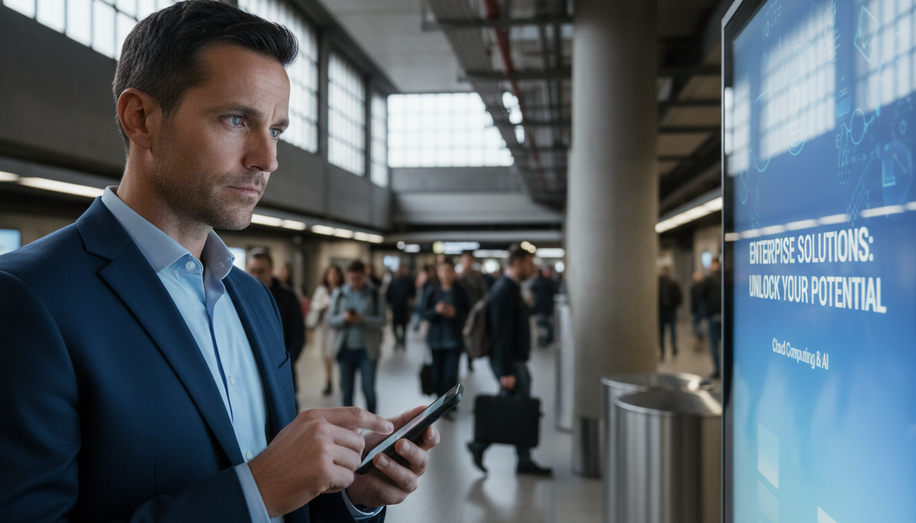

In the bustling corridors of corporate hubs, where executives sip coffee between meetings and commuters navigate rush-hour routes, out-of-home (OOH) advertising is quietly revolutionizing how B2B brands connect with decision-makers. Long dismissed as a consumer-focused medium dominated by billboards and transit posters, OOH has evolved into a precise, measurable tool that places business messages exactly where professionals encounter them daily—unskippable and unblockable. This shift challenges the digital overload plaguing B2B marketing, where 41% of decision-makers use ad blockers, offering brands a fresh path to visibility and engagement.
The transformation stems from technological leaps, particularly digital out-of-home (DOOH) and programmatic OOH (pOOH), which enable hyper-targeted campaigns tailored to business audiences. Publishers now offer segmentation by company size, revenue, industry, or roles like C-suite executives, IT decision-makers, lawyers, or HR professionals, supporting account-based marketing (ABM) strategies with proximity targeting near points of interest or specific venues. Geo-fencing extends this precision: ads can trigger based on a company’s headquarters, commuter pathways, or even stock market fluctuations, delivering dynamic creative that adjusts in real-time for weather, location, or audience triggers. Talon, an OOH specialist, reports that such contextually relevant campaigns yield a 23% uplift in brand metrics, with consideration rising 63% and purchase intent climbing 50%, while dynamic ads boost brain response by 32%.
Place-based OOH amplifies this reach by infiltrating the professional ecosystem. Indoor placements in office elevators, vending machines, and lobbies immerse brands in decision-makers’ daily routines, establishing presence without invasive digital pings. Workplaces remain vital, with 44% of employees back full-time and Tuesdays peaking at 43% on-site attendance, making these spots ideal for unskippable exposure. Outdoors, commuter routes in tech hubs like San Francisco, Austin, or Denver capture dense traffic of office-bound professionals, where succinct, eye-catching messaging ensures quick absorption amid the drive. Business travelers, perpetually on the move via public transport or international flights, encounter OOH in airports, train stations, and city centers—precisely when they’re 20% more likely to discover new B2B brands.
Creative agility sets modern OOH apart, moving beyond static imagery to full-motion video and data-driven personalization. B2B brands can customize calls-to-action for specific accounts, turning a LinkedIn post from a Snowflake executive into a Times Square billboard, as SaaS innovators Mutiny and Ramp did to snag attention. QR codes bridge the physical-digital divide, driving immediate scans for deeper engagement, while DOOH integrations track lifts in branded searches, website visits, and pipeline activity—debunking myths that OOH suits only Fortune 500 giants. Programmatic platforms now deliver over 90% ROI satisfaction, with double- or triple-digit gains in conversions, proving OOH’s full-funnel prowess from awareness to action.
This unexpected public presence builds industry authority in ways traditional channels like LinkedIn or email blasts cannot. By appearing in high-context environments—near industry events, key market pathways, or competitor locales—OOH fosters familiarity and trust among elusive decision-makers. Kantar’s Media Reactions report underscores OOH and DOOH as preferred channels for global professionals, excelling not just in top-of-funnel fame but in bottom-funnel metrics once reserved for digital. For B2B marketers, it’s a strategic pivot: in a world of fleeting online impressions, a towering billboard or lobby screen lingers, prompting research on phones or sparking conversations in boardrooms.
Yet success demands intentionality. Brands must map key pathways, prioritize dynamic relevance over generic blasts, and measure via smart attribution linking exposures to digital signals. Smaller players need not shy away; scalable programmatic buying democratizes access, allowing nimble targeting without massive budgets. As offices repopulate and hybrid work solidifies routines, OOH positions B2B brands to lead conversations in the physical spaces where deals are born.
Ultimately, OOH redefines B2B outreach by meeting professionals on their terms—in elevators humming with deal talk, highways pulsing with ambition, and urban arteries teeming with opportunity. It’s not just advertising; it’s infiltration, turning public serendipity into strategic advantage and proving that the most unexpected spaces yield the most profound leads.
To truly harness this strategic pivot, B2B marketers need robust platforms that enable precision and proof. Blindspot empowers brands to execute hyper-targeted programmatic DOOH campaigns, leveraging advanced location intelligence for optimal site selection and robust ROI measurement to link OOH exposure directly to digital engagement and pipeline acceleration, ensuring every impression drives tangible business outcomes. Discover how at https://seeblindspot.com/