
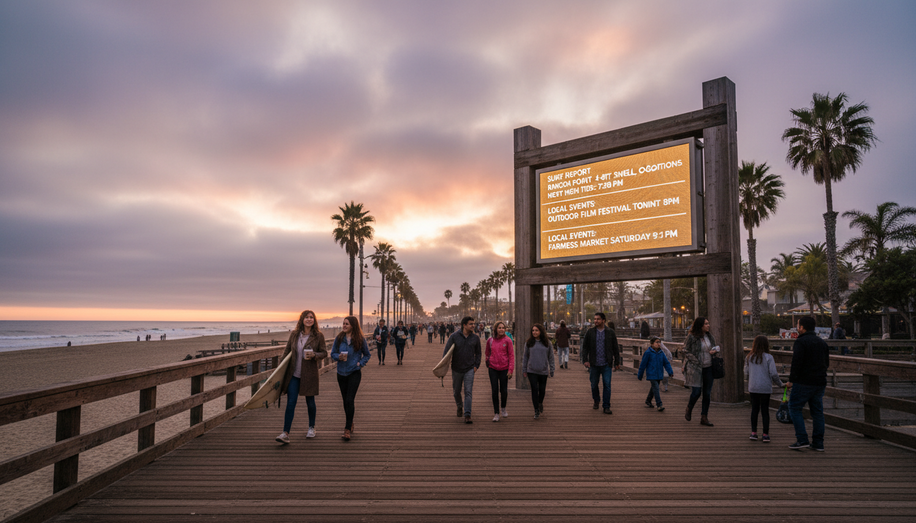

In the bustling heart of a city intersection, a digital out-of-home (DOOH) screen flickers to life, not with a static promotion, but with content that pulses in sync with the world around it. As a sports team scores a last-minute victory nearby, the display instantly swaps to celebratory beer offers, drawing cheers from passing fans. This is the power of real-time contextual triggers in DOOH, where live data feeds—from sports scores and traffic jams to breaking news and local events—transform screens into hyper-relevant conversationalists, far beyond mere weather checks.
Traditional DOOH relied on time-of-day or basic weather data to nudge relevance: coffee ads in the morning chill or iced drinks under summer sun. But today’s programmatic DOOH (pDOOH) platforms pull from expansive live feeds, making ads feel intuitively helpful rather than pushy. Traffic density data can trigger calming messages for frustrated commuters, like “Escape the gridlock—grab a snack inside,” on screens at convenience stores. News headlines feed in real-time sentiment; a stock market surge might prompt investment apps to flash timely promotions, while local event calendars sync ads to festivals or concerts, urging attendees toward nearby pop-up booths.
Consider British Airways’ iconic “Magic of Flying” campaign, where radar data detected planes overhead. As a flight passed, screens showed a child pointing skyward, complete with the flight number and destination—a moment of magic that blurred ad and reality, boosting engagement through sheer timeliness. Similarly, sports scores integrate seamlessly: during a big game, screens near stadiums or bars shift to highlight team merchandise or post-win specials, capitalizing on collective euphoria. Retail sales trends and product availability data allow dynamic swaps—promoting in-stock items based on footfall spikes from mobile location signals—ensuring messages align with immediate shopper needs.
Event data elevates this further. Concert listings or public transit delays can activate tailored creatives; a sold-out show nearby prompts ride-share discounts, while subway jams advertise alternative walking routes with coffee detours. Social media trends and audience demographics add layers, filtering feeds to display viral challenges or demographically tuned offers, fostering a sense of community. Gas stations exemplify this: cold snaps summon hot beverage visuals, while heatwaves push chilled relief, all triggered by precise weather APIs.
The mechanics hinge on dynamic creative optimization (DCO), where pDOOH platforms ingest these feeds via APIs, processing triggers in milliseconds to serve bespoke content. Brands identify context-aligned signals first—what real-world moments prime purchase intent? For a beverage maker, it’s not just temperature but game scores tying into victory toasts; for B2B software, perhaps traffic data signaling remote work frustrations. Geofencing and beacons refine this, activating location-based ads for restaurants or coworkers, blending physical proximity with live context.
Proof lies in performance. Contextual DOOH lifts customer reception by 18%, spontaneous ad recall by 17%, and sales by 16%, per industry benchmarks, as relevance turns passive viewers into responders. It thrives in omnichannel ecosystems, complementing mobile and TV by anchoring public-space encounters—from Times Square spectacles to mall screens—that influence on-the-spot decisions. Yet, execution demands nuance: not every trigger fits every brand. A coffee chain thrives on weather, but a fintech might prioritize market volatility for stock-tip tie-ins.
Challenges persist, from data privacy to integration latency, but advancements in proof-of-play dashboards enable real-time monitoring and tweaks, verifying delivery and engagement. Forward-thinking networks, like those in convenience retail, already run fully dynamic campaigns across stores, adapting to time, weather, traffic, and beyond.
As DOOH evolves, these triggers herald a future where screens anticipate needs, not just broadcast them. In an attention-scarce world, hyper-relevance isn’t a gimmick—it’s the edge that makes advertising indispensable, embedding brands into the rhythm of daily life. Agencies embracing this—mapping triggers to consumer mindsets—unlock campaigns that don’t just reach audiences, but resonate in the moment, driving loyalty and results that static media can’t touch. Blindspot directly facilitates this by providing comprehensive programmatic DOOH campaign management, enabling seamless integration of diverse real-time data feeds with dynamic creatives. Its advanced audience measurement, location intelligence, and real-time performance tracking capabilities equip advertisers to precisely map these triggers to specific consumer mindsets and locations, ultimately optimizing campaigns for maximum resonance and demonstrable ROI. Discover how at https://seeblindspot.com/