
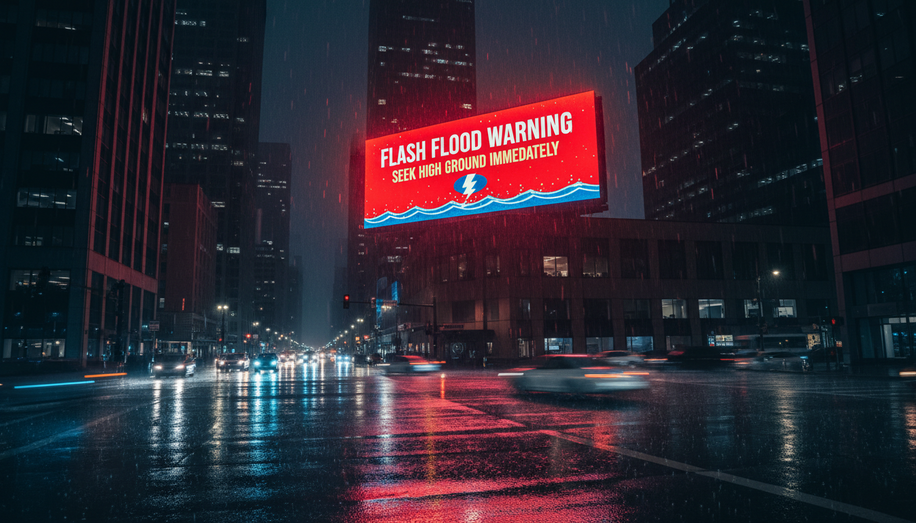

In the frenzied moments of a crisis, when every second counts, out-of-home (OOH) advertising networks stand ready to transform from commercial billboards into lifelines of public safety. Picture a hurricane barreling toward the coast or a flash flood sweeping through urban streets: while traditional broadcast channels grapple with overload and digital notifications falter amid power outages, OOH displays—ubiquitous on highways, transit hubs, and city squares—offer an unyielding, always-on platform for rapid information dissemination. These networks, often equipped with digital capabilities, can pivot in minutes to broadcast emergency alerts, weather warnings, and essential community updates, proving their mettle as indispensable public service announcers.
The precedent is clear from past emergencies. During the coronavirus pandemic, OOH advertisers swiftly repurposed their inventory to convey critical messages. Billboards blazed with “We’re Open” signs for essential services, announcements of altered business hours, delivery options, and stock availability for vital supplies. Even non-commercial pleas, like the Red Cross’s call for blood donations, lit up displays alongside government directives on hygiene and prevention. As noted by the Out of Home Advertising Association of America (OAAA), this agility stemmed from OOH’s status as a recognized medium of communication, affirmed by the U.S. Supreme Court, underscoring its role in essential messaging. Contactless services became a new advertising vernacular, etched across digital screens to guide a disoriented public through unprecedented lockdowns.
This adaptability extends far beyond health crises into the realm of natural disasters and civic imperatives. OOH’s strength lies in its hyper-local reach and inescapability—drivers, pedestrians, and transit riders encounter it involuntarily, ensuring messages pierce through the noise of personal devices. Public sector campaigns have long harnessed this power for voter turnout drives, social causes, and health initiatives, as evidenced by widespread deployments on bus shelters, taxis, and street furniture. Government agencies and nonprofits praise OOH for creating urgency, mobilizing communities, and driving behavioral change at scale. In one striking example, during wildfire seasons in California, digital OOH networks in evacuation zones flashed real-time updates on shelter locations, road closures, and air quality indexes, credited with saving lives by reaching those without reliable internet or TV access.
Technological advancements have supercharged this capability. Modern OOH networks integrate with emergency alert systems like the Wireless Emergency Alert (WEA) framework, which disseminates rapid notifications through government channels. A 2018 report from the National Academies of Sciences, Engineering, and Medicine on Emergency Alert and Warning Systems highlights the need for diverse, resilient dissemination methods—precisely where OOH fits. Digital out-of-home (DOOH) platforms now connect via APIs to National Weather Service feeds, allowing automated updates for tornado warnings or amber alerts. In New York City, for instance, LinkNYC kiosks and Times Square spectaculars have synced with citywide alert systems, displaying evacuation routes during subway disruptions or terror threats. This seamless integration means a single command from an emergency operations center can cascade across thousands of screens, overriding commercial content in seconds.
Deployment speed is OOH’s hallmark. Unlike radio or TV, which require FCC approvals or scheduling, OOH operators can reconfigure content remotely through cloud-based digital signage software. Major networks like Clear Channel Outdoor and Lamar Advertising have demonstrated this in drills and real events, switching to public service modes within 90 seconds. Cost-effectiveness seals the deal: for pennies per thousand impressions, OOH blankets high-traffic areas, far outpacing targeted digital ads that users can ignore. During Hurricane Ida in 2021, Louisiana’s OOH providers blanketed interstates with flood warnings and boil-water advisories, complementing FEMA’s efforts and reaching rural motorists bypassed by cell alerts.
Challenges persist, of course. Power dependencies in blackouts demand backup generators or solar integrations, increasingly standard in new installations. Message clarity is paramount—bold visuals, minimal text, and multilingual support ensure accessibility. Yet, these hurdles pale against OOH’s proven impact. Public awareness campaigns leveraging OOH have boosted civic engagement measurably, from higher vaccination rates to increased disaster preparedness.
Looking ahead, as climate volatility intensifies and urban populations swell, OOH networks must evolve further. Partnerships with federal agencies could embed OOH into Integrated Public Alert and Warning Systems (IPAWS), mandating rapid takeover protocols. Interactive DOOH, with QR codes linking to detailed apps, adds depth without overwhelming static views. In an era of misinformation, OOH’s authoritative, location-verified presence cuts through skepticism, fostering trust.
Ultimately, OOH transcends advertising to become a civic guardian. By leveraging its vast, dynamic displays for emergency alerts and vital information, communities gain a resilient shield against chaos. As crises grow more frequent, this medium’s role as a public service announcer isn’t just valuable—it’s vital, ensuring no one misses the call to safety. To fully realize this potential, advanced platforms are essential to ensure the strategic deployment and agile management of these vital alerts. Blindspot’s location intelligence and programmatic DOOH campaign management capabilities empower public agencies and OOH operators to precisely target emergency messaging to critical areas, enabling rapid content overrides and ensuring that vital information reaches vulnerable communities without delay. Learn more at https://seeblindspot.com/.