
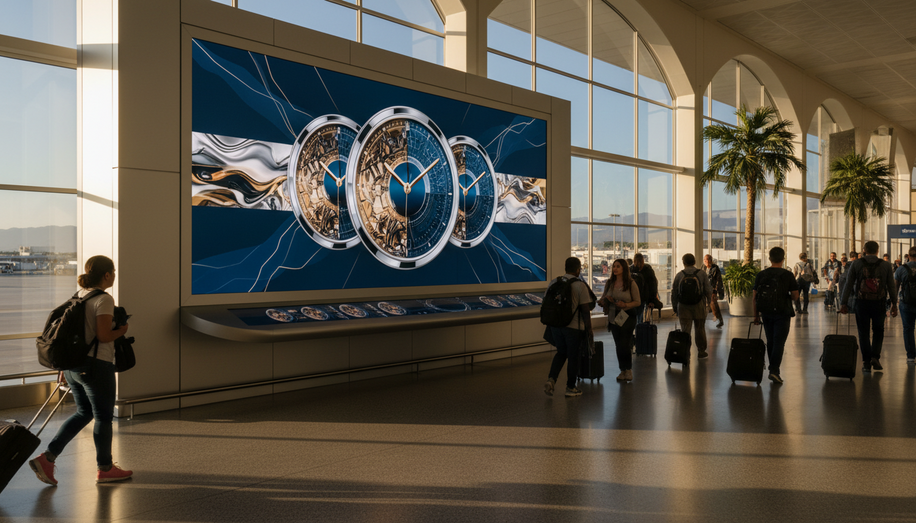

In the bustling corridors of major airports, where affluent travelers weave through security lines and linger at gates, out-of-home (OOH) advertising has evolved into a precision tool for premium brands targeting high-value audiences. These environments offer unparalleled access to decision-makers, luxury seekers, and frequent flyers—demographics with disposable income and a penchant for upscale experiences. Unlike fleeting roadside billboards, airport OOH capitalizes on extended dwell times, turning moments of anticipation into opportunities for deep brand immersion. From pre-security zones teeming with arrivals to post-security lounges where passengers savor hours-long layovers, strategic placements ensure messages resonate long after the flight departs.
The journey begins pre-security, where high-traffic areas like parking garages, check-in halls, and baggage claim serve as the first touchpoint. Here, travelers are in a receptive mindset, unencumbered by the rush of boarding and open to distractions that enhance their experience. Clear Channel Outdoor’s Airports Division, with its network spanning over 55 U.S. commercial airports and 115 private jet terminals, exemplifies this approach through high-impact digital screens and experiential activations. A Nielsen study commissioned by the company found that 83 percent of frequent flyers notice airport ads, with 75 percent taking action afterward, underscoring the medium’s influence on affluent passersby. Premium brands like luxury watchmakers or high-end spirits producers thrive in these spaces by deploying sequential storytelling: an initial spectacular in the parking lot introduces the brand’s elegance, followed by a digital diorama near baggage claim inviting virtual “try-ons” via augmented reality. This narrative builds anticipation, leveraging the natural progression of the traveler’s path.
As passengers advance to security and concourses, the environment shifts to one of controlled chaos, demanding ads that cut through the noise with bold visuals and emotional resonance. High-contrast designs, large fonts, and evocative imagery—think sun-drenched destinations or sleek cabin interiors—ignite wanderlust in seconds, as advised by airport marketing experts. J.C. Decaux’s installation for Hi-Chew at Miami International Airport illustrates the power of interactivity even in transitional zones: colorful exhibits with product sampling, games, and photo ops drew families, students, and international jet-setters into a multi-sensory brand encounter. For premium advertisers, this translates to QR codes linking to exclusive offers, such as VIP lounge access or personalized shopping discounts, transforming passive viewers into engaged prospects. Data-driven targeting, informed by flight schedules, time of day, and demographics, ensures relevance; a business-class ad might appear for delayed international flights, when dwell times stretch and minds wander to indulgences.
The true goldmine lies post-security, particularly in gate areas, lounges, and dining zones, where dwell times can exceed an hour. These high-value pockets allow for repeated exposure, fostering familiarity and loyalty among influencers who share experiences on social media. Blip Billboards advocates for premium placements like digital video walls and mini-spectaculars, where sequential messaging unfolds: a luxury airline might highlight seat comfort at security, then pivot to loyalty perks at the gate. Interactive elements amplify impact—touchscreens for contests or AR activations that let travelers “board” a virtual first-class cabin. ADARA’s digital strategies complement this with programmatic OOH synced to travel intent data, geo-targeting by origin or destination to promote tailored retail and parking offers. The result? Brands position themselves as gateways to aspiration, with studies showing airport ads boost purchase intent among high-income travelers by reinforcing premium positioning.
Extended dwell times are the secret sauce, distinguishing airport OOH from other channels. Passengers aren’t speeding by; they’re waiting, scrolling, and observing, often multiple times per trip. This repetition drives 20-30 percent higher recall rates compared to urban billboards, per industry benchmarks. Premium brands like those in fashion or finance exploit this by coordinating with digital extensions—DOOH screens feeding into social campaigns or CTV pre-arrival ads—for a full-funnel assault. Nickelytics and Plug Talk Media emphasize A/B testing on digital formats to refine messaging, tracking engagement via analytics for real-time optimization.
Yet success hinges on synergy. Airports as commercial ecosystems demand partnerships with operators for prime real estate and data insights. Experiential layers, from branded lounges to tastings, elevate mere visibility to memorable encounters, encouraging shares that extend reach organically. For premium brands, the ROI is clear: connecting with 80 percent of travelers earning over $100,000 annually, in a mindset primed for premium purchases. As air travel rebounds in 2026, airport OOH isn’t just advertising—it’s curating first-class impressions that propel brands above the competition.