
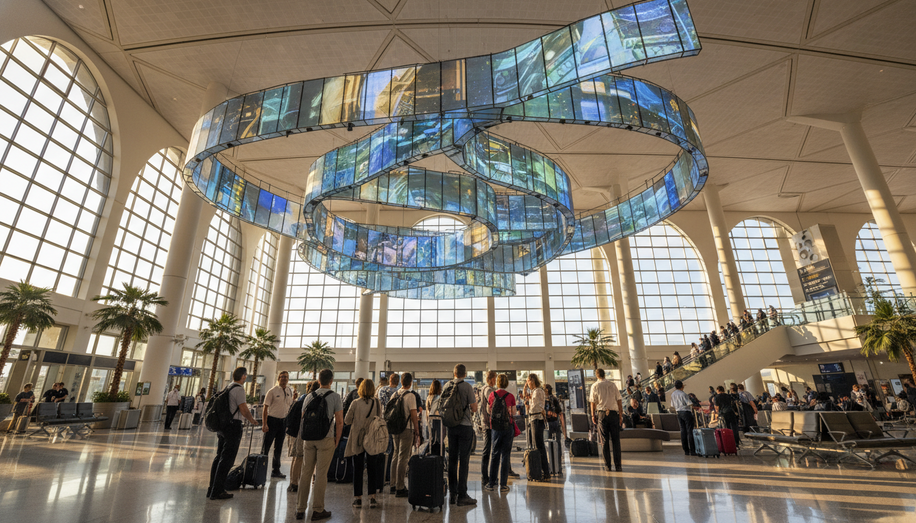

As international travel rebounds and premium passenger volumes surge, airports are once again becoming some of the most valuable canvases in out-of-home. Far from being mere transit hubs, they function as global gateways where affluent leisure travelers, frequent flyers and senior decision-makers converge, often with time on their hands and a heightened openness to messaging. For brands, this creates a rare mix: a captive, high-value audience and an environment built for scale, spectacle and memorability—provided the media strategy matches the moment.
The starting point is understanding the airport as a journey, not a single venue. From curbside and check-in to security, lounges, retail corridors and baggage claim, each stage offers distinct dwell times, emotional states and audience profiles. A business traveler rushing through security has very different needs and receptivity than a family waiting at the gate or an executive unwinding in a premium lounge. The most effective campaigns map creative and format selection to these micro-moments, building a cohesive brand story that unfolds across the terminal rather than relying on isolated impressions.
Large-format digital screens remain the backbone of high-impact airport advertising, especially in high-traffic chokepoints like departure halls and central atriums. These monuments to attention deliver instant brand stature and broad reach, but their power lies increasingly in dynamic content rather than static loops. Brands can tailor messaging by destination, daypart or flight bank, spotlighting relevant offers or services when they are most likely to resonate. A financial brand can serve premium card messaging around early-morning business banks, while a luxury retailer highlights tax-free exclusives during weekend leisure peaks. Integrating real-time elements—such as live currency rates, sports scores or destination weather—keeps content fresh and encourages travelers to look up again and again.
At the gate and along key corridors, smaller digital placements and targeted video units offer a different kind of opportunity: longer dwell times and closer proximity. Here, narrative becomes more important than sheer scale. Sequential storytelling, where a series of screens build on one another, can move travelers from awareness to consideration within a single walkway. Brands promoting complex offerings—enterprise software, wealth management, B2B services—can use these zones to unpack benefits in digestible chapters, confident that the surrounding environment naturally slows audiences down.
Beyond screens, experiential and immersive formats are redefining what it means to advertise in airports. Pop-up lounges, interactive kiosks, VR try-ons and product trial zones turn passive exposure into active engagement. For categories like automotive, travel, technology and luxury goods, tactile experiences can be particularly effective with high-spend, time-rich travelers. A premium luggage brand offering smart bag demonstrations near security or boarding can directly address real-world pain points, while a hospitality brand might recreate a slice of its resort aesthetic inside the terminal. The key is to ensure the experience feels additive to the passenger journey rather than an interruption, delivering utility, comfort or entertainment in exchange for attention.
Affluent and business audiences demand precision, not just presence. That is pushing airport campaigns toward increasingly sophisticated targeting. Many media owners now offer the ability to align campaigns with specific flight routes, destinations or airline partners, effectively segmenting audiences by purpose and purchasing power. A luxury watchmaker may prioritize international long-haul terminals frequented by high-net-worth individuals, while a SaaS provider targets airports and concourses with a strong concentration of corporate traffic. Strategic airport selection—choosing business-focused hubs over tourist-heavy gateways, or vice versa—becomes a media decision as critical as channel mix.
Connectivity is also changing how airport advertising is bought and measured. Digital out-of-home networks, combined with mobile and programmatic capabilities, give brands tools to extend and verify impact. QR codes and near-field prompts can turn a fleeting glance into an online session, enabling retargeting once the traveler reaches their destination. Cost per visit to key zones, uplift in concession sales, parking pre-bookings and website conversions tied to airport exposures are increasingly common KPIs, replacing the old reliance on traffic projections alone. Brands that integrate airport media into broader omnichannel campaigns—reinforcing terminal exposures with social, connected TV and mobile—tend to see stronger brand recall and more attributable outcomes.
Creative strategy in airports must balance ambition with clarity. The audience is global, multilingual and often in motion, which means bold visuals, minimal copy and instantly recognizable brand cues outperform dense messaging. At the same time, the premium context demands that creative lives up to its surroundings. High-end finishes, cinematic imagery and meticulous localization all contribute to perceived brand quality. In lounges and long-dwell spaces, brands can afford more depth—longer-form video, interactive content, even editorial-style storytelling—but the value proposition still needs to be grasped within seconds.
For advertisers, the biggest shift may be cultural rather than technological: viewing airports not as an expensive out-of-home add-on, but as strategic nodes in a global communication network. As travel patterns normalize and premium traffic grows, airports give brands an unparalleled chance to speak to people at their most aspirational—on the way to close deals, explore new markets or indulge in long-planned trips. The brands that win in this environment are those that orchestrate formats, data and creativity into a connected experience, turning the global gateway into a high-performing media channel rather than a beautiful backdrop.