
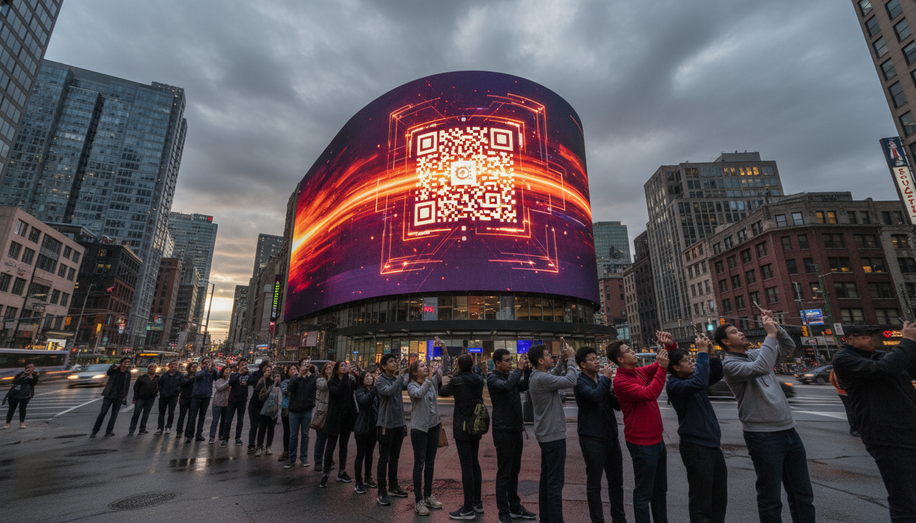

Out-of-home advertising has long been prized for its scale, visibility and ability to command attention in the real world. But as audiences become more accustomed to scrolling past polished creative online, the category is being pushed to do more than simply be seen. The most effective OOH today is not just a large-format message dropped into a public space; it is an invitation to participate. Brands are increasingly designing campaigns that create a two-way exchange, turning a static impression into a moment of interaction.
That shift is being driven by both consumer expectations and technological access. People now move through physical spaces with smartphones in hand, accustomed to seamless digital journeys and instant utility. OOH advertisers are responding by building bridges between the street and the screen. QR codes remain one of the simplest and most widely used tools in that effort. Once dismissed by some marketers as a basic shortcut, the QR code has become a practical gateway to richer content, from product demos and location-based offers to interactive games and shoppable experiences. Its appeal lies in its low friction: a viewer can move from awareness to action in a matter of seconds, without needing to download an app or remember a URL.
NFC, or near-field communication, is beginning to play a similar role, particularly in environments where physical proximity is part of the value proposition. With a tap of a phone, a poster, vending machine or retail display can trigger content, unlock rewards or collect data for future engagement. The technology is still less ubiquitous than QR, but it offers a more elegant, almost invisible user experience. In some cases, that invisibility is the point. The most successful interactive OOH campaigns often avoid making the mechanics feel like a gimmick. Instead, they use the touchpoint to solve a problem, reduce friction or deepen the story behind the brand.
That focus on usefulness is important because audiences are quick to ignore interaction that feels forced. OOH occupies public space, and public space demands clarity. If the mechanism is confusing or the payoff is too small, people will keep walking. This is why the best interactive executions are typically built around a strong creative idea first and a technology layer second. A bus shelter that lets commuters vote on a local issue, a billboard that triggers a real-time response, or a storefront graphic that reveals hidden content through AR can all work well, but only if the interaction feels intuitive and rewarding. The objective is not to showcase technology for its own sake. It is to create a memorable experience that gives people a reason to engage.
Augmented reality has become a useful tool in this regard, especially for campaigns that need a sense of wonder or spectacle. By overlaying digital elements onto physical advertising, AR can transform a poster or billboard into a scene that extends beyond its printed frame. It can animate characters, reveal product features or allow users to explore a brand world in their own environment. Yet AR works best when it is easy to access. Web-based experiences, often unlocked through QR codes or mobile links, have helped reduce the barriers that once limited adoption. The less effort required, the more likely audiences are to participate.
There is also a growing appetite for OOH that behaves more like a service than a message. Interactive installations can offer sampling, personalization, instant feedback or direct commerce, making the medium feel closer to a utility. That evolution is especially visible in retail-adjacent environments, transit hubs and event spaces, where consumers are already in a mindset to discover, compare or act. In those contexts, interactivity can provide a genuine benefit, whether that means redeeming an offer, exploring a product in detail or simply experiencing something unexpected.
For advertisers, the attraction goes beyond novelty. Interactive OOH creates measurable pathways that traditional billboard formats have never fully offered. QR scans, taps, dwell time and subsequent site visits can all provide signals about engagement. That data can help brands refine messaging, optimize placements and better understand what motivates audiences in specific locations. In a market under pressure to demonstrate value, that accountability matters.
Still, there is a balance to strike. OOH remains one of the few channels that can reach people at scale without asking them to opt in first. Its power comes partly from that public visibility and partly from the surprise of discovery. Interactivity should enhance those qualities, not replace them. The most compelling campaigns respect the physical environment they occupy while using digital touchpoints to extend the experience in meaningful ways.
In the end, truly interactive OOH is not about turning every surface into a screen. It is about making the medium more responsive, more memorable and more human. As brands look beyond passive viewing, the opportunity lies in designing experiences that invite people to do something, feel something or take something with them. The screen may still be central, but the real innovation is happening around it.