
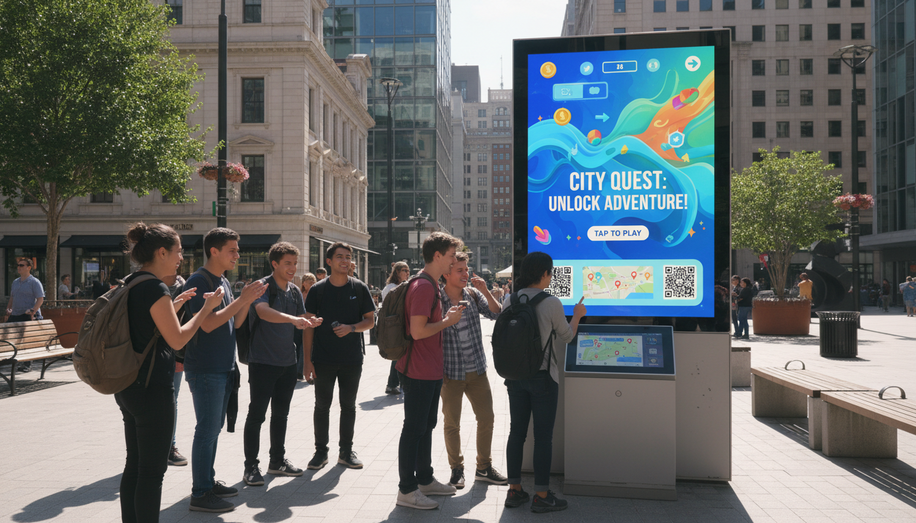

Out-of-home advertising has long relied on static visuals to capture attention, but a fundamental shift is reshaping the industry. Gamification—the integration of game-like elements into marketing campaigns—is transforming passive billboards into interactive experiences that drive measurable engagement and lasting brand recall.
The traditional model of outdoor advertising treated sidewalks and transit hubs as one-directional channels, where brands broadcast messages to audiences with minimal opportunity for interaction. Today’s consumers demand something different. They want to participate, to play, and to feel a sense of control over their brand experiences. Gamification addresses this desire directly by turning viewers into active participants, fundamentally changing how audiences engage with outdoor advertising.
At its core, gamification in out-of-home advertising works because it taps into intrinsic human motivations: the desire for achievement, curiosity, and reward. When audiences encounter a puzzle to solve, a challenge to complete, or a game to play, they’re no longer passive observers—they’re engaged participants. This shift from passive to active engagement creates measurable differences in brand perception and recall. Research indicates that individuals tend to remember brands associated with enjoyable and interactive experiences far more effectively than those with static advertisements.
The mechanics of gamified OOH campaigns vary widely, reflecting the creativity of modern marketers. Sidewalk activations frequently employ QR code-triggered experiences that launch augmented reality content on smartphones. Nike’s “Reactland” campaign invited pedestrians to race digital avatars down branded sidewalks while testing new shoes, generating significant social engagement and product trial lift. Netflix’s “Stranger Things” promotion placed QR-coded markers across major U.S. cities, creating a gamified scavenger hunt that led fans to physical prize locations and drove substantial social sharing.
Beyond street-level activations, digital out-of-home displays are becoming increasingly sophisticated. RCBC, a financial services company, integrated interactive programs like loan calculators and picture puzzles with financial literacy lessons into digital bus shed displays. The Star Casino in Sydney created an interactive experience where passersby could win dinner vouchers by completing tasks on digital displays during Lunar New Year celebrations. These examples demonstrate that gamification isn’t limited to a single format—it adapts across touchscreens, AR experiences, physical challenges, and location-based activations.
The effectiveness of gamified OOH extends beyond immediate engagement metrics. When audiences participate in an outdoor game or challenge, they’re more likely to share their experience on social media, amplifying reach far beyond those who directly interacted with the campaign. This organic amplification is particularly valuable for brands seeking cost-effective ways to extend campaign visibility. Additionally, gamified campaigns generate trackable data: QR scans, AR sessions, and social shares provide marketers with concrete metrics to evaluate campaign performance and optimize future activations.
ALDI Danmark’s “Spot the Difference” summer campaign illustrates the measurable impact of well-executed gamification. Running for just ten days, the campaign attracted nearly 15,000 visitors with a conversion rate of 74.2%, with players averaging one minute and thirty seconds of engagement per session. Similarly, a Dutch supermarket chain used a real-life Monopoly game where residents could bid on virtual streets and buildings, demonstrating how gamification principles extend to point-of-sale marketing and community engagement.
For brands considering gamification in their OOH strategy, success requires thoughtful placement and clear promotion. High-foot-traffic zones near schools, cafes, gyms, and parks offer optimal visibility. Equally important is actively promoting the experience through local influencers, social media teasers, and informational signage to encourage discovery. The most effective campaigns view gamification not as a novelty add-on but as an integral component of brand storytelling that deepens audience connection while delivering measurable business results.
As consumer expectations continue to evolve, gamified OOH advertising represents not a trend but an essential evolution in how brands communicate in public spaces. By transforming mundane moments—a walk down the street or a wait at a bus stop—into engaging experiences, gamification creates the conditions for genuine brand interaction and lasting market impact.