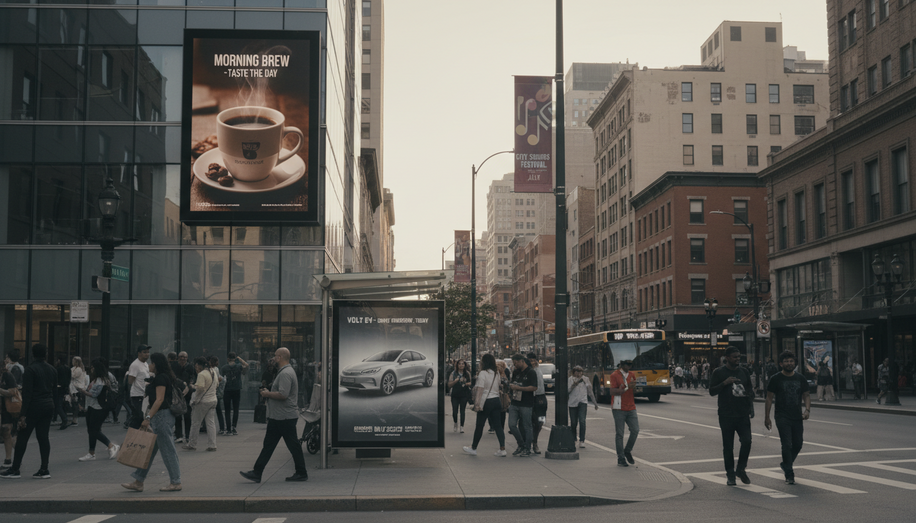

In the dynamic world of out-of-home (OOH) advertising, relying on a single format like traditional billboards limits a campaign’s potential to just a fraction of its audience’s daily journey. Multi-format planning, which integrates diverse OOH channels such as billboards, transit ads, digital displays, and experiential installations, has become indispensable for maximizing reach and impact. By deploying varied formats strategically, brands ensure their message permeates multiple touchpoints, amplifying visibility and driving deeper engagement in an era where consumers navigate fragmented media landscapes.
This approach stems from the inherent strengths of OOH’s versatility. Traditional billboards excel in high-traffic highways, delivering massive reach to commuters and travelers with 24/7 exposure that builds broad brand awareness. Transit ads, placed in buses, subways, and stations, target urban dwellers during routine commutes, capitalizing on captive audiences who encounter the message repeatedly over time. Digital out-of-home (DOOH) screens add dynamism, allowing real-time content updates and geolocation-triggered relevance, which boosts engagement through interactive elements like QR codes. Large-format prints, such as banners and wraps, provide bold, weather-resistant visuals that convey complex narratives from afar, fostering emotional connections in high-visibility public spaces. Together, these formats create a synergistic network, where a roadside billboard sparks initial curiosity, subway ads reinforce the narrative, and DOOH prompts immediate action, guiding consumers along the path to purchase.
The data underscores why single-format campaigns fall short. Studies show that integrated OOH efforts using four or more channels outperform those with just two by up to 300%, thanks to heightened visibility and consistent messaging that strengthens brand recall. Consumers exposed to brands across multiple OOH touchpoints demonstrate higher response rates and conversion likelihood, as repeated, contextually tailored encounters build trust and loyalty. For instance, a campaign targeting young adults might pair college-nearby posters with trendy street digital signs and event tents, ensuring the message aligns with their habits—from campus walks to nightlife outings—far more effectively than isolated billboards.
Audience understanding drives this precision. Multi-format planning begins with dissecting target demographics’ behaviors: drivers favor highway billboards, public transport users respond to vehicle wraps, and event-goers engage with experiential formats. High-traffic placements amplify this, placing ads in bustling city centers or major roadways for unavoidable exposure to diverse demographics. Customizing content per format enhances impact—concise CTAs on fleeting transit views, detailed storytelling on expansive large-format signs, and animated bursts on DOOH—while maintaining consistent branding like logos and colors across all. This cohesion creates a unified brand identity, reinforcing the message wherever audiences turn, from commutes to shopping streets.
Beyond reach, multi-format strategies offer adaptability in today’s fast-evolving market. DOOH’s flexibility enables performance-based adjustments, such as swapping creatives based on real-time data from geolocation tools, optimizing spend without overhauling the entire campaign. Timing synchronization further elevates results: aligning peak-hour transit ads with evening DOOH blasts or seasonal highway displays capitalizes on lifestyle patterns, weather shifts, and events, embedding the message deeply into consumers’ routines. Unique identifiers like campaign-specific URLs or QR codes track cross-format attribution, revealing how a billboard view leads to a mobile scan, proving ROI with tangible metrics.
Cost-effectiveness seals the case. OOH’s low cost-per-impression, combined with multi-format scalability, delivers outsized returns compared to digital alternatives prone to ad fatigue or blockers. Large-format printing keeps production economical, enabling vibrant, durable materials for varied applications without prohibitive budgets. Campaigns gain resilience too—static formats weather storms while DOOH pivots digitally—ensuring uninterrupted presence that digital channels can’t match.
Critics point to challenges like measurement hurdles or premium placement costs, yet multi-format planning mitigates these through targeted selection and data integration, turning potential drawbacks into strengths. Brands like those leveraging public transport for niche audiences or highways for mass reach illustrate the transformation: from forgettable single blasts to memorable, multi-layered experiences that dominate the physical world.
Ultimately, in a landscape where consumers dodge online noise, multi-format OOH commands attention unapologetically. It doesn’t just advertise—it immerses, reaching people where they live, work, and play with tailored precision. For advertisers, skipping this evolution risks irrelevance; embracing it unlocks campaigns that don’t just reach audiences, but move them. As urban mobility and digital-physical hybrids evolve, multi-format planning stands as the cornerstone of OOH success, delivering unparalleled impact in an always-on world.
Blindspot directly addresses this imperative by providing the comprehensive data and tools essential for optimizing multi-format OOH strategies. Through advanced audience measurement, precise location intelligence, and real-time performance tracking across diverse OOH channels, it empowers brands to meticulously orchestrate integrated campaigns, tailor content per format, and measure cross-channel attribution with unparalleled clarity. This ensures every touchpoint contributes measurably to business objectives, turning the promise of multi-format OOH into quantifiable success. Learn more at https://seeblindspot.com/