
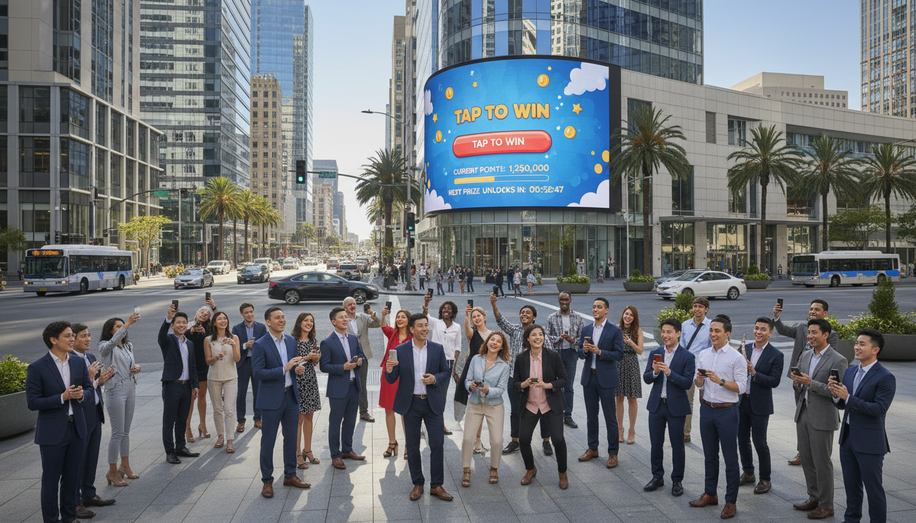

The out-of-home advertising landscape is undergoing a fundamental transformation. Rather than treating sidewalks, transit stations, and public spaces as static billboards, brands are reimagining these environments as interactive playgrounds where audiences become active participants rather than passive observers.
Gamification and Out-of-Home Advertising: The Strategic Shift
Gamification—the integration of game mechanics into non-game contexts—has emerged as a powerful tool for revitalizing outdoor advertising. By incorporating elements like challenges, rewards, and competition, brands are converting fleeting moments of pedestrian attention into meaningful brand interactions. The approach addresses a critical challenge in OOH advertising: in an increasingly saturated media landscape, static visuals struggle to break through the noise and command engagement.
When executed effectively, gamified OOH campaigns tap into intrinsic human motivations. Audiences want surprise, interaction, and a sense of control—elements that traditional outdoor advertising fails to deliver. By providing these experiences, brands transform passive viewing into active participation, generating measurable engagement metrics and social amplification in the process.
Real-World Applications Driving Results
Leading brands have demonstrated the effectiveness of gamified OOH across diverse sectors and geographies. Nike’s “Reactland” campaign invited pedestrians to participate in an AR-powered running game on city sidewalks, where users could race digital avatars while testing new products. The activation generated substantial social engagement and measurable product trial lift, proving that entertainment and marketing objectives can align seamlessly.
Netflix’s promotion for “Stranger Things” leveraged QR-coded sidewalk markers across major U.S. cities, creating a gamified scavenger hunt that led fans to physical prize locations through sequential AR clues and character animations. The campaign succeeded because it combined the mystery and social nature of games with the geographic specificity of OOH media, encouraging fans to share their experiences organically.
Financial institutions have also adopted this approach. The Rizal Commercial Banking Corporation designed an interactive digital OOH installation in Manila featuring a loan calculator and financial literacy puzzles, demonstrating how gamification can educate while entertaining. Similarly, Mondelēz International’s Oreo campaign in London used gamified digital displays in transit environments to encourage mobile app downloads, directly linking outdoor experiences to digital ecosystem engagement.
The Technology Behind Engagement
Modern gamified OOH campaigns leverage multiple technological innovations. Augmented reality transforms physical placements into portals for immersive brand stories—3D characters can interact with users on smartphone screens, virtual try-ons enable product experimentation, and AR product demonstrations bring services to life. Meanwhile, facial analytics technology, as demonstrated by GMC’s Acadia campaign, enables personalized content delivery based on audience demographics, allowing digital displays to show targeted messaging from dozens of variations based on real-time viewer analysis.
QR code integration remains fundamental, providing a frictionless bridge between physical and digital experiences. Dynamic QR codes enable precise tracking of traffic, clicks, engagement, and conversions, transforming what was once an unmeasurable medium into a data-rich channel. This measurability has been crucial in demonstrating ROI to skeptical marketers accustomed to traditional OOH’s attribution challenges.
Strategic Advantages for Brands
The benefits extend beyond entertainment value. Gamified OOH campaigns generate deeper engagement as users spend extended time interacting with content—a significant advantage in a medium traditionally measured in seconds. Movement, play, and tangible rewards strengthen memory formation and brand recall. Perhaps most importantly, these campaigns generate community buzz, with locals discussing unexpected experiences and sharing them across social networks, creating organic reach amplification among non-participants.
The hyperlocal nature of sidewalk and transit advertising, combined with gamification’s inherent shareability, creates a compounding effect. A single installation in a high-foot-traffic zone can generate awareness far beyond its physical footprint through social media distribution and word-of-mouth amplification.
As outdoor advertising continues evolving, gamification represents more than a tactical innovation—it reflects a fundamental shift toward consumer participation as the foundation of effective brand communication. By respecting audience autonomy and desire for entertainment, brands are discovering that OOH’s greatest power lies not in interruption, but in invitation.
As out-of-home evolves into an interactive and measurable medium, demonstrating the precise impact of gamified campaigns becomes crucial. Blindspot empowers brands to move beyond estimation, providing real-time performance tracking and robust ROI measurement and attribution for these dynamic OOH experiences. This ensures marketers can confidently prove the value of their innovative, engaging strategies, transforming pedestrian attention into quantifiable results. https://seeblindspot.com/