
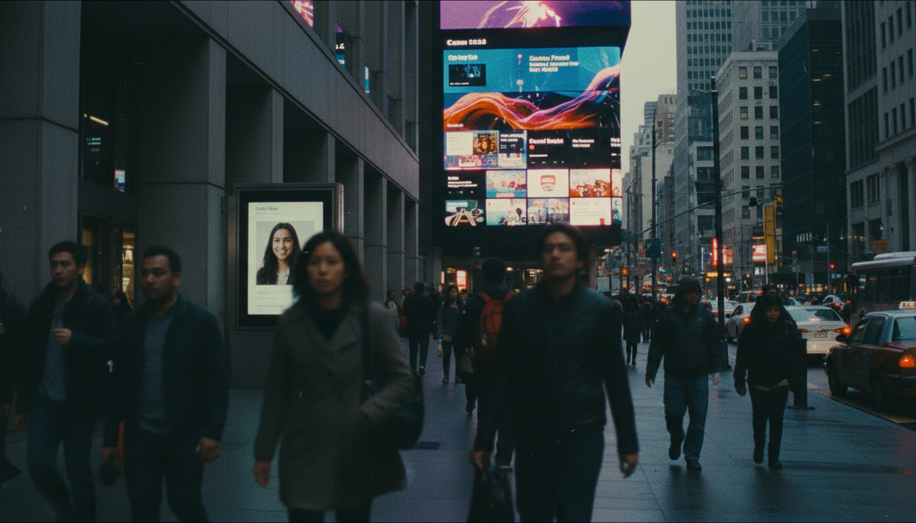

The streaming wars have fundamentally transformed how audiences consume entertainment, yet the challenge of breaking through ad clutter remains as persistent as ever. Streaming platforms and content producers increasingly recognize that a single-channel approach to promotion leaves significant audience engagement opportunities untapped. The strategic integration of out-of-home advertising with connected TV campaigns has emerged as a transformative solution, creating a dual-channel ecosystem that captures consumer attention both at home and throughout their daily lives.
Connected TV has revolutionized advertising measurement and targeting, offering unprecedented insights into viewer demographics, engagement rates, and conversion metrics. However, this digital precision alone cannot overcome a fundamental limitation: consumers spend considerable time outside their homes, traveling to work, shopping, dining, and navigating public spaces. This is where out-of-home advertising becomes not merely complementary but essential. By combining CTV’s measurable targeting capabilities with OOH’s ability to reach consumers in real-world environments, streaming platforms can create a cohesive marketing ecosystem that maintains consistent brand presence and messaging across multiple touchpoints.
The synergy between these channels delivers measurable impact. Research indicates that campaigns pairing OOH with other media experience significant lift, with TV campaigns complemented by OOH seeing a 21 percent increase in return on investment compared to TV-only efforts. For streaming services specifically, the results prove compelling. A streaming platform that integrated OOH advertising into its brand awareness campaign achieved a 20 percent lift in consumer awareness and a 22 percent increase in purchase consideration among exposed audiences. These metrics demonstrate that OOH’s real-world presence directly translates to measurable business outcomes.
The mechanics of this synergy center on strategic repetition and contextual relevance. A television advertisement introducing a new show creates initial awareness and emotional connection, establishing the narrative foundation within viewers’ homes. Simultaneously deployed OOH campaigns—particularly in high-traffic urban areas frequented by the platform’s target demographic—reinforce this message during commutes, shopping trips, and weekend activities. This multi-faceted exposure combats recency decay, the phenomenon where consumers quickly forget advertisements after initial exposure. When audiences encounter reinforcing brand messages in different environments, brand recall strengthens substantially, translating to higher tune-in rates when new content launches.
Modern programmatic digital out-of-home technology amplifies this advantage further. Unlike static billboards, DOOH campaigns can update in real time, displaying location-specific information about content availability, premiere dates, and platform updates. A streaming service might deploy DOOH ads near entertainment venues that change messaging based on local event schedules, or ads near transit hubs that vary timing announcements according to commuter patterns. This dynamic capability ensures messaging remains perpetually relevant, maximizing audience engagement potential.
The measurement sophistication that made CTV attractive to advertisers now extends to OOH through advancing technology. Geo-fencing and demographic data integration enable precise tracking of which audiences see OOH advertisements and whether exposure correlates with subsequent streaming engagement. This attribution clarity eliminates the guesswork previously associated with out-of-home advertising, allowing streaming platforms to optimize campaigns based on concrete performance data. When marketers can trace consumer journeys from OOH exposure through platform engagement and content consumption, they gain competitive intelligence that informs future campaign strategy.
Creative execution becomes paramount in maximizing this synergy. Successful dual-channel campaigns maintain visual and narrative consistency across both CTV and OOH placements, reinforcing brand identity and message retention. The most effective approaches leverage the distinct strengths of each medium—television’s storytelling capacity and OOH’s visual impact in high-attention environments—rather than simply repeating identical creative across channels.
The integration of compelling video content within OOH environments further enhances effectiveness. Research shows that 64 percent of viewers prove more likely to engage with advertisements when paired with entertainment content in out-of-home settings, while 89 percent of people notice content-heavy CTV OOH screens. This engagement cuts through advertising fatigue and creates memorable brand interactions that extend beyond passive viewing.
As streaming platforms navigate increasingly competitive markets, the OOH-CTV integration represents more than tactical efficiency. It fundamentally reimagines how brands reach audiences by acknowledging that consumer attention spans both digital and physical spaces. By orchestrating coordinated campaigns across these channels, streaming services amplify viewership potential, strengthen brand recall, and drive measurable tune-in—transforming how audiences discover and engage with new content in an increasingly fragmented media landscape.