
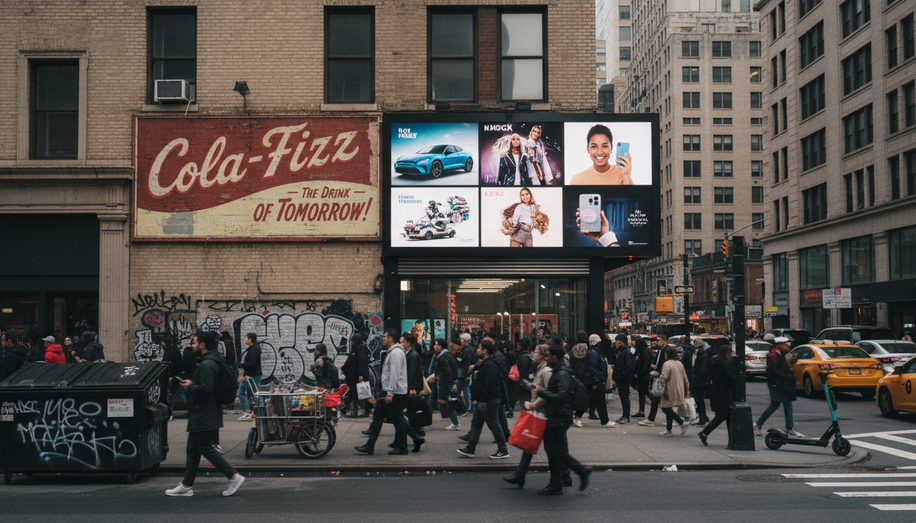

Long before neon lights flickered or pixels danced across massive screens, out-of-home advertising captured the public’s gaze with simple, bold strokes. Ancient Egyptians carved stone obelisks around 3000 BC to proclaim laws and announcements, laying the groundwork for messages etched into the public realm. Vendors in early civilizations dangled signs from shops, hawking wares with rudimentary symbols that evolved into the vibrant spectacles dominating cityscapes today. This enduring medium, now known as OOH, has mirrored societal shifts, from hand-painted proclamations to digital marvels, proving its resilience as a cornerstone of mass communication.
The modern era ignited in the 19th century, fueled by printing revolutions. Johannes Gutenberg’s 1450 invention of movable type democratized printed materials, but it was the 1796 perfection of lithography—using smooth stone or metal plates—that birthed the illustrated poster. By 1835, Jared Bell plastered New York with the first large-format outdoor poster, hyping a circus spectacle and setting a precedent for spectacle-driven promotion. Street railways soon bore exterior ads by 1850, while leased billposting boards emerged in 1867, spawning nearly 300 posting companies by 1870. Icons like Palmolive, Kellogg, and Coca-Cola jumped in, mass-producing billboards for national reach, transforming walls into branded battlegrounds.
Industry maturation followed swiftly. In 1872, the International Bill Posters’ Association of North America formed, professionalizing the trade. By 1891, it evolved into the precursor of today’s Outdoor Advertising Association of America (OAAA), enforcing standards amid explosive growth. Hand-painted murals dominated: artisans meticulously crafted vibrant scenes on wooden boards, their brushes conjuring everything from soap suds to soda fizz. These weren’t mere ads; they were public art, drawing crowds and embedding brands in collective memory. Howard Johnson’s 1929 billboards near Boston epitomized this, fueling his roadside empire as motorists zipped by.
The 20th century brought mergers, measurement, and milestones. In 1925, the Poster Advertising Association merged with the Painted Outdoor Advertising Association to birth the OAAA, while the Fulton Group and Cusack Co. fused into General Outdoor Advertising Company—the first major consolidation. An educational committee launched in 1913 urged public service ads, a tradition persisting today. The 1934 Traffic Audit Bureau introduced audience data, quantifying eyeballs on the hustle. Bus shelters debuted in 1962, funded purely by ad revenue, dotting urban veins.
Regulation tempered expansion. President Lyndon Johnson’s 1965 Highway Beautification Act curbed billboards on interstates, confining them to commercial zones with strict size, lighting, and spacing rules—a blow that spurred innovation. Wars amplified OOH’s voice: billboards rallied support or peddled peace, while a 1972 tobacco broadcast ban funneled cigarette pitches outdoors. Effectiveness got scientific proof in 1975, when Outdoor Advertising Inc. blanketed boards with newly crowned Miss America Shirley Cochran. Her name recognition skyrocketed 940%, silencing skeptics and affirming OOH’s punch.
The 1970s ushered vinyl sheets, ditching paint for durable wraps that slashed maintenance and boosted vibrancy. Digital whispers began in the 1990s, but explosion hit post-2000. Arbitron and Nielsen tested ratings in 2002; by 2005, inaugural digital networks lit up. Static gave way to dynamic: screens swapped messages in real time, dayparted by hour, tailored to weather or traffic. A 2010 shift to ecoflex posters cut paper waste, greening the industry. DOOH formats proliferated—digital billboards, transit screens in buses and stations, airport networks, even 3D LED immersions—blending data with dazzle for hyper-targeted hits.
Iconic moments punctuate this arc. Coca-Cola’s early bulletins quenched national thirsts; tobacco’s 1999 OOH exile reshaped venues. Mergers like Clear Channel’s 1997 gobble of Patrick Media scaled operations. Yet OOH’s soul endures: unskippable, larger-than-life, it commands attention in an ad-saturated world. From Egyptian stones to algorithmic spectacles, it has adapted without fading, funding public amenities while shaping culture.
Today, as programmatic buying and AI refine placements, OOH thrives. Digital spectacles rotate campaigns instantly, measure impressions precisely, and fuse with mobile for closed-loop attribution. Hand-painted murals, once labor-intensive relics, inspire hybrid art-tech fusions in street activations. Through plagues, wars, and tech upheavals, OOH remains public communication’s unbreakable thread—bold, immediate, and omnipresent. Its history whispers a truth: in a fleeting digital age, nothing beats a message that meets you where you live, work, and wander.