
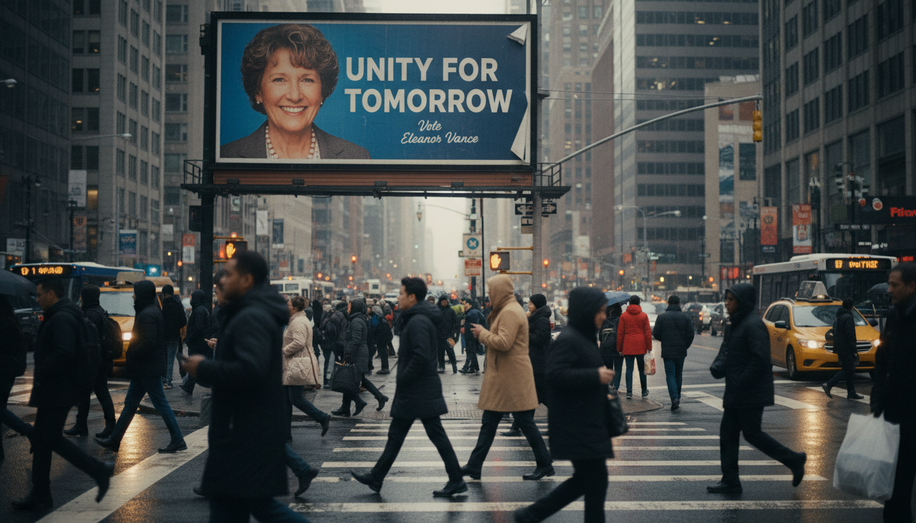

In the heat of election cycles, out-of-home (OOH) advertising emerges as a street-level powerhouse, blanketing billboards, bus shelters, and transit hubs with bold political messages that cut through digital noise. Unlike the fragmented world of streaming video or social media feeds, OOH reaches 91% of active voters weekly as they drive, commute, or navigate public spaces, making it an indispensable tool for campaigns aiming to dominate public discourse. This visibility surge propelled OOH ad revenue to $2.78 billion in the second quarter of 2024 alone, fueled by political spenders who recognize its unmatched ability to engage voters in real-world contexts.
Yet deploying OOH in political battles presents distinct challenges. Traditional TV, long the king of political ads, faces eroding viewership—down over 7%—and skyrocketing costs, with average cost-per-viewer rising from $304 in 2020 to $349 by 2023. OOH counters this with superior efficiency: in the top ten designated market areas, it delivers 4.6 times better cost-per-thousand impressions than TV, according to GeoTrak and SQAD data. Still, campaigns must grapple with placement precision. Historical reliance on U.S. Census data for targeting has faltered, with the 2020 count underrepresenting minorities, skewing outreach to key demographics. Enter data-driven alternatives: programmatic OOH platforms now pull from fresh digital audiences—surveys, online behaviors, and location visits—enabling real-time tweaks to messaging and geo-fencing ads to precise districts, minimizing waste in an era of tightening location data regulations.
Strategic innovation amplifies OOH’s edge. Programmatic buying offers agility, allowing campaigns to pivot from persuasion to get-out-the-vote (GOTV) efforts overnight, a flexibility TV cannot match. During the 2022 midterms, which shattered records with $10 billion in total ad spend, OOH captured just $28 million—a modest slice, yet one generating recall rates rivaling pricier channels. Fast-forward to 2024, and OOH’s growth accelerated, with 68% of likely voters encountering political OOH ads and 50% seeing one in the past month alone, indexing highest among younger, educated, higher-income groups. A Morning Consult survey for the Out of Home Advertising Association of America found 49% of exposed voters deeming these ads personally influential, with 56% expressing trust—figures that outpace social media and match broadcast TV.
This potency stems from OOH’s unfiltered reach: it blankets highways, gyms, and mass transit, ensnaring audiences TV misses amid cord-cutting trends. In contrast to online ads, where $1.9 billion flowed through Meta, Google, Snap, and X in 2024—often laced with negative tones from parties and super PACs—OOH thrives on stark, unavoidable visuals that spark discourse without algorithmic silos. Republicans leaned into candidate promotion and GOTV (23% of spend), while Democrats chased fundraising (38%), but OOH levels the field by hitting everyone in motion. Digital out-of-home (DOOH) variants push further, projecting dynamic content in airports and stadiums with 48% recall rates, transforming static bulletins into responsive advocacy tools.
Ethical quandaries shadow these triumphs. OOH’s inescapability—plastered across public realms—raises questions of coercion in a polarized age. While 53% of voters find OOH ads informative, akin to newspapers, its placement in transit and urban cores can feel omnipresent, potentially amplifying misinformation or attack ads without the counterbalance of online fact-checks. Regulations lag behind digital platforms, leaving gray areas on disclosure for super PAC-funded boards that dwarf candidate efforts. Campaigns must weigh this: does ubiquitous exposure foster civic engagement or voter fatigue? Moreover, equitable targeting remains elusive; undercounted groups risk sidelining, perpetuating representational gaps unless data tools evolve inclusively.
Strategic best practices demand balance. Successful OOH leans on location-based precision—transit ads for commuters, bulletins for highways—to mirror voter flows, as post-pandemic travel rebounds. Pairing with CTV or social amplifies impact, but OOH’s true strength lies in branding: 86% recall seeing products from OOH within six months, a breakthrough metric amid ad blindness elsewhere. For 2026 cycles, expect DOOH’s share to swell toward 42% of OOH spend by 2029, with programmatic hitting $1.35 billion, empowering hyper-local GOTV amid fragmented media.
Ultimately, OOH reframes the campaign trail as a literal street fight, where bold visuals ignite public debate. Its challenges—data accuracy, regulatory voids—pale against rewards: trusted influence on undecideds, unskippable persuasion, and a democratic pulse check in shared spaces. As ad dollars chase voters, OOH stands resilient, decoding politics one billboard at a time. Blindspot directly addresses the critical challenge of precise, data-driven targeting by leveraging its audience measurement and analytics to identify and reach diverse voter segments more equitably. Through advanced location intelligence and programmatic DOOH campaign management, it empowers campaigns to deploy messages with unparalleled precision, ensuring every dollar maximizes impact and minimizes waste across vital public spaces. https://seeblindspot.com/