
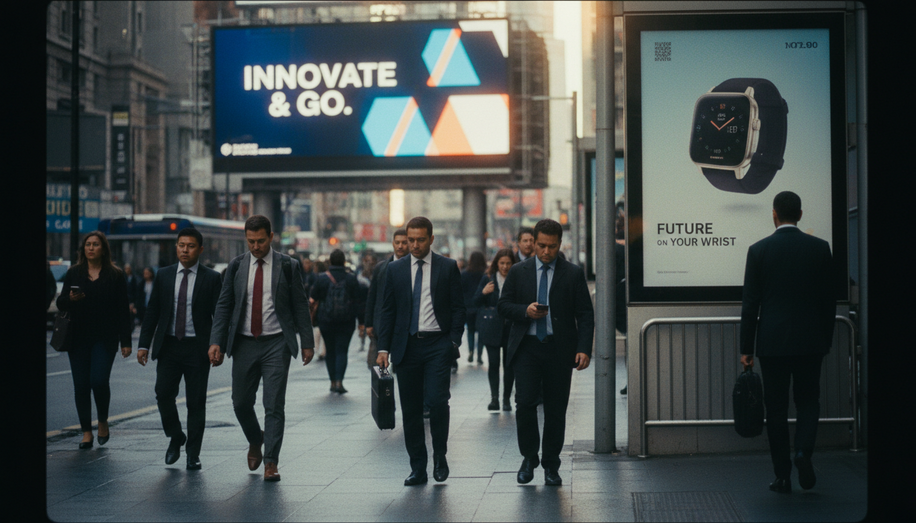

In the bustling corridors of urban centers, where executives stride purposefully between meetings and commuters navigate crowded transit hubs, out-of-home (OOH) advertising emerges as a potent weapon for B2B marketers aiming to capture the attention of elusive decision-makers. Far from the scattershot billboards of yesteryear, today’s OOH strategies leverage precise placement, data-driven targeting, and seamless integration with digital channels to infiltrate the daily routines of business professionals, fostering top-of-funnel awareness that amplifies account-based marketing (ABM) efforts.
Urban landscapes offer a goldmine of opportunities for B2B brands to position their messages where decision-makers cannot avoid them. Consider the daily commute: highways and thoroughfares snaking through cities like San Francisco, Denver, or Austin see dense flows of office-bound traffic, providing ideal canvases for eye-catching billboards with succinct, compelling messaging. These placements ensure repeated exposure—morning inbound, evening outbound—embedding brands in the subconscious of C-suite commuters who absorb information in fleeting glances. One effective evolution is “surround sound” advertising, where billboards cluster near target company headquarters or along key routes, creating inescapable visibility that reinforces ABM tactics without the one-to-one personalization of digital ads.
Transit-heavy environments amplify this reach even further. Airports, taxis, and shuttles servicing business districts deliver ads directly to traveling executives, while street-level formats like bus wraps and transit shelters intercept professionals en route to client meetings or industry events. A legal technology firm, for instance, deployed transit billboards circling conference hotspots, yielding a 329% ROI and 2.2 times its social share goals by timing exposures to pre- and post-event hours. Similarly, fintech company Brex blanketed key markets with OOH during post-pandemic reopenings, targeting residential and spending zones of former commuters to drive massive top-of-mind awareness at a fraction of digital costs.
Place-based OOH takes precision to indoor frontiers, infiltrating the very workspaces of decision-makers. Elevators in office towers, vending machines in corporate lobbies, and digital screens in high-rise atriums integrate brands into daily rituals, turning mundane moments into branded encounters. These environments, often overlooked in favor of outdoor spectacles, establish a persistent presence amid the professional grind, where executives spend hours deliberating procurement and partnerships.
For B2B campaigns, events and tradeshows represent high-stakes battlegrounds. With industry gatherings rebounding—drawing niche audiences of decision-makers—OOH follows attendees seamlessly: airport displays upon arrival, freeway billboards to venues, hotel integrations, and taxi wraps circling event perimeters. This “event journey” mapping ensures sustained visibility, capitalizing on heightened receptivity when professionals are immersed in sector-specific conversations.
Technological advancements supercharge these strategies, debunking myths of OOH as imprecise “spray-and-pray.” Programmatic OOH (pOOH) automates real-time ad buys using mobility data, geofencing, and proximity targeting to map where decision-makers live, work, and gather. Platforms draw from over 100 data sources to pinpoint optimal slots, adjusting for weather, time, or audience flows. SaaS innovators Mutiny and Ramp exemplified this by transforming a LinkedIn post from a Snowflake executive into a Times Square billboard, securing instant attention from the target account.
Retargeting bridges OOH’s physical impact to digital precision. Exposure to a billboard triggers follow-up via connected platforms, delivering personalized bottom-funnel messages across email, social, or search—extending campaign lifespan and conversion potential. QR codes on static or digital OOH (DOOH) ads invite immediate scans, funneling viewers to landing pages tailored for busy professionals.
Measurement, once OOH’s Achilles’ heel, now rivals digital rigor. Brands track branded search lift in ad zones versus controls, spikes in website traffic, and even pipeline acceleration post-exposure. Smart attribution links offline impressions to online actions, with platforms reporting over 90% ROI satisfaction and double-digit conversion boosts. This data validates OOH’s role in B2B funnels, proving its cost-effectiveness amid digital fatigue.
Yet success demands strategic restraint over blanket coverage. Effective planning hinges on analyzing movement patterns, peak times, and contextual relevance—near HQ for ABM reinforcement, commuter paths for awareness, events for intent capture. In urban jungles overloaded with digital noise, OOH cuts through as a tangible, unskippable touchpoint, humanizing brands amid abstract online barrages.
For B2B marketers, OOH is no relic but a revitalized channel, surgically reaching decision-makers in their natural habitats. By blending hyper-local placement, programmatic smarts, and cross-channel synergy, it not only builds awareness but propels leads through the funnel. In cities pulsing with professional ambition, the right OOH strategy turns passersby into prospects, one strategic glance at a time.