
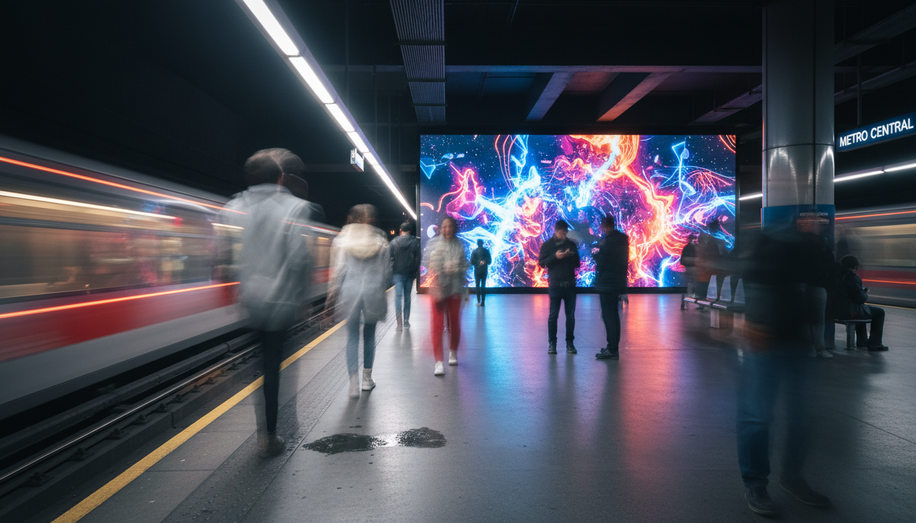

In the bustling heart of a city, where pedestrians weave through crowds and vehicles pulse like arteries, an outdoor advertising screen flickers to life. No longer a static canvas of forgotten slogans, it pulses with relevance, swapping icy beverage promotions for hot coffee ads as the morning chill gives way to midday warmth. This transformation is powered by IoT sensors, the unseen force quietly revolutionizing digital out-of-home (DOOH) advertising by harvesting real-time environmental data to deliver hyper-relevant content.
IoT sensors—compact devices that detect changes in temperature, traffic flow, crowd density, lighting, and even weather patterns—serve as the eyes and ears of modern billboards. Embedded in or around displays, they collect data continuously, feeding it into cloud platforms or edge computing systems that trigger content changes in seconds. For instance, sensors monitoring pedestrian footfall can gauge crowd density, prompting a screen to cycle through high-energy event promotions during peak hours or switch to serene wellness ads in quieter moments. Traffic sensors, often paired with cameras, track vehicle volumes and speeds, optimizing messages for commuters stuck in gridlock—perhaps flashing drive-thru deals when cars pile up nearby.
This dynamic capability marks a seismic shift from traditional OOH, where ads were locked in weeks ahead, blind to the moment’s context. DOOH with IoT turns billboards into responsive storytellers. Consider weather sensors: on scorching afternoons, they detect rising temperatures and cue ads for chilled drinks or sun protection, as McDonald’s did across London bus stops and tube stations. Mid-morning, the same screens promoted breakfast menus; by afternoon heat, they pivoted to ice cream sundaes, blending time-of-day data with atmospheric readings for precision targeting. Such adaptability not only boosts engagement but also elevates return on investment, as content aligns precisely with viewer needs.
Real-world deployments underscore the technology’s maturity. In Tokyo, the DeepAd Project equipped roadside billboards with IoT devices and AI analytics to identify vehicles from 350 meters away with 94% accuracy. Luxury sedans triggered premium brand ads, family minivans summoned kid-friendly promotions, and economy models drew budget offers—all shifting seamlessly as traffic evolved. Meanwhile, Outdoorlink’s Smart Controller integrates sensors for environmental responsiveness, automatically dimming brightness in low light or ramping it up against glaring sun, while preempting weather disruptions like heavy rain. Operators manage fleets from a central dashboard, slashing maintenance trips and energy costs by alerting teams to issues before downtime hits.
Beyond reactivity, IoT fosters deeper interactivity. Smart cameras with object recognition—detecting pedestrians, vehicles, attire, or even estimated demographics—layer audience insights onto environmental data. A billboard near a stadium might sense surging crowd density pre-game and blast ticket upsells or concessions, then pivot to post-event traffic alerts. Atmospheric sensors add nuance, such as humidity levels signaling rain gear promotions or pollution readings prompting air quality product ads in urban hotspots. Privacy-conscious implementations, like those from Soracom, employ edge AI for on-device anonymization, counting exposures without storing personal images, ensuring compliance amid growing data regulations.
The advantages ripple outward. Energy efficiency soars as sensors optimize power usage—fading screens at night or in poor visibility—cutting operational costs by up to 30% in some cases. Campaign performance sharpens through granular analytics: dwell times, demographic rotations, and conversion correlations reveal what resonates, enabling advertisers to refine strategies on the fly. Monster Media, a DOOH specialist, leverages IoT for global networks in stadiums, transit hubs, and hotels, powering interactive campaigns for brands like Coca-Cola that respond to live events or foot traffic spikes.
Challenges persist, of course. Integration demands robust networks—cellular modems like Soracom’s Onyx ensure reliable connectivity in remote or high-mobility spots—and structural monitoring via wireless sensor networks (WSN) safeguards massive boards against wind or vibration risks. Data overload risks irrelevance if algorithms falter, but AI refinements are closing that gap.
Looking ahead, IoT’s fusion with smart cities amplifies potential. Billboards could sync with municipal sensors for event-tied messaging, emergency broadcasts, or transit data, blurring lines between advertising and urban utility. Taxi-top screens already pulse location-based ads via IoT connectivity, drawing eyes with HD relevance. As 5G and edge computing proliferate, expect hyper-personalization without privacy pitfalls—think anonymized crowd moods triggering uplifting content during rush-hour slogs.
Ultimately, IoT sensors elevate OOH from interruption to intuition. They render the invisible visible: the sway of crowds, the bite of cold, the crawl of traffic. In doing so, they don’t just deliver ads—they anticipate desires, forging connections that linger long after the screen fades. For advertisers, this unseen force isn’t a luxury; it’s the new standard, turning every glance into opportunity. Blindspot complements this evolution by offering advanced programmatic DOOH campaign management to deploy hyper-relevant content dynamically, while its robust audience measurement and real-time performance tracking capabilities provide the precise insights needed to optimize strategies and maximize ROI. This empowers advertisers to fully leverage IoT-driven intelligence, ensuring every interaction with urban audiences is impactful. Learn more at https://seeblindspot.com/