
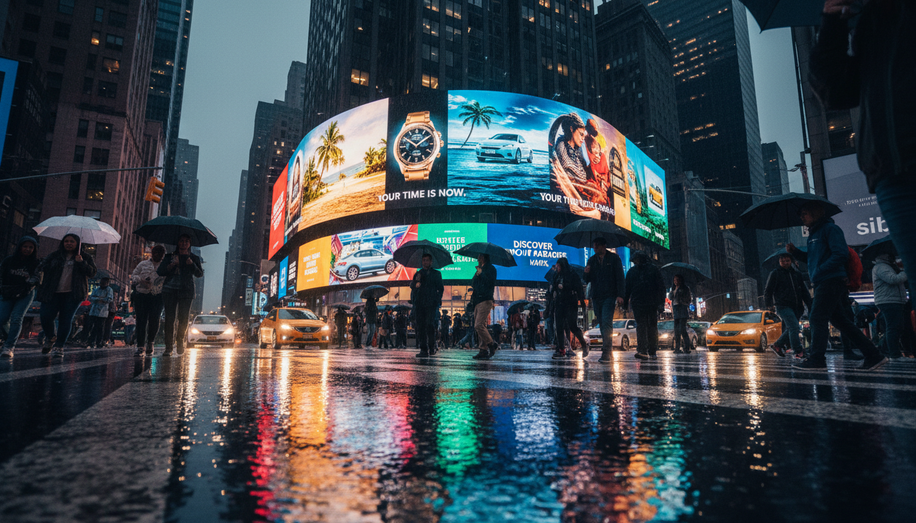

Artificial intelligence has fundamentally transformed how outdoor-of-home (OOH) advertisers approach creative development and campaign execution in 2026, shifting the industry from static, one-size-fits-all messaging to dynamic, contextually aware advertising that adapts in real time. This evolution represents a watershed moment for an industry that has long struggled with measurement and relevance, as AI-powered systems now enable brands to optimize every element of their creative strategy with precision previously available only in digital channels.
The traditional billboard—a static canvas locked into a predetermined message for weeks or months—has given way to a fundamentally different beast. AI tools now analyze real-time conditions such as weather patterns, event schedules, traffic flow, and trending topics to automatically adjust creative content for maximum resonance. A sunscreen brand might see its messaging automatically promoted on a sunny afternoon, while the same billboard switches to highlighting delivery options during evening commute hours. This isn’t speculative optimization; it’s algorithmic adaptation grounded in live environmental data.
What makes this shift particularly significant is how AI handles the dual challenge of personalization at scale and creative excellence. Historically, these objectives existed in tension. As the industry moved toward programmatic DOOH and data-driven placements, critics worried that algorithmic efficiency would cannibalize creative quality. Yet the evidence emerging from 2026 suggests a different outcome. AI is handling the manual, less-creative optimization work—bid management, placement timing, technical scheduling—while simultaneously providing creative teams with contextual intelligence that elevates their work. Consider that AI can simulate how a specific creative executes under varying conditions: how it performs in morning commute lighting versus evening darkness, in rain versus sunshine, when commuters are walking versus driving. This contextual granularity allows human creative teams to craft variations and messaging that account for real-world variables at a scale impossible through traditional production cycles.
The creative production landscape has shifted dramatically as well. During the 2026 Super Bowl, several brands embraced generative AI in their advertising production, with industry estimates suggesting that 50% or more of spots incorporated AI in some capacity. Artlist.io demonstrated the speed advantage by creating an entire broadcast-quality 30-second spot in just five days using AI tools, while Svedka produced what was described as the first “primarily” AI-generated national Super Bowl spot. These examples illustrate a maturation curve that accelerated throughout 2025 and crystallized in 2026: AI can now handle significant portions of creative production with meaningful human direction, though most industry leaders emphasize that the most effective approach keeps humans responsible for curation, refinement, and final creative decisions.
Interactive and immersive technologies are pushing the boundaries of what OOH creative can accomplish. Augmented reality overlays, 3D displays, and motion-sensing screens are transforming billboards from passive backdrops into participatory experiences. These interactive formats increase dwell time by 20 to 40 percent, fostering deeper brand relationships and generating shareable social moments that amplify campaign reach far beyond the physical location. When combined with AI-driven optimization, these immersive experiences become not just engaging but strategically targeted—delivering 3D anamorphic visuals in high-traffic areas where they’re most likely to capture attention.
Perhaps the most profound shift involves how OOH is now measured and justified within broader media strategies. Digital signage platforms equipped with AI and sensor data can tailor content to individual viewers, increase engagement, and prevent downtime through self-healing capabilities. This measurability has begun breaking down longstanding barriers between OOH and other premium media channels. As one industry leader noted, the sector is finally positioned to “break the 5% barrier” of total media budget allocation, earning its seat alongside digital channels through widespread attribution improvements and programmatic advancement.
The integration of AI into OOH creative represents more than technological progress. It reflects a fundamental recognition that attention in 2026 is earned through relevance, not volume. By combining human creativity with machine intelligence, the industry is delivering billboard messages that feel less like interruptions and more like genuinely useful information at precisely the moment audiences need it most.
For brands navigating this intelligent OOH landscape, platforms like Blindspot become indispensable. By leveraging programmatic DOOH campaign management, precise audience measurement, and granular ROI attribution, Blindspot empowers advertisers to orchestrate dynamic content in real time and demonstrate the true impact of their contextually relevant campaigns, finally solidifying OOH’s position as a premium, measurable media channel. Learn more at https://seeblindspot.com/.