
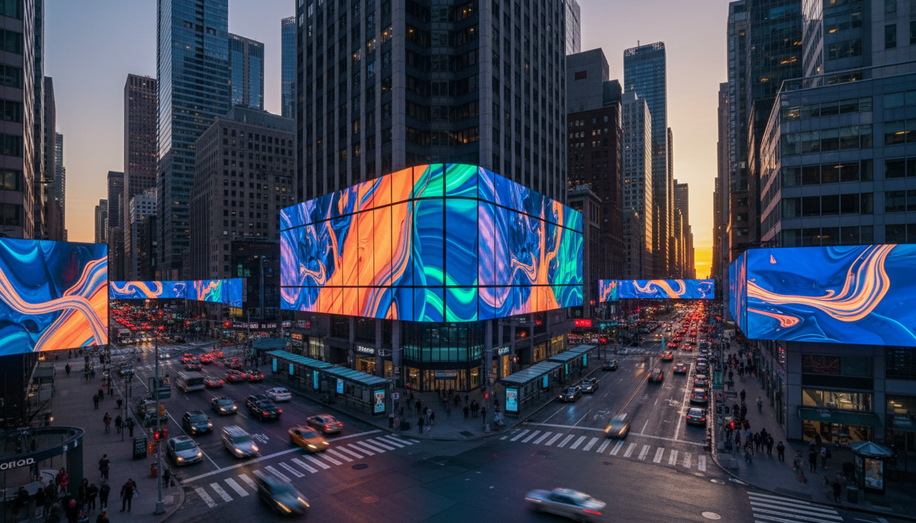

In an era where consumer attention fragments across countless digital platforms, outdoor advertising has emerged as a powerful medium for telling stories that unfold over time and space. Rather than treating each billboard or transit ad as an isolated message, forward-thinking brands are crafting narrative arcs that evolve across multiple touchpoints within urban environments, transforming passive viewing moments into active discovery experiences.
The shift represents a fundamental evolution in how outdoor advertising functions. Traditional OOH campaigns relied on a single, static message—a striking visual and a memorable tagline designed to make an immediate impact. But today’s most effective campaigns embrace what industry professionals call transmedia storytelling, where a brand’s narrative unfolds sequentially across different locations, formats, and even digital channels. A mysterious billboard in one neighborhood might introduce a character or mystery, while a bus shelter advertisement miles away reveals the next chapter, and a QR code connects viewers to an augmented reality experience or social media account that deepens the storyline.
Why does this approach work so effectively? The answer lies in human psychology. People are naturally drawn to unresolved narratives—we crave the satisfaction of discovering what comes next. When brands design campaigns with intentional cliffhangers and sequential reveals, they create a compelling reason for audiences to remain engaged beyond a single exposure. This extended engagement directly translates to measurable business outcomes. Studies show that narrative-driven outdoor campaigns significantly increase ad recall compared to traditional approaches. More importantly, they foster emotional connections that transform passive viewers into active participants in the brand story.
The technical infrastructure supporting these campaigns has evolved considerably. Modern OOH marketers leverage QR codes, near-field communication chips, augmented reality filters, and geolocation technology to seamlessly transition audiences from physical advertisements to digital experiences. A digital screen at a transit hub might display only a teaser of a film’s backstory, inviting viewers to unlock the full narrative through a mobile app. An interactive bus shelter could feature a riddle connected to a branded online game. These touchpoints aren’t merely advertisements—they’re gateways to larger, interconnected worlds that audiences can explore on their own terms.
The strategic advantage becomes apparent when examining real-world application. For younger, digitally native audiences in particular, this approach proves far more effective than traditional interruption-based advertising. Rather than demanding attention, transmedia campaigns invite exploration and participation, allowing consumers to discover content organically. This shift from push to pull fundamentally changes the relationship between brand and audience, creating what feels like meaningful engagement rather than commercial intrusion.
Implementing this approach requires rethinking the traditional OOH planning process. Rather than selecting locations based solely on foot traffic and visibility metrics, brands must begin with the story itself—identifying the narrative arc, defining characters, and mapping conflict or mystery across campaign phases. Only then does the spatial strategy emerge: which locations in an urban environment will host which chapter? How will audiences discover the sequence? What role will each format play in advancing the narrative?
Successful execution demands that each campaign element—whether a billboard, transit ad, or interactive installation—contributes uniquely to the larger story rather than simply repeating the same message across formats. A poster might introduce visual mystery through an enigmatic image, while a follow-up advertisement elsewhere answers partially, and a social media element provides backstory. This additive approach creates a layered narrative experience where engaged audiences piece together the complete story across multiple exposures and platforms.
The timeframe also matters significantly. Transmedia storytelling in outdoor advertising isn’t a one-off promotional stunt but rather a sustained narrative arc designed to unfold over days or weeks. This extended timeline allows campaigns to build momentum, generate word-of-mouth discussion, and maintain audience interest across multiple seasonal periods or campaign phases.
As attention becomes increasingly scarce and valuable in urban environments, the brands winning consumer minds are those willing to invest in architecture of meaning rather than shouting the loudest. By crafting sequential, interconnected narratives across the urban canvas, forward-thinking marketers transform outdoor advertising from a medium of interruption into a medium of discovery—one that respects audience intelligence while creating genuinely memorable brand experiences.