
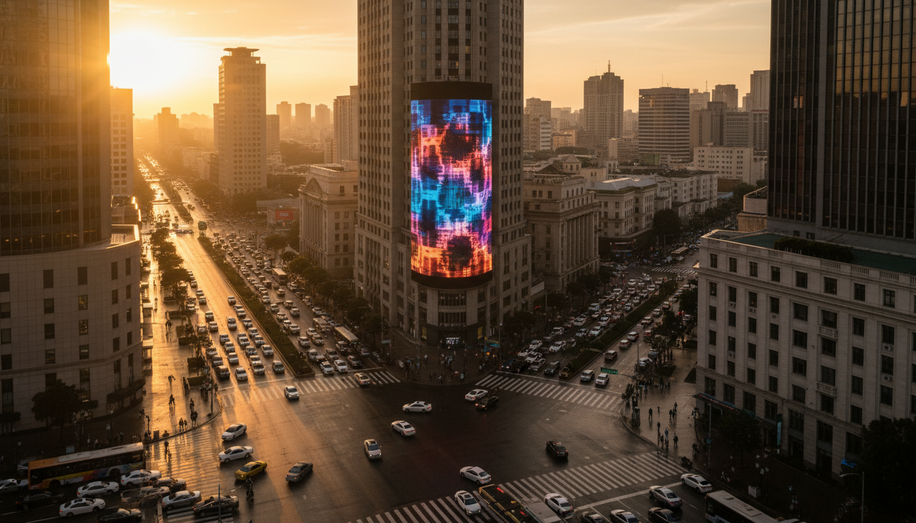

Artificial intelligence is fundamentally transforming how out-of-home advertisers create, test, and deploy campaigns at unprecedented speed and scale. Where traditional production workflows once required weeks of manual design iterations and coordination across multiple stakeholders, AI-powered systems are now enabling agencies and brands to generate thousands of contextually relevant creative variations in hours, fundamentally reshaping the economics and possibilities of outdoor advertising.
The most striking example of this transformation emerged when storage company PODS partnered with digital marketing agency Tombras to create what they called “the world’s smartest billboard.” Using Google’s Gemini AI platform, the team uploaded brand guidelines, marketing plans, and executive transcripts to train the system, then deployed it on a roving digital billboard across New York City. The result was extraordinary: as the truck navigated through all 299 of the city’s neighborhoods in just 29 hours, the AI generated over 6,000 unique headlines tailored to each location, adjusting messaging based on real-time inputs including weather, traffic conditions, and transit delays. Creating that volume of content manually would have been, as PODS’s VP of Brand and Media noted, “humanly impossible without AI.” The campaign drove a 60% increase in website visits, demonstrating that AI-generated creative can deliver measurable business impact.
Beyond headline generation, AI is accelerating the entire creative development cycle through rapid A/B testing and real-time optimization. Traditional out-of-home campaigns often locked in creative for extended periods, limiting the ability to test variations or respond to performance data. Modern AI systems enable brands to assess multiple message variations simultaneously, then make rapid decisions about which performs best or what adjustments might improve results. When one advertiser tested different logo sizes across campaigns, AI analytics allowed them to quickly identify which size performed consistently better and deploy that insight across their broader campaign.
The production efficiency gains extend beyond creative generation to encompass comprehensive campaign management. OneVision’s AI Billboard Validation platform exemplifies this evolution, using computer vision and artwork recognition to automate proof of posting and quality control across thousands of placements. Rather than manually verifying each installation photo, agencies and printers now receive instant automated feedback about whether artwork has been posted correctly and meets brand specifications. This shift from manual inspection to intelligent automation reduces workload while improving consistency and catching errors early, when they remain easy and inexpensive to correct.
Content versioning—creating multiple creative iterations suited to different contexts, times, and locations—represents another frontier where AI is creating new possibilities. With AI, advertisers can now deploy dynamic content that adjusts in real time based on contextual factors. Cold beverage advertisements can appear on hot days; retail promotions can highlight nearby stores during peak shopping hours. This responsiveness transforms out-of-home from a static medium into an adaptive one, where the same physical space can deliver different messages to different audiences at different moments.
The data infrastructure supporting these capabilities has evolved in parallel. Historically, audience measurement for outdoor advertising relied on estimated foot traffic averages, making campaign planning and ROI justification difficult. AI video analytics and computer vision systems now enable precise, real-time measurement of who actually sees advertisements, including demographic information and engagement signals. This transparency fundamentally changes how media planners justify outdoor advertising spend and optimize placements. Advertisers can now calculate accurate CPM rates, confirm they’re reaching their target demographics, and directly correlate DOOH exposure to measurable business outcomes like foot traffic and conversions.
Looking ahead, the convergence of AI, IoT, and advanced analytics suggests even more transformative possibilities. Smart cameras with facial recognition capabilities can track audience reactions, while atmospheric sensors add contextual performance data that informs creative rotation decisions. These developments point toward a future where outdoor advertising becomes increasingly intelligent, responsive, and accountable—a medium where AI handles the operational complexity of production and deployment, freeing creative teams to focus on strategic messaging and brand storytelling.
The shift is already underway. As AI continues to mature, the competitive advantage increasingly belongs to those who can harness these tools to produce smarter, faster, more accountable outdoor campaigns. For an industry built on visibility, adding intelligence represents the next essential evolution.
This evolution demands robust platforms that can manage the complexity of intelligent outdoor campaigns and overcome traditional measurement limitations. Blindspot’s integrated suite empowers advertisers to leverage AI-driven insights for real-time audience measurement, precise ROI attribution, and dynamic programmatic DOOH campaign management, ensuring every dollar spent delivers demonstrable impact in this new era of intelligent OOH. https://seeblindspot.com/