
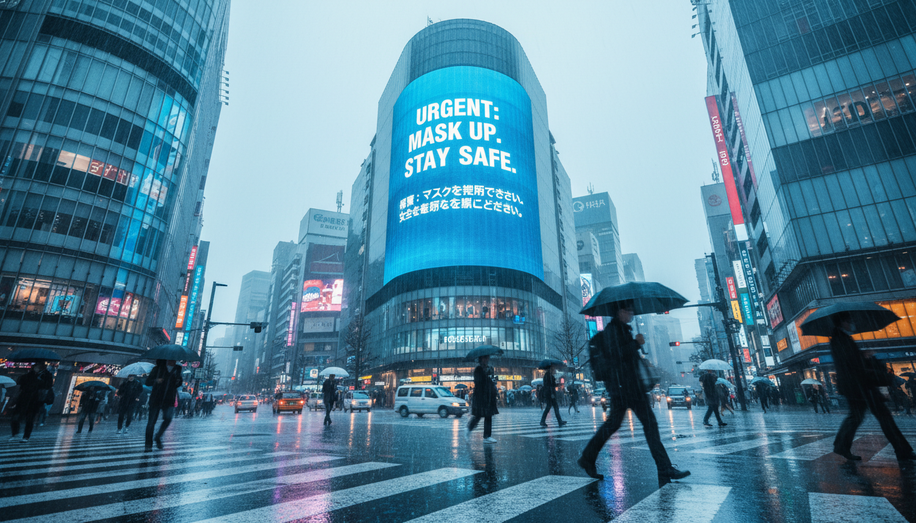

When disaster strikes, outdoor (OOH) advertising transforms from a commercial tool into a lifeline for public safety. Billboards, transit displays, and digital screens deliver urgent messages to millions who may be on the move, without relying on smartphones or internet access that crises often disrupt. This immediacy positions OOH as indispensable for crisis communication, reaching drivers, pedestrians, and commuters with critical alerts on health threats, evacuation routes, and safety protocols.
Consider the role of OOH in natural disasters or pandemics. During hurricanes or floods, electronic billboards flash real-time evacuation orders and shelter locations, visible to those navigating chaotic roads. Health authorities leverage these spaces for vaccination drives or symptom warnings, as seen in global responses where static and digital OOH cut through digital overload. Unlike social media, prone to misinformation and algorithmic silos, OOH offers unfiltered, location-specific reach—high-traffic transit hubs ensure messages hit dense populations precisely when mobility peaks. Studies affirm this potency: larger OOH formats drive higher engagement, with exterior bus ads outperforming interiors by capturing eyes in transit-heavy zones.
OOH’s strength lies in its multi-channel integration and rapid adaptability. Digital LED screens enable instant updates, swapping commercial content for public service announcements (PSAs) in seconds—a flexibility static media lacks. In economic downturns or crises, while competitors pause campaigns, active OOH sustains visibility, fostering trust as brands or governments appear steadfast. Programmatic capabilities further amplify this, allowing targeted, real-time deployment across networks for scale and precision, ensuring alerts reach demographics most at risk, from urban commuters to rural drivers. This aligns with core crisis principles: transparency, timeliness, and consistency across channels like billboards, buses, and parking displays.
Public service announcements thrive on OOH’s ubiquity. Amber Alerts on highways have proven life-saving, with drivers spotting descriptions of missing children amid traffic. During health emergencies, such as opioid crises or infectious outbreaks, OOH disseminates hotline numbers and prevention tips, bypassing language barriers with bold visuals and simple text—essential since viewers glance for mere seconds. Governments and NGOs value this for community-wide messaging; in Tashkent, LED screens maintained brand-like trust during instability, a model applicable to PSAs where perceived reliability calms panic.
Yet OOH’s crisis efficacy demands strategic execution. Effective deployment mirrors advertising’s crisis playbook: predefined protocols, a unified spokesperson for messaging, and real-time monitoring to tweak content based on feedback. Cross-departmental teams—uniting PR, media owners, and authorities—ensure seamless rollout, with transparent updates preventing rumors. For instance, pairing OOH with SMS or apps creates a feedback loop, where public response refines on-site messages. Research underscores integration’s power: OOH viewers are 17% more likely to engage brands digitally post-exposure, suggesting PSAs spark follow-up actions like calling helplines.
Challenges persist, but OOH mitigates them adeptly. Power outages threaten digital displays, yet hybrid static-digital networks provide redundancy. Visibility in adverse weather requires high-brightness tech, now standard in modern setups. Cost concerns fade in crises, as donated or subsidized space—common in public-private partnerships—maximizes impact without fiscal strain. During the COVID-19 era, though not detailed here, OOH pivoted swiftly to mask mandates and distancing rules, proving resilience amid flux.
Beyond immediacy, OOH builds long-term societal resilience. Consistent crisis use normalizes its role, training publics to heed billboards instinctively. Brands maintaining OOH during turmoil emerge stronger, perceived as reliable—a parallel for governments fostering civic trust. In an era of fragmented media, OOH’s physical presence cuts through, delivering unskippable truths. As climates shift and threats evolve, investing in expansive, tech-forward OOH networks isn’t optional—it’s a public imperative, shielding communities when seconds count.
This medium’s evolution promises even greater potential. AI-driven content personalization could tailor alerts by locale or time, while sustainable materials address environmental critiques. For OOH publishers, embracing this dual role—commerce by day, sentinel by crisis—cements relevance. In safeguarding lives, OOH doesn’t just advertise; it activates, proving that in chaos, the most visible voice often saves the day.
To truly unlock OOH’s full potential as a crisis lifeline, strategic platforms are essential for ensuring maximum efficacy and rapid deployment. Tools like Blindspot offer programmatic DOOH campaign management, location intelligence for optimal site selection, and real-time performance tracking, enabling authorities and media owners to precisely target and rapidly adapt life-saving messages across diverse networks. This commitment to precision and agility, championed by solutions found at https://seeblindspot.com/, fortifies OOH’s role as the indispensable, always-on voice in times of peril.