
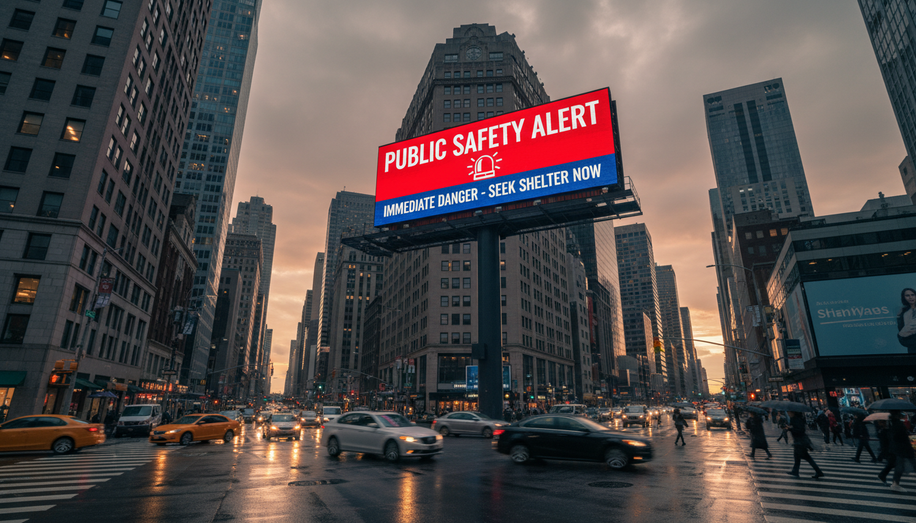

Out-of-home media has emerged as a critical infrastructure for delivering time-sensitive information when crises unfold across communities. Unlike digital channels that require active engagement or traditional broadcast media that operates on fixed schedules, OOH advertising provides instantaneous, unavoidable access to information at scale—a capability that becomes invaluable when seconds matter and lives depend on rapid awareness.
The power of OOH in crisis communications lies in its unique positioning within the public sphere. When emergencies strike, whether environmental disasters, public health threats, or safety alerts, communities need immediate notification across all demographics and locations. OOH accomplishes this through permanent infrastructure already embedded in high-traffic areas: transit stations, highways, parking facilities, and public spaces where people naturally congregate. This existing network eliminates the deployment lag that other communication channels face, allowing critical messages to reach audiences before they’ve even processed the crisis through social media or news outlets.
Real-time monitoring capabilities have transformed OOH’s role in crisis response. Advertising companies now implement alert systems that detect emerging issues and coordinate rapid message deployment across networks. When a public health emergency surfaces, transportation disruptions occur, or severe weather threatens, OOH networks can shift from commercial content to critical public service announcements within minutes. This speed proves essential—research demonstrates that the 24/7 news cycle demands immediate response to crises, as they can unfold at any hour and require organizations to prevent communications failures that compound the emergency.
The effectiveness of OOH during crises also stems from its inherent design advantages. Larger advertisements significantly outperform smaller formats in capturing audience attention and engagement. During emergencies, this size advantage translates directly to improved message comprehension. When residents need evacuation routes, shelter locations, or health guidance, the visual prominence of OOH ensures messages cut through the noise and competing information that characterizes crisis periods.
The placement diversity of OOH networks amplifies their crisis utility. Bus advertisements, highway billboards, parking garage displays, and transit station signage reach people during their daily movements—moments when they’re most receptive to critical information. A commuter stuck in traffic due to a road closure encounters evacuation instructions on nearby billboards. A transit rider sees health alerts on interior signage. This environmental ubiquity ensures information reaches communities across all socioeconomic and demographic segments, addressing equity gaps that digital-dependent communication systems often create.
Effective crisis messaging through OOH requires the same principles that govern all emergency communications: transparency, consistency, and clarity. Organizations deploying crisis messages via OOH networks must ensure their first public communication is thoughtful and honest, including specific actions being taken and timelines for implementation. This structured approach prevents the confusion and misinformation that proliferate during emergencies. Consistent messaging across all OOH placements reinforces critical information while avoiding the contradictions that undermine public trust during vulnerable moments.
The integration of OOH into broader crisis communication strategies reflects a maturation in how communities approach emergency preparedness. Rather than relying solely on push notifications or social media algorithms, organizations now recognize that ubiquitous, unavoidable communication infrastructure serves essential public functions. OOH networks provide the visible, immediate, and comprehensive coverage necessary when time-critical information must reach entire populations—from directing people away from dangerous areas to communicating vaccine information or providing utility outage updates.
As crises become more frequent and complex, OOH advertising’s role in public sphere communication will only deepen. The medium’s inherent advantages—permanence, scale, immediate visibility, and demographic inclusivity—position it as infrastructure for civic resilience. Communities that fully integrate OOH into their crisis communication planning gain a powerful tool for protecting public safety and maintaining social cohesion when it matters most. In an era of fragmented media consumption and information overload, out-of-home media remains one of the few communication channels that reaches everyone, everywhere, immediately.