
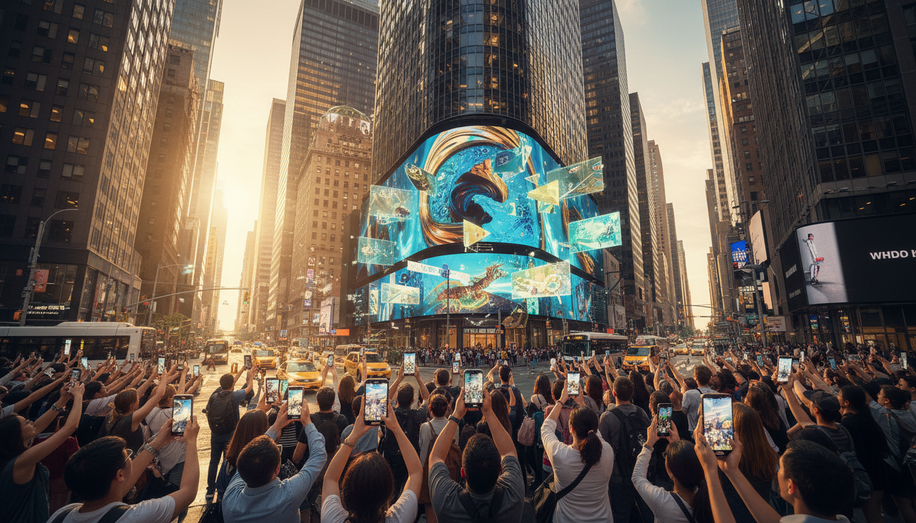

In the bustling streets of urban centers, where static billboards once commanded fleeting glances, augmented reality is reshaping out-of-home advertising into a portal of interactivity. By overlaying digital layers onto physical or digital OOH displays via smartphone cameras, AR transforms passive visuals into dynamic experiences that captivate passersby and extend engagement far beyond the initial encounter. This fusion of real-world canvases with virtual enhancements invites consumers to scan a QR code or app, unlocking 3D animations, games, and personalized content that respond to their environment.
The mechanics are elegantly simple yet profoundly effective. A traditional billboard, for instance, serves as the hook—its bold imagery drawing eyes—while the AR overlay expands the narrative. Viewers point their phones at the ad, and suddenly 3D models burst forth: a soda bottle might fizz with animated bubbles, or a fashion silhouette could let users virtually try on clothes. Computer vision technology anchors these elements precisely to the physical ad, ensuring seamless integration that feels magical rather than gimmicky. This approach works across formats, from murals and bus shelters to transit wraps, turning even the most conventional spaces into interactive playgrounds.
Brands have wasted no time exploiting this potential. Coca-Cola’s 2018 Times Square campaign exemplifies the power of AR billboards: pedestrians scanned a massive display to watch virtual bottles cascade in 3D, blending the ad’s static imagery with immersive animations that drove social shares and foot traffic. Vodafone took a gamified route in Germany, deploying QR-enabled billboards where users unlocked 3D experiences and competed for prizes, boosting dwell time and recall. Pepsi Max shocked London commuters with a bus shelter “window” that superimposed realistic 3D scenarios—like tigers prowling the street—blurring the line between ad and reality. These campaigns illustrate AR’s versatility: it extends ad space creatively, incorporating motion, context-aware responses, and calls-to-action like store directions or exclusive offers.
The benefits ripple through metrics that matter to advertisers. AR significantly increases dwell time as audiences pause to engage, phones in hand, rather than rushing past. This active participation fosters deeper memory retention; studies and reports highlight how interactive elements lead to higher brand recall and word-of-mouth buzz. Engagement data becomes trackable too—scans, interaction durations, and geolocations provide actionable insights for retargeting. Personalization amplifies this: AR can deliver tailored content, such as virtual product try-ons for IKEA furniture or quizzes tied to a brand’s story, turning one-way messaging into two-way conversations.
Market momentum underscores AR’s ascent. A 2023 ARtillery Intelligence report projected the AR advertising sector to hit $8 billion by 2025, fueled by smartphone ubiquity and maturing tech. App downloads for AR experiences surged from 1 billion in 2016 to over 5.5 billion by 2022, signaling consumer readiness. Even app-less web-based AR, as seen in Kinder’s in-store safari portals with animated animals and fun facts, lowers barriers to entry. For OOH specialists, this means bridging physical inventory with digital scalability—static posters spring to life, digital screens gain infinite depth—without overhauling infrastructure.
Challenges persist, of course. Not every viewer carries a compatible device or the patience for setup, potentially alienating segments of the audience. Execution demands high-quality creative to avoid novelty fatigue, and measurement standards are evolving as agencies refine attribution models. Yet the pros dominate: AR elevates OOH from interruptive to irresistible, creating shareable moments that amplify reach organically via social media.
Looking ahead, as 5G and advanced AR glasses loom, OOH stands at the forefront of this evolution. Billboards will not just advertise; they will immerse, guiding users from street to screen to store with unprecedented seamlessness. Brands ignoring this bridge risk fading into the background, while pioneers craft experiences that linger in the cultural conversation. In an era craving connection, AR overlays prove that the most compelling ads are no longer seen—they are lived.