
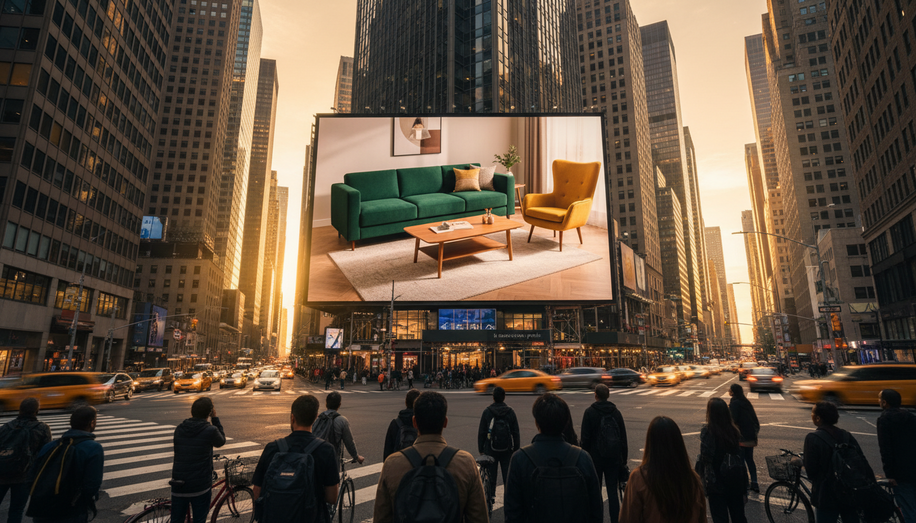

In the crowded digital landscape, direct-to-consumer (DTC) brands born on screens are discovering a powerful antidote: out-of-home (OOH) advertising. These digitally native companies, from cookware innovator HexClad to intimates maker ThirdLove, are deploying billboards, transit ads, and experiential displays to carve out a tangible presence in the physical world, fostering trust and amplifying awareness where online algorithms alone fall short.
For DTC players long reliant on e-commerce funnels and social media scrolls, OOH represents a pivotal evolution. It bridges the gap between virtual buzz and real-world credibility. Seeing a brand manifest on a towering Times Square billboard or a subway car doesn’t just catch the eye—it humanizes the seller. As one guide notes, this “real life” exposure adds layers of trust, countering the skepticism that shadows faceless online pitches. HexClad, for instance, harnessed OOH across multiple markets with billboards and transit placements, not only spiking website visits and conversions but also elevating its profile as an emerging kitchenware force.
This shift marks a maturation for DTC marketing. Early adopters treated OOH as a flashy milestone, splashing venture capital on provocative billboards to signal offline arrival. Today, the strategy is sharper, blending awareness with conversion. Brands like Saint James, Dagne Dover, and Coterie pair OOH with targeted events and product launches, reshaping perceptions and driving immediate sales. Kevin Bartanian of Kevani, an OOH specialist, recalls the channel’s roots in directional calls-to-action from the late 1800s— a heritage DTC firms are reclaiming amid competitive markets saturated by endless digital noise.
Programmatic digital OOH (DOOH) supercharges this potential, offering precision that rivals online targeting. Ads trigger based on audience proximity, slashing waste by displaying only to nearby viewers and enabling hyper-local campaigns. A landmark New York City initiative by Nickelytics, Branded Cities, and Ivee exemplifies this: a two-week blitz in Times Square and prime spots for DTC standouts like Athena Club, Fly By Jing, Wild, ThirdLove, Menē, and Caraway Home generated over 3 million impressions and 820,000 minutes of in-car exposure. Precision placement—73% of in-car ads within five minutes of a Target store—propelled search growth by over 5,000%, earning “Breakout” status on Google Trends. Such omnichannel synergy underscores OOH’s role in reinforcing digital efforts, with cross-channel integrations yielding 2-3 times higher engagement than siloed campaigns.
Beyond static displays, experiential OOH turns passive glances into active connections. Pop-up installations, product demos, and sensory activations at high-traffic hubs invite interaction, sparking viral social shares and 75% higher brand recall than traditional ads. Data-driven proximity targeting further amplifies impact, boosting store visits by over 1.3 million in proven cases. For DTC brands eyeing retail partnerships, OOH near outlets draws foot traffic, builds retailer rapport, and spotlights new products or seasonal pushes.
Yet OOH’s resurgence isn’t mere nostalgia; it’s a response to digital fatigue. With consumers navigating ad-blocked feeds and privacy clamps, OOH cuts through uninvited, reaching audiences in unbound public spaces like highways and transit hubs. Trends like dynamic, context-aware messaging—tailored to time, place, and demographics—make it indispensable in 2025 and beyond. DTC firms, once wary of OOH’s perceived complexity, now see robust ROI measurement tools tracking lifts in searches, visits, and sales.
Critics might argue OOH favors big budgets, but DOOH’s cost efficiencies and scalability democratize access. For emerging brands, it’s a catalyst: establishing offline footprints that lend permanence to ephemeral online identities. As markets tighten, those mastering OOH—whether through geo-fenced billboards or buzzworthy activations—don’t just build awareness; they forge lasting loyalty, proving that in brand-building, presence truly matters. The physical ad space, once overlooked, now anchors DTC success in an increasingly hybrid world.