
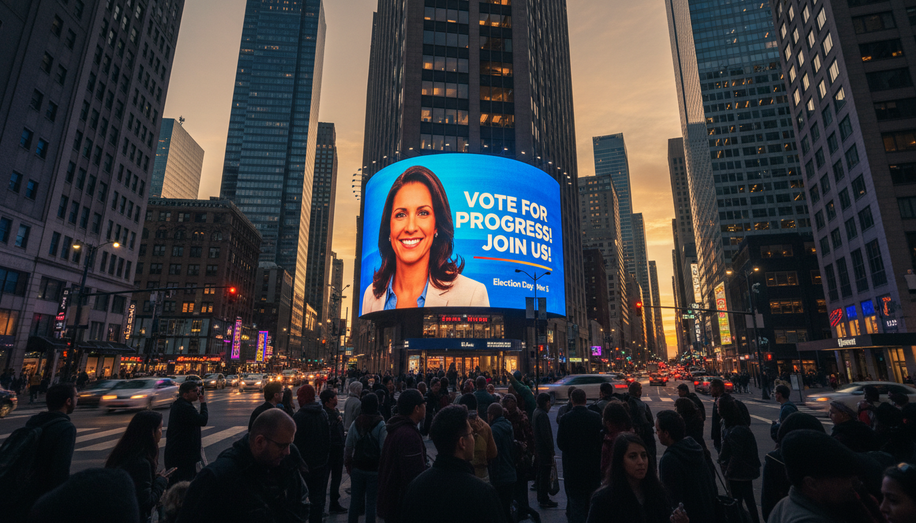

In the high-stakes arena of modern elections, out-of-home (OOH) advertising has emerged as a powerhouse for political campaigns, cutting through digital clutter to directly influence public opinion and drive voter turnout. Billboards, transit ads, and digital out-of-home (DOOH) displays deliver bold, unmissable messages that resonate in everyday spaces, from highways to urban streetscapes, shaping discourse where voters live, work, and commute. As the 2026 election cycle ramps up—one of the most competitive and capital-intensive in history—parties and advocacy groups are pouring record investments into OOH to mobilize supporters and sway undecideds.
OOH’s resurgence stems from its unique ability to command attention amid fragmented media landscapes. Unlike online ads that can be scrolled past or blocked, OOH meets voters in the physical world, fostering credibility and trust. According to the Out of Home Advertising Association of America (OAAA), OOH ties with print media for consumer favorability, with 85% of U.S. adults finding these ads useful. In recent cycles, 68% of likely voters reported seeing OOH political ads, including 50% within the past month, and nearly half—49%—said the ads personally influenced them, with 20% rating them very influential. This impact is amplified by OOH’s capacity to spark conversations; its larger-than-life visuals often ignite controversy, spilling over into social media for free earned media that magnifies reach.
Political strategists leverage OOH to address core voter concerns like the economy, polarization, and misinformation, building trust in an era of skepticism. During the 2024 campaigns, OOH ad revenue surged, with a 3.4% increase to $2.78 billion in the second quarter alone, fueled partly by political spend. Anna Bager, a leading industry voice, noted this as part of a broader omnichannel trend, where OOH integrates with digital efforts for maximum engagement. Campaigns target high-traffic zones—near ballot boxes, conventions, and key demographics—to reach persuadable voters precisely where they are. For instance, providers like Clear Channel Outdoor offer national billboard networks tailored for election seasons, ensuring messages hit swing districts and urban hubs effectively.
DOOH takes this further, offering dynamic, real-time adaptability that static billboards can’t match. Screens in high-traffic areas, such as those from Screenverse, allow campaigns to rotate messages instantly based on polling data or events, turning passive exposure into action. Remarkably, 76% of adults reported taking device-based actions—like searching candidates or sharing content—after encountering an OOH ad. This interactivity bridges physical and digital realms, boosting turnout by prompting immediate engagement. In 2022 midterms, OOH political spending jumped 113% year-over-year and 90% over 2018 levels, hitting records as total ad budgets neared $9 billion. Looking to 2026, experts predict even greater reliance on OOH’s flexibility amid crowded TV and social channels.
Advocacy groups amplify these tactics, using OOH for issue-based messaging that transcends party lines. Environmental campaigns, civil rights organizations, and economic reform advocates deploy provocative visuals to frame narratives and rally bases. Billboards with stark contrasts—simple slogans over powerful imagery—achieve sky-high visibility, as seen in tricks like oversized typography and strategic lighting for nighttime impact. Platforms like Fliphound democratize access, letting smaller campaigns buy digital slots from $10 a day with customizable templates, leveling the playing field.
Yet OOH’s influence extends beyond awareness to measurable turnout. Studies show it excels at rapid brand-building and voter mobilization, with placements near polling stations reminding supporters to vote. In polarized times, its perceived neutrality—rooted in public spaces—lends authenticity, countering digital echo chambers. Critics argue it risks oversimplification, but data underscores effectiveness: OOH breaks through noise, influences opinions, and correlates with higher participation rates.
As 2026 unfolds, OOH will remain indispensable, evolving with AI-driven targeting and immersive DOOH to redefine political outreach. Campaigns that master its scale, precision, and cultural penetration will not only shape discourse but turn passive observers into active voters, proving once again that in elections, visibility is victory.