
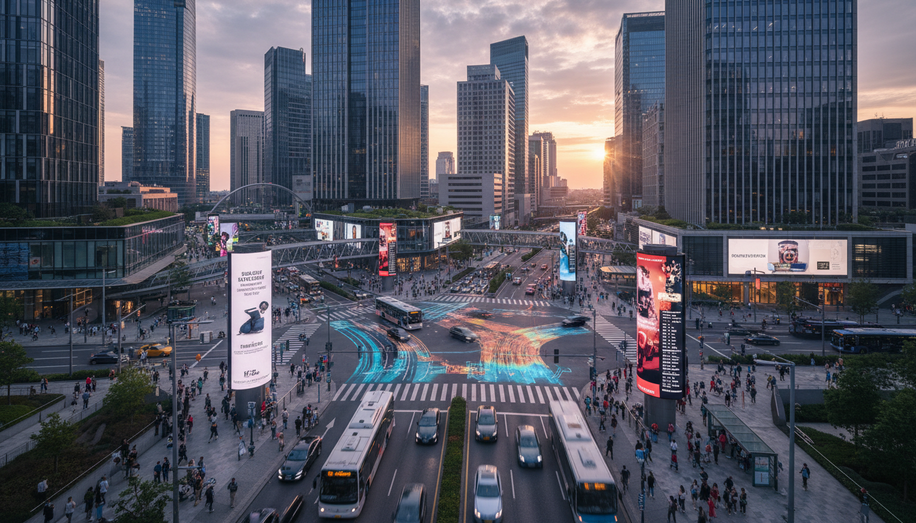

Out-of-home advertising is entering a new phase as cities themselves become more connected, measurable, and responsive. For decades, OOH has been defined by scale, visibility, and location. In smart cities, those strengths remain, but they are being extended by data, automation, and infrastructure that can make campaigns more relevant to the people moving through urban space. The result is a shift from static placement to a more intelligent form of public communication, one that responds to how cities actually function in real time.
Smart city initiatives are built around layers of sensors, connected devices, and digital systems that monitor everything from traffic flow and transit capacity to weather conditions and pedestrian movement. For advertisers, that infrastructure creates new context. A screen near a metro station can adjust messaging when commuter volume peaks. A roadside digital board can change creative when congestion spikes or when rain alters travel patterns. In these environments, OOH is no longer just a medium that people pass by; it becomes a channel that can align with the rhythms of the city itself.
That alignment matters because smart cities are increasingly designed around efficiency and public utility. Transportation networks, public information systems, mobility hubs, and civic screens are all becoming more data-rich and more connected. OOH fits naturally into that environment because it already exists in high-traffic, high-visibility public space. What changes is the degree to which it can integrate with surrounding systems. A transit screen, for example, can serve both a public service function and an advertising function, displaying arrival information while also delivering contextually relevant messaging. In this model, utility and advertising are not separate ideas. They reinforce each other.
The evolution is also being driven by programmatic buying and automation. As smart city data becomes more accessible, OOH campaigns can be planned and optimized with greater precision. Instead of relying solely on broad geographic assumptions, advertisers can use location data, mobility trends, and real-world conditions to determine when and where messages should appear. That makes campaigns more agile, especially in cities where foot traffic can shift quickly by neighborhood, hour, or event. The practical effect is a medium that behaves more like digital media while retaining the public presence that makes OOH distinctive.
There is also a growing opportunity for OOH to work alongside public services in ways that benefit both advertisers and city residents. Smart city infrastructure increasingly supports open data, emergency alerts, environmental monitoring, and wayfinding. When OOH is connected to those systems, it can become more responsive to civic context. A screen could highlight local transit updates while also promoting a nearby retailer. It could shift creative during extreme weather to support public messaging and adapt brand communication accordingly. This does not just improve relevance. It allows OOH to participate in the broader information ecosystem of the city.
The future may also bring more personalized and localized creative execution, though within the constraints of public space and privacy expectations. The most effective smart city OOH will likely be contextual rather than invasive, using aggregate signals such as time of day, traffic density, weather, or event schedules rather than individual-level tracking. That balance will be important as advertisers, municipalities, and citizens all place greater value on transparency and trust. In a smart city, successful OOH will need to feel helpful and timely, not intrusive.
Measurement will continue to be a central part of that evolution. One of the historic challenges for OOH has been proving impact beyond impressions. Smart city environments offer a path forward by connecting exposure data with mobility patterns, store visitation, and digital engagement. When combined with mobile retargeting or search activity, OOH can play a more clearly measurable role in cross-channel campaigns. That capability will likely make the channel even more attractive to brands that want the scale of outdoor media without sacrificing accountability.
Just as importantly, OOH in smart cities will be part of a larger conversation about what public space is for. Cities are becoming more connected, but they are also becoming more complex. Residents expect infrastructure that is efficient, informative, and adaptable. Advertisers that understand this shift will approach OOH not as an isolated buy, but as part of a living urban network. The best campaigns will feel embedded in the city rather than simply placed within it.
As smart cities continue to develop, OOH has a chance to become one of the most visible expressions of urban innovation. It can bridge the physical and digital worlds, support public communication, and deliver brand messages that reflect the environment around them. In that sense, the future of OOH is not only about better screens or smarter targeting. It is about becoming a more integrated part of the city experience itself.