
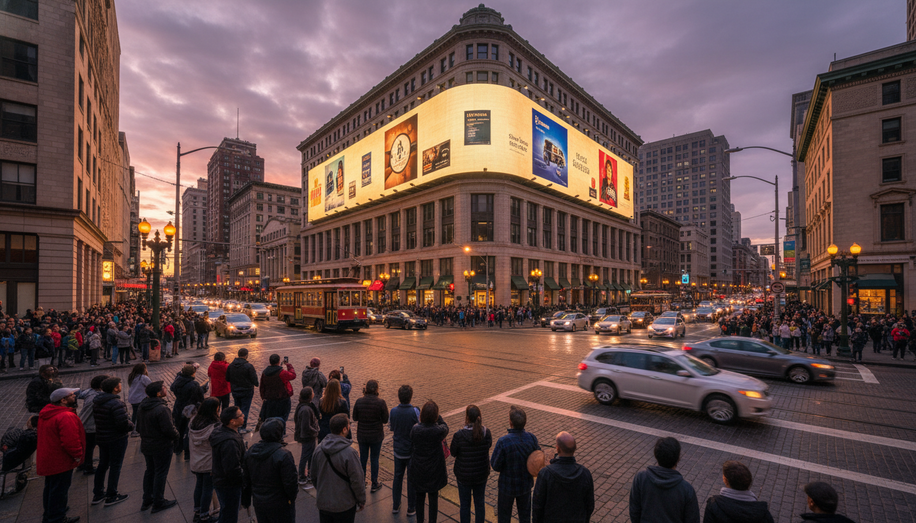

A billboard can do more than sell sneakers, soda, or a streaming subscription. In the right place, at the right moment, it can become part of a city’s visual memory, a reference point for locals, and a landmark that people mention the way they do a bridge, a mural, or a neon sign. Some out-of-home campaigns become so embedded in the urban landscape that they outgrow the role of advertisement altogether. They evolve into cultural icons—objects of nostalgia, civic pride, artistic fascination, and, occasionally, collective obsession.
This transformation begins with visibility, but visibility alone is not enough. The billboards and displays that endure tend to share a rare combination of scale, simplicity, timing, and repetition. They are often planted in high-traffic corridors where millions pass them without trying to. Over time, the image becomes part of the scenery, then part of the city’s identity. In that sense, OOH has a unique advantage over many media formats: it does not merely interrupt urban life. It inhabits it.
Cities have long treated certain signs as unofficial landmarks. Some are remembered because they were always there, anchoring an intersection or skyline. Others matter because they captured a specific cultural mood. Think of fashion campaigns wrapped around buildings, oversized product images glowing above busy streets, or a witty transit poster that becomes the shorthand for an entire era. What begins as a commercial message can turn into a local touchstone precisely because OOH lives where culture is already happening—in the commute, the nightlife strip, the shopping district, the tourist route, the neighborhood main street.
That proximity gives OOH an unusual relationship with public memory. Unlike a TV spot that disappears after the break or a digital ad that is skipped and forgotten, a billboard can be seen repeatedly across months or years. Familiarity breeds affection, and sometimes, ownership. Residents start to use it as a navigation cue: meet me by the sign, turn left after the board, it’s near the old ad for that brand. The message may change, but the location persists, and the location becomes the landmark. In dense urban environments, these signs can function like informal monuments to the city’s commercial and cultural history.
There is also a strong artistic dimension to this phenomenon. OOH has always shared territory with public art, graphic design, and urban storytelling. The best campaigns understand composition, scale, color, and context as carefully as a gallery installation does. When those elements align, the result can transcend promotion and enter the visual canon of a place. Photographers document it. Designers study it. Historians archive it. Tourists seek it out. The billboard, once a utilitarian format, becomes an object of aesthetic interest, proof that advertising can leave behind an image worth preserving.
Some of the most memorable examples achieve this through character and continuity. A recurring campaign figure can become almost anthropological—a symbol of a brand, yes, but also of a city’s shared references. A slogan, illustrated face, or branded scene repeated across seasons can gather cultural weight simply by surviving long enough to be remembered. The same is true of landmark placements: a giant display on a famous avenue or a digital screen in a globally recognized district gains meaning from the location itself. The ad and the place become inseparable in public imagination.
This is why OOH can be more than a channel; it can be a contributor to city identity. A campaign launched for a few weeks may end up defining how a neighborhood is photographed for years. A brand message positioned at the edge of a cultural district may become part of how that district is marketed, discussed, and experienced. In some cases, the ad even enters civic folklore, remembered with the same fondness as a movie theater marquee or an old storefront sign. The commercial intent remains, but its social function expands.
That expansion carries responsibility. If out-of-home advertising can shape a city’s image, it must do so with respect for the communities that live there. The most enduring campaigns are rarely the loudest; they are the ones that understand local context, avoid cultural shortcuts, and contribute something recognizable rather than intrusive. When OOH reflects a city honestly—its humor, pace, diversity, and visual codes—it has a better chance of becoming beloved rather than merely tolerated.
In the end, the reason some billboards become landmarks is simple: they participate in the life of a city instead of hovering above it. They are seen in traffic, in weather, in the routines of ordinary days and the spectacle of major events. They become part of the backdrop against which local culture unfolds, and then, in rare cases, part of the story itself. That is when OOH stops being just advertising and starts becoming memory.