
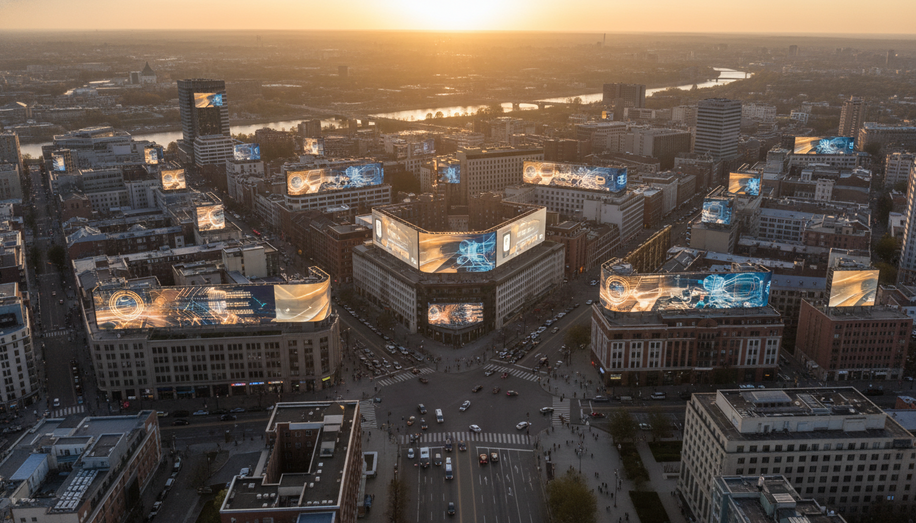

For years, conversations about artificial intelligence in advertising have fixated on generative tools and automated creative. Yet in Out-of-Home, the most transformative impact of AI is happening somewhere far less glamorous than a design file: in the spreadsheet, the traffic model, the geospatial heat map. The real revolution is how AI is reshaping where brands show up, when, and in front of whom—turning OOH site selection from a static media buy into a living, predictive system.
Traditional OOH planning has always mixed art and science. Planners gathered traffic counts, demographic data, past campaign anecdotes and local knowledge, then made the best decisions they could. But those decisions were effectively snapshots, based on historical averages and limited datasets. Movement patterns, retail ecosystems and consumer behaviour have all become more fluid, yet the underlying planning tools struggled to keep pace.
AI-driven analytics change that equation by ingesting and interpreting far more data than any human team could reasonably process. Location intelligence platforms now blend mobile movement data, anonymised device IDs, census and purchasing data, weather patterns, event schedules, retail and transit feeds, even social media activity. Machine learning models comb through this mix to detect patterns in where different audience segments go, how often they pass specific locations, and what actions they take afterward.
The output is not just a list of “busy” sites; it is a ranked set of locations scored by predicted performance for specific objectives. A brand focused on app downloads, for example, can ask the model to prioritise sites whose previous exposure has been statistically linked to surges in app installs among its target cohort. A retailer can search for panels with the highest predicted store visitation lift within a defined radius. Instead of starting with inventory and asking, “Who do we think this reaches?”, planners start with desired outcomes and ask, “Which locations are mathematically most likely to drive them?”
Predictive analytics is the engine behind this shift. Rather than simply describing what has happened, AI models forecast what is likely to happen under different media scenarios. They learn from past campaigns: which locations overdelivered, which underperformed, which creative and dayparts correlated with higher conversion. They incorporate external variables—weather, school holidays, public transport disruptions, major events—to predict when and where target audiences will concentrate. Over time, the system becomes better at estimating reach, frequency and downstream actions, enabling planners to simulate multiple site mixes and budget levels before committing spend.
This moves OOH planning closer to the scenario testing common in digital performance marketing. A CPG brand can model how reallocating budget from a cluster of high-traffic but low-conversion sites to a smaller set of contextually rich locations might improve ROI. An entertainment client launching a film can test whether concentrating inventory around commuter hubs in the three days before opening weekend yields more ticket sales than a longer, more diffuse campaign. AI gives operators and agencies the tools to quantify those trade-offs with far greater confidence than intuition alone.
Programmatic Digital OOH is where this predictive power becomes truly dynamic. Instead of renting a site in fixed blocks and hoping the right people pass by, advertisers can now buy impressions based on real-time audience availability. AI algorithms monitor live mobility data, weather feeds and event triggers, then adjust which screens are activated and when. If a sudden downpour shifts foot traffic from high streets into malls and transit shelters, impressions automatically follow. If a sports team advances unexpectedly in a tournament, screens near bars and viewing venues can be prioritised for relevant categories.
Crucially, the same models that inform pre-campaign planning feed into ongoing optimisation. As exposure and outcome data accumulate, AI systems compare predicted performance with actual results. Sites that underperform expectations can be deprioritised in real time; surprise overperformers can receive more budget. This continuous feedback loop tightens the link between site selection and business outcomes, and it accelerates learning for future campaigns. What once took quarters of post-campaign analysis now happens mid-flight.
For operators, this evolution is as strategic as it is tactical. Inventory once valued mainly on raw traffic counts is now assessed on its ability to reach specific, high-intent audiences and drive measurable actions. AI-based scoring can reveal hidden gems—panels with moderate overall impressions but exceptional exposure to a valuable niche segment or a key path-to-purchase corridor. It can also surface saturation issues, flagging when a particular audience in a submarket has been overexposed and incremental impressions are unlikely to move the needle.
This new level of precision does not eliminate the human dimension of OOH; it elevates it. Local knowledge remains critical for understanding the nuance behind a data point: why a particular intersection feels “sticky,” how construction might affect visibility, how a neighbourhood’s character is evolving. The best results emerge when planners and operators treat AI as a co-pilot—challenging its recommendations, overlaying contextual insight, and using the time saved on manual analysis to focus on strategy and creative integration.
There are also important questions around privacy and ethics. The same mobile and geolocation data that make hyper-targeted site selection possible must be handled with strict anonymisation and compliance with data protection regulations. Leading platforms are investing heavily in privacy-safe methodologies, using aggregated and modelled data rather than tracking individuals. As AI-powered OOH matures, maintaining consumer trust will be as vital to long-term viability as technical accuracy.
What is clear already is that AI is fundamentally changing how value is defined in OOH. The most powerful applications are not the flashy creative tricks on digital screens, but the quiet algorithms ranking locations, simulating outcomes and reallocating impressions minute by minute. For brands, that means OOH can finally operate with the accountability and agility of digital channels, while preserving its unique strengths in scale and physical presence. For the industry, it signals a future where “site selection” is no longer a static choice, but an ongoing, data-driven performance discipline.
This new paradigm is precisely what platforms like Blindspot are built to enable, transforming OOH from a static buy into a living, predictive system through advanced location intelligence, audience analytics, and real-time programmatic campaign optimization. By providing granular ROI measurement and continuous performance tracking, Blindspot allows advertisers to precisely quantify impact and adapt strategies mid-flight, ensuring OOH investments are as accountable and agile as their digital counterparts. Explore these capabilities at https://seeblindspot.com/