
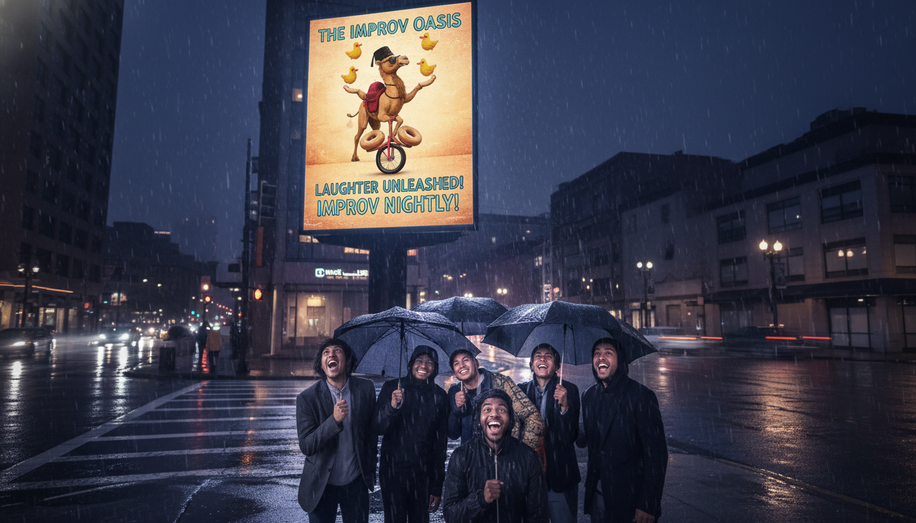

In a media landscape where attention is the most precious currency, a genuine laugh is still one of the fastest ways to earn it. Out-of-home (OOH) advertising, with its bold canvases and fleeting viewing windows, is uniquely suited to humor. A clever line on a billboard or a witty twist on a digital screen can stop commuters mid-scroll, turn a dull commute into a shared moment, and lodge a brand in memory long after the journey ends.
Marketers have long known that humor works, but recent research and real-world campaigns are underscoring just how powerful it can be. Studies from firms like Nielsen and Kantar have shown that funny ads significantly increase recall compared with straight, informational messaging. For OOH specifically, where exposure is brief and often repeated, humor’s ability to lower defenses and create an instant positive emotion becomes a strategic advantage. When a message makes people smile, they’re more likely to look up, look twice, and later look for the brand.
That matters in an environment where consumers are bombarded with thousands of messages every day. Much of that content feels heavy, salesy, or interchangeable. Humor breaks that monotony. It cuts through the noise precisely because it feels like entertainment, not interruption. A witty OOH execution doesn’t just communicate a product benefit; it turns the ad itself into a tiny piece of content people actually want to engage with—photographing it, sharing it on social media, and turning a local placement into a far wider media moment.
The most effective humorous OOH campaigns tend to rely on a few core techniques: situational comedy, observational humor, and sharp wordplay. Situational comedy takes familiar, often mundane moments and exaggerates them just enough to be funny yet recognizable—a crowded train, a traffic jam, a late-night snack run. Observational humor holds up a mirror to everyday quirks, from office politics to family chaos, prompting a knowing chuckle of recognition. Wordplay takes advantage of OOH’s concise format, where a short, punchy line can deliver both a laugh and a brand message in a single hit.
Clever, location-based wordplay has become a hallmark of standout OOH. Think of brands that reference the exact city block, local landmarks, or regional in-jokes to build instant rapport. A coffee chain joking “You’re not stuck in traffic. You’re just pre-caffeinated” above a busy arterial, or a streaming service teasing “Perfect for ignoring your in-laws, two exits ahead.” These lines combine context, timing, and wit, turning an otherwise forgettable sign into a moment of camaraderie between brand and audience.
Humor doesn’t just drive attention; it shapes how audiences feel about the brands behind the jokes. A well-crafted funny campaign signals confidence, personality, and self-awareness. It makes companies seem more human and approachable, especially in categories that are typically functional or dry. Financial services, utilities, and B2B brands, for instance, have successfully used tongue-in-cheek OOH lines to disarm skepticism and soften complex messages. The result is often a warmer brand perception and a greater willingness to listen when the conversation does turn serious.
Some of the most celebrated humorous campaigns demonstrate this blend of charm and clarity. Insurance brands have turned quirky mascots and situational comedy into long-running OOH and cross-channel platforms, using billboards and transit wraps to extend character-driven narratives that people look forward to seeing. Food and beverage brands regularly deploy puns and visual gags—oversized imagery, unexpected juxtapositions, or playful “talking” products—to make their offerings feel fun and irresistible. Even tech companies have leaned into self-deprecating lines about updates, bugs, or digital overload, acknowledging consumer frustrations while positioning themselves as the solution.
For OOH practitioners, the craft lies in making sure the joke serves the strategy. Humor must connect back to a clear message: what the brand stands for, what it offers, and why it matters. A memorable line that leaves people laughing but unsure who said it is a missed opportunity. The best work finds the overlap between a genuine insight about the audience, a relevant brand benefit, and a comedic angle that can be expressed in a handful of words or a single striking visual.
Clarity and simplicity are crucial. OOH messages are consumed at speed, often from a distance, sometimes at 80 kilometers an hour. That’s not the place for layered, complex jokes that require multiple readings or niche cultural references. The humor should land in a second or two, with the brand and call to action still unmistakable. Visual humor can help here: a surprising image, an unexpected scale, or a visual twist that delivers the punchline even before the copy is processed.
There are risks, of course. Humor that punches down, leans on stereotypes, or misreads local sensitivities can quickly backfire, especially in the age of instant online backlash. What amuses one demographic might alienate another. This is where rigorous audience understanding, diverse creative teams, and thoughtful testing come in. The goal is not to be edgy for its own sake, but to invite as many people as possible into the joke without excluding or offending.
When done well, humorous OOH creates a feedback loop that extends far beyond the physical placement. A witty billboard is photographed, posted, and reposted, turning a single board into thousands of impressions. Transit ads become backdrops for selfies. Digital OOH screens invite real-time interactions, from live polls to contextual gags tied to weather, sports scores, or local events. In this way, a good joke doesn’t just fill media space; it generates earned media, conversation, and cultural relevance.
Ultimately, the power of laughter in OOH lies in its ability to make brands feel less like faceless entities and more like companions in the everyday grind. In a crowded marketplace, that human connection is often what separates a forgotten ad from an unforgettable one. With the right mix of insight, timing, and wit, humor can transform a few square meters of space into a moment people remember—and a brand they don’t forget.