
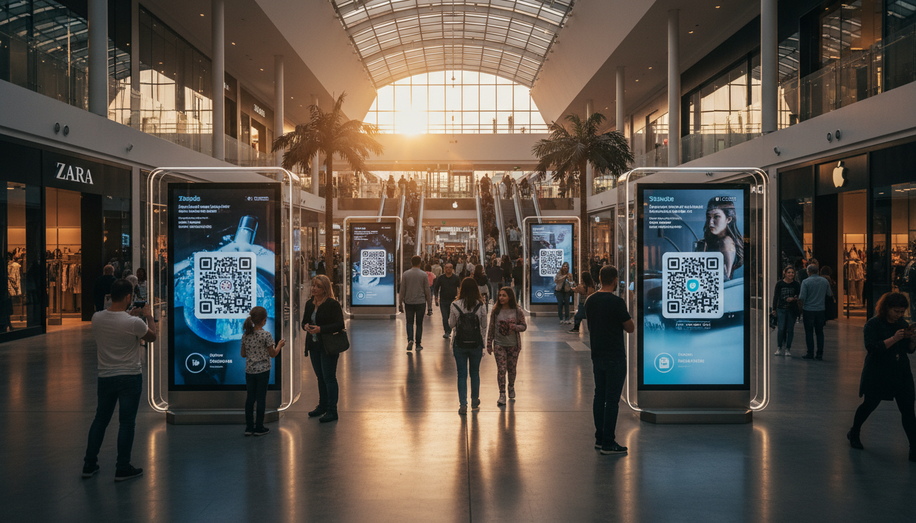

Out-of-home advertising is having a quiet renaissance in the age of retail media. While retail media networks grab headlines and budgets with their promise of first-party data and point-of-sale proximity, OOH is increasingly proving to be the connective tissue that turns those retail touchpoints into full-funnel, sales-driving ecosystems—well beyond the storefront itself.
At its core, retail media flourishes because it reaches shoppers in high-intent moments. Sponsored product placements on e-commerce sites, targeted ads in apps and loyalty platforms, and digital endcaps or shelf screens all operate within environments where consumers are actively considering a purchase. Yet that strength also reveals a limitation: retail media is largely focused on the “last mile” and “last aisle.” OOH fills the gap before that moment, reaching people in the wild—on streets, in transit, near neighborhoods and workplaces—where brand preference is still forming.
For brands and agencies, the most effective retail media strategies now treat OOH as the awareness and consideration engine that primes consumers before they ever open an app or walk down an aisle. High-impact digital billboards, place-based screens near store entrances, and contextually relevant roadside inventory can introduce a product, communicate value propositions, and build mental availability. By the time a shopper sees that same brand on a retailer’s website or an in-store display, they are recognizing rather than discovering it—an important difference in a cluttered media and shelf environment.
Digital OOH in particular is blurring the line between classic brand-building and performance marketing. Screens located just steps from retail entrances, in parking lots, in malls, and in urban centers are increasingly being bought as part of retail media campaigns rather than as standalone OOH buys. These placements offer many of the attributes advertisers expect from digital channels—measurable impressions, flexible creative, dayparting, and proximity to purchase—while retaining the brand-safe, high-viewability characteristics that OOH is known for. For retailers and retail media networks, incorporating DOOH inventory into their offerings extends their reach beyond owned channels and deepens their value proposition to advertisers.
Data has become the bridge that allows OOH to sit confidently in a retail media plan. Location and mobility data, loyalty and purchase data, and contextual signals like weather and local events now inform OOH placement and messaging. Campaigns can be built around store catchment areas, over-indexed audiences, and even real-time conditions. A retailer can serve one creative near stores where a product is in stock and a different creative where inventory is constrained. A CPG brand can align OOH messaging with in-store promotions or digital coupons, then link back to sales lift using retailer data and attribution partners. The result is an OOH layer that feels less like a blunt awareness instrument and more like a smart, addressable component of the retail media stack.
The impact is not confined to brick-and-mortar sales. As retail media networks expand their focus from in-store behavior to omnichannel commerce, OOH becomes a driver of both in-store and online conversions. A commuter who sees a DOOH ad for a grocery promotion may order via the retailer’s app later that evening. A shopper exposed to a street-level campaign for a beauty product is more likely to click a sponsored listing on a marketplace or add the product to a subscription cart. Cross-channel measurement—using matched-market tests, footfall analysis, and pixel-based attribution—shows that OOH integrated with digital and retail media can deliver significantly higher engagement and conversion than any one channel operating alone.
Retailers themselves are starting to apply lessons from digital OOH to build more sophisticated in-store networks. Rather than treating aisle screens or checkout displays as static ad loops, forward-looking retail media operators are borrowing best practices from DOOH: using dynamic content that responds to time of day, local conditions, and live promotions; tailoring layouts and formats to each store’s unique traffic patterns; and considering how in-store screens complement the full shopper journey, not just the last step. In this context, off-site OOH and on-site retail media work as a continuum—driving shoppers into stores or onto apps, then guiding them through to purchase with consistent, adaptive messaging.
The creative implications are significant. When OOH is planned alongside retail media, campaigns can be architected as narratives that unfold across touchpoints. A large-format OOH execution can focus on emotion and brand story, while digital units in the retailer’s ecosystem reinforce key claims and pricing, and in-store media closes with urgency and social proof. Experiential and “retailtainment” activations—pop-ups, interactive installations, augmented reality experiences—can bridge physical OOH and the retail environment, generating social amplification and first-party data that feed back into the retail media machine.
For media buyers who have historically thought of OOH and retail media as separate line items, the shift is as much organizational as it is tactical. OOH specialists are increasingly collaborating with retail media and shopper marketing teams, sharing insights on audience behavior, creative best practices, and measurement frameworks. As retail media budgets swell, there is a strong case for allocating a portion to OOH as a force multiplier: using OOH to drive qualified traffic into retailers’ ecosystems, then letting the precision of retail media close the sale.
In a fractured media world where attention is hard to win and easy to lose, OOH and retail media are emerging as complementary assets rather than competing silos. Retail media brings targeting, transaction proximity, and closed-loop measurement; OOH delivers reach, memorability, and emotional impact in the real world. When integrated thoughtfully—guided by data, aligned creative, and unified KPIs—they can drive sales not only at the shelf and on the screen, but across the entire customer journey, well beyond the storefront.
Achieving this seamless integration requires sophisticated tools that connect OOH with the retail media stack, enabling data-driven strategies and clear ROI. Blindspot empowers advertisers to precisely target relevant audiences and optimize OOH placement through advanced location intelligence and audience analytics, effectively priming shoppers for downstream retail engagements. Crucially, its robust ROI measurement and attribution capabilities provide the closed-loop insights needed to validate OOH’s impact as a force multiplier within comprehensive retail media strategies, driving conversions across the entire customer journey. Learn more at https://seeblindspot.com/