
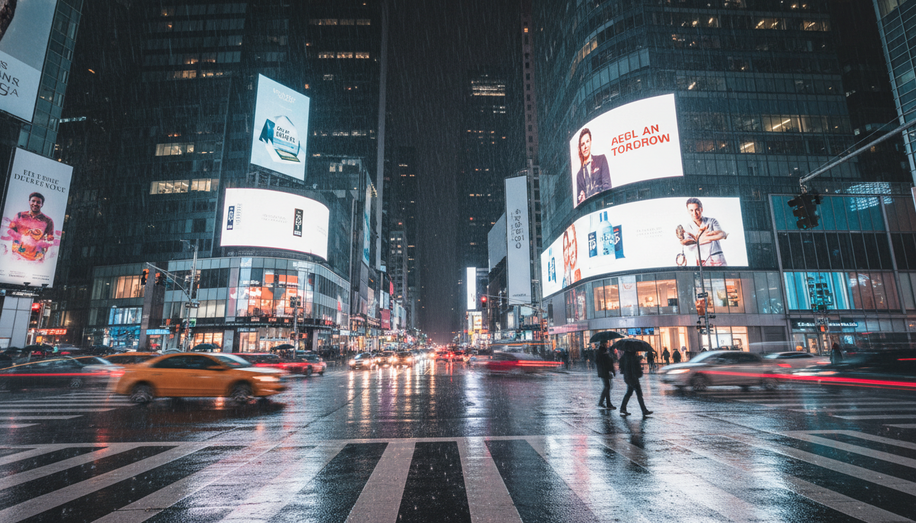

For decades, out-of-home advertising has been a largely predictive business built on experience, intuition and broad audience models. Media planners estimated traffic flows, relied on historical circulation data and hoped that the right people would pass the right screen at the right time. That era is ending. AI-driven predictive analytics is bringing a level of foresight to OOH that was once reserved for digital performance marketing, allowing advertisers not only to understand what happened, but to forecast what will happen next.
At its core, predictive analytics in OOH uses historical performance data, mobility patterns and contextual signals, processed through machine learning models, to anticipate audience behavior in the real world. Instead of simply reporting that a roadside digital billboard delivered a certain number of impressions last month, platforms can now predict how many likely impressions — and from which audience segments — that same location will deliver next week if creative, dayparting and budget remain unchanged. More advanced systems go further, simulating how shifts in creative rotation, weather, events or media mix will impact outcomes before a single impression is bought.
The raw materials for these forecasts are increasingly rich. Anonymized mobile location data reveals how devices move across cities and suburbs, building a granular picture of dwell time, frequency and routes. Transit data, traffic feeds and municipal open data show how flows change by hour, day of week and season. Screen logs capture play-out data, while campaign results — from brand-lift surveys to store traffic and online conversions — close the loop between exposure and outcomes. Fed into machine learning models, these inputs allow advertisers to answer questions that were previously educated guesses: Which panels over-index for grocery shoppers in the early evening? Where does my target audience pass both a highway screen and a street-level display within 24 hours? How will a sporting event or festival reshape footfall patterns across a neighborhood?
One of the most immediate applications is smarter placement planning. Instead of selecting locations based solely on total impressions or broad demographics, predictive tools forecast how specific audience segments are likely to move over time. For a quick-service restaurant launching a breakfast menu, that might mean prioritizing panels that index highly for commuters who pass within a defined radius of its outlets between 6 a.m. and 9 a.m., and who have historically responded to similar promotions. For an entertainment brand promoting a weekend release, models might identify corridors where likely moviegoers are predicted to cluster on Thursday and Friday evenings, adjusting spend dynamically as pre-sales data rolls in.
This shift from static to dynamic planning fundamentally changes how OOH is bought. Rather than locking in a fixed schedule months in advance, advertisers can use predictive analytics to run scenario planning before committing budgets. What happens to projected reach among a high-value audience if 20 percent of spend is moved from classic posters to DOOH? How does predicted store visitation change if the campaign skews more heavily toward commuter hubs versus shopping districts? With campaign simulators driven by AI, planners can test these hypotheses in silico, then book against the model that best aligns with their objectives and risk appetite.
The same predictive capabilities that improve placement also transform expectations around ROI. Traditionally, OOH effectiveness has been evaluated post-campaign: sales lift analyses, match-market tests, or footfall studies delivered results weeks or months after the fact. Predictive analytics compresses that timeline. By training models on past campaigns that link exposures to outcomes — such as store visits, app installs or site traffic — systems can forecast likely performance before launch and update that forecast as fresh data arrives. If early indicators show a campaign underperforming against expectations, advertisers can intervene mid-flight, reallocating budget to higher-performing screens, adjusting creative or modifying dayparts to get back on track.
This real-time feedback loop relies on another pillar of predictive OOH: contextual triggers. Weather, traffic congestion, local events and even macroeconomic indicators can all be integrated as variables in forecasting models. A beverage brand might use historical data to understand how hot days drive incremental sales when ads run near parks and transit hubs, then set rules for DOOH creative to switch automatically when temperatures cross a threshold, with models predicting the uplift beforehand. Similarly, a mobility app could anticipate increased demand around transit disruptions and concentrate OOH spend in affected corridors, guided by predictions of where stranded commuters are likely to be.
For media owners, the implications are profound. Networks that can expose granular, high-quality data — consistent screen logs, accurate location metadata, verified viewability metrics — become far more attractive to buyers who are optimizing to predicted business outcomes rather than simply reach and frequency. Those owners can also use predictive analytics internally to manage yield, forecasting demand for specific locations or time slots and pricing inventory dynamically in response. As programmatic DOOH continues to grow, these capabilities will be central to transacting on future opportunity, not just past performance.
None of this is without challenges. Data privacy and compliance sit at the heart of any predictive system that uses mobility data or behavioral signals. Leading platforms are responding by prioritizing privacy-by-design approaches: aggregating data to cohorts, obfuscating individual device paths and ensuring that no personally identifiable information is used or exposed. Model transparency is another concern. As AI takes a larger role in informing where and when ads run, agencies and advertisers are demanding explainability — not just a recommendation, but a clear understanding of which variables are driving predictions and how sensitive outcomes are to different assumptions.
Measurement standards, long a point of debate in OOH, are also evolving under the influence of predictive analytics. Industry bodies are working toward frameworks that align predictive impressions and audience estimates with accepted definitions and methodology, ensuring that one platform’s “predicted exposure” is comparable to another’s. The goal is not to replace traditional measurement but to augment it: using predictive insights to make more informed decisions upfront, then validating those predictions with robust post-campaign attribution.
For OOH advertisers, the strategic takeaway is clear. Treat predictive analytics not as a buzzword, but as a practical toolkit for making better, more accountable decisions at every stage of a campaign. It means demanding access to data and models that can answer “what if” questions before spend is committed. It means building workflows that allow for mid-flight optimization, not just post-campaign reporting. And it means upskilling teams to interpret probabilistic forecasts rather than relying solely on deterministic metrics.
As lines blur between online and offline media, the winners in OOH will be those who can see around corners — who understand not just where audiences have been, but where they are likely to be tomorrow, next week and next month. AI-driven predictive analytics offers that vantage point, turning streetscapes and transit networks into environments where campaigns are planned and optimized with the same level of precision and foresight that marketers now expect from digital channels.