
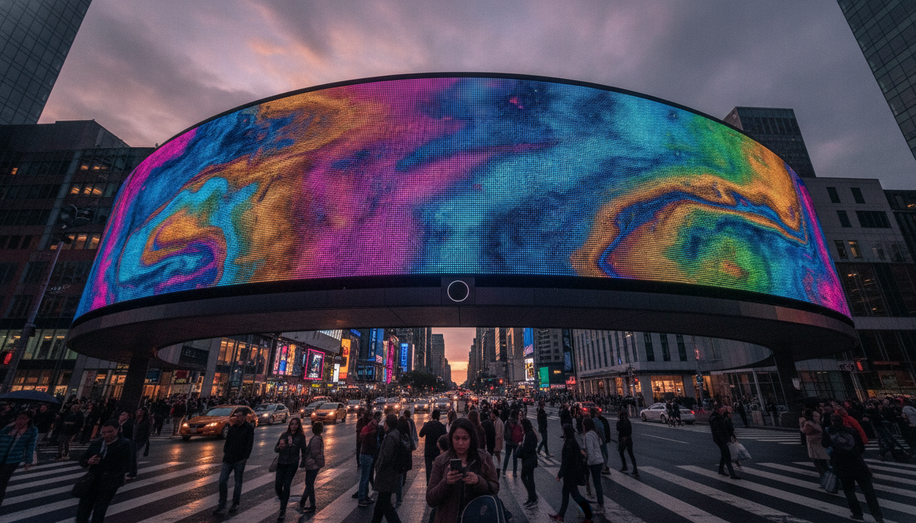

As modern digital out-of-home (DOOH) advertising demands greater campaign accountability and real-time responsiveness, legacy modeling and static traffic estimations are no longer sufficient for progressive media buyers. The industry has increasingly turned to decentralized, privacy-compliant, edge-computing computer vision sensors capable of generating precise audience analytics directly at the screen level. These hardware and software systems analyze raw visual inputs locally to deliver instantaneous metrics on impressions, dwell times, and demographics while keeping individual data anonymous.
1. Quividi
Quividi is a prominent pioneer in anonymous video analytics (AVA), offering an Audience Measurement Platform (AMP) designed to analyze screen-level audience engagement in real time. The technology operates locally on media players at the edge, utilizing a standard camera to detect human faces, measure precise attention time, and estimate age and gender distributions without ever capturing or archiving personal data. By executing its proprietary algorithms entirely within volatile memory, it converts raw video inputs into anonymous structured data before immediately deleting the frames. This high-fidelity audience stream can be leveraged to dynamically trigger creative variations on-screen and integrates with more more than thirty content management systems to support programmatic (pDOOH) campaign monetization.
2. AdMobilize
AdMobilize provides edge-computing AI sensors that turn any standard public screen into an intelligent, audience-aware node. Its patented computer vision models process real-time pedestrian and vehicle traffic, tracking precise dwell patterns, physical proximity, and demographic classifications with zero reliance on centralized cloud servers. To ensure full compliance with privacy regulations like GDPR, all personal visual characteristics are instantly anonymized at the point of capture, exporting only aggregate metadata to its cloud analytics platform. The solution is designed for seamless integration into OOH systems and works natively with partner platforms like DoohClick, facilitating programmatic trading by providing verified audience delivery reports.
3. Navori Labs
Navori Labs develops Aquaji, a sophisticated, computer-vision-based marketing analytics software designed to track real-time physical audience engagement near retail screens and DOOH displays. Aquaji connects to standard IP network cameras and performs local edge-based deep learning inference to count unique passersby, calculate dwell times, assess attention spans, and classify demographics. This anonymous, aggregate data stream allows physical venues to run like digital web networks, offering identical metrics for ad impressions, conversion rates, and shopper interest. Aquaji features an open API that can synchronize with major programmatic supply-side platforms (SSPs) and content management systems to dynamically optimize the displayed media mix based on live viewer profiles.
4. Camlytics
Camlytics is an autonomous space analytics software that transforms standard security, web, or IP cameras into intelligent audience measurement sensors for digital signage and OOH setups. The software operates strictly on local Windows or Linux devices at the edge, analyzing local video streams to count people and vehicles, map spatial walking directions, and calculate how long viewers linger in specific zones. Because the system is 100% self-contained, it runs without an active internet connection, ensuring that visual information never leaves the local network environment. The anonymous statistical outputs generated by Camlytics enable media operators to reliably measure ad-exposure metrics while keeping the deployment simple, cost-effective, and fully secure.
5. Blimp
Blimp is an Italian deep-tech enterprise that delivers specialized pedestrian and vehicle flow monitoring through its proprietary, edge-computing “Head-Counter” optical sensors. The solution combines on-device machine learning with data fusion algorithms to measure exact billboard exposure, vehicle classifications, passage speeds, and estimated age or gender groups. Operating with a strict privacy-by-design framework, Blimp’s local software processes video frames in volatile RAM in under 500 milliseconds before permanently purging the files to guarantee GDPR compliance. The resulting aggregate metrics are made accessible via a dedicated cloud dashboard and custom APIs, allowing DOOH publishers to optimize campaign performance with real-time, context-driven content scheduling.
6. Calton Datx
Calton Datx provides advanced neural network and computer vision systems designed to deliver real-time people and vehicle analytics for modern out-of-home networks. The software acts as an intelligent roadside and venue analytics sensor, classifying vehicles by type and speed while simultaneously tracking pedestrian engagement, crowd density, and demographics. By running all processing algorithms at the device level, it translates complex public environments into actionable statistical trends without collecting or archiving any personally identifiable information (PII). This edge-based real-time analysis allows DOOH operators to calculate verified, hourly Cost-Per-Mille (CPM) pricing models, ensuring a high level of transparency and efficiency for media buyers.
Deploying decentralized computer vision at the screen level represents a major evolution in how the out-of-home industry measures and verifies real-world impact. By replacing generalized mobility modeling with real-time, privacy-compliant edge analytics, media owners and advertisers can confidently scale programmatic activations with verified, attention-adjusted impression delivery. These advanced hardware and software sensors successfully balance the advertiser’s need for accurate performance metrics with the public’s right to absolute privacy in shared physical spaces.