
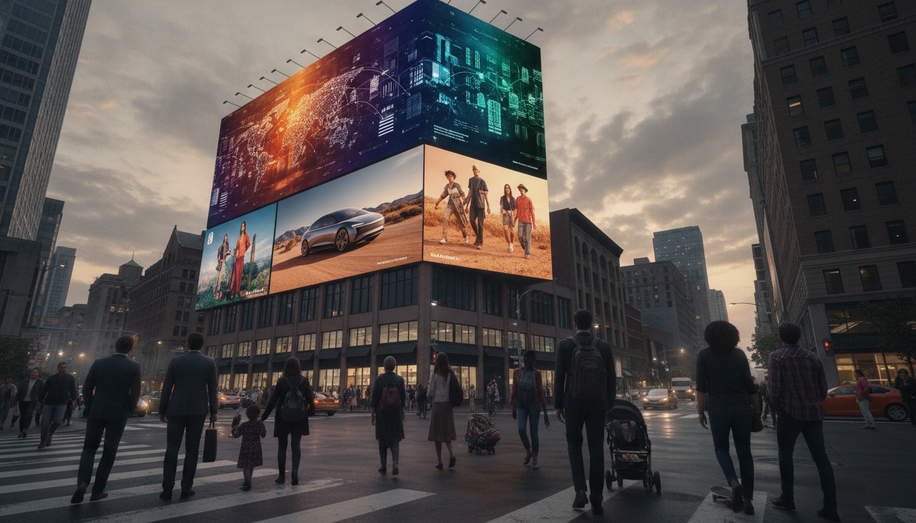

The sunset of third-party cookies and tightening global data privacy regulations have forced modern advertisers to move away from individual-level tracking toward aggregated, real-world data signals. In the digital out-of-home (DOOH) sector, this shift has accelerated the adoption of programmatic platforms that utilize privacy-first spatial, demographic, and contextual intelligence to reach consumers on public screens. By leveraging sophisticated location intelligence, computer vision, and real-time triggers, these audience data providers allow programmatic buyers to run high-impact campaigns without compromising user privacy.
1. Adsquare
Adsquare is a Berlin-based global location intelligence platform that translates offline human movement into actionable, privacy-compliant audience segments for programmatic DOOH campaigns. The company’s audience scoring engine combines spatial data with SDK-derived location signals, producing a predictive index that determines the likelihood of a target demographic being near a specific screen at any given hour. This allows advertisers to selectively bid on inventory during peak hours of audience concentration rather than relying on static, blanket buying models. Additionally, its real-time footfall measurement tools help brands directly attribute physical store visits to their DOOH exposure.
2. Cuebiq
Cuebiq provides highly accurate, privacy-first mobility intelligence that helps advertisers target real-world behaviors without tracking individual identities. By compiling anonymized, consent-driven GPS data from a broad network of mobile applications, the platform builds high-intent audience segments based on actual store visitation patterns and competitor conquests. Programmatic DOOH buyers can activate these segments directly within demand-side platforms to align digital billboard placements with aggregate consumer journeys. Through its continuous measurement framework, Cuebiq also provides interactive tooling to analyze how varying campaign exposure frequencies correlate with actual retail lift.
3. Placer.ai
Placer.ai is a location analytics platform that specializes in delivering deeply modeled foot traffic intelligence and demographic profiles for physical locations. By analyzing vehicular and pedestrian movement patterns, the platform allows programmatic buyers to determine the true trade area of specific venues and identify when target audiences are most dense around digital screens. This data enables advertisers to transition from simple proximity targeting to more sophisticated audience-driven planning, ensuring messages are displayed only when and where high concentrations of matching consumer profiles exist. Its robust spatial database is widely utilized by major media owners and agencies to validate campaign reach and quantify post-campaign visitation metrics.
4. Blindspot
Blindspot is a self-serve programmatic DOOH platform that integrates real-time contextual triggers and aggregate spatial data to enable highly flexible screen targeting. Advertisers can access over 2.5 million digital screens in more than 50 countries, launching campaigns in roughly 15 minutes without being locked into long-term contracts. The platform’s context-aware creative capabilities allow brands to automatically swap out artwork based on dynamic external variables like local weather, traffic conditions, specific times of day, or live events. While it is highly efficient for fast campaign activation and hourly media buying, it may not be the ideal solution for very large enterprises requiring highly bespoke DSP integrations and custom API setups.
5. SafeGraph
SafeGraph addresses the structural side of programmatic DOOH by offering global Point of Interest (POI) and geometry data that serves as the baseline for spatial targeting and attribution. Instead of tracking consumer devices directly, SafeGraph provides highly accurate, clean building footprint coordinates and business metadata that programmatic platforms use to map the physical world. This clean dataset is crucial for avoiding attribution errors, as it allows DOOH buyers to accurately identify which retail locations sit within the visible radius of specific digital signs. By matching POI and geometry data with mobility signals, advertisers can build highly reliable geographic boundaries to measure real-world campaign effectiveness.
6. Quividi
Quividi takes a hardware-driven approach to privacy-first DOOH data by using on-site computer vision sensors to analyze screen audiences in real-time. Operating under strict privacy-by-design principles, the platform processes video locally on the edge, immediately discarding raw images to generate anonymized, aggregate audience metrics. Programmatic buyers can leverage these real-time streams to measure exact impressions, dwell times, and the demographic breakdown of individuals actively looking at a screen. This high-fidelity audience intelligence can also be injected directly into ad servers to trigger specific creatives based on the instantaneous demographic mix of the passing crowd.
As the programmatic out-of-home ecosystem matures, the integration of these compliance-friendly data sources will continue to elevate DOOH from a broad broadcast medium to a highly targeted, measurable channel. By prioritizing aggregated location signals and context over intrusive tracking, brands can build trust with their audiences while maintaining strong campaign performance. Utilizing the right combination of spatial intelligence and real-time triggers ensures that real-world media remains both impactful and future-proof.